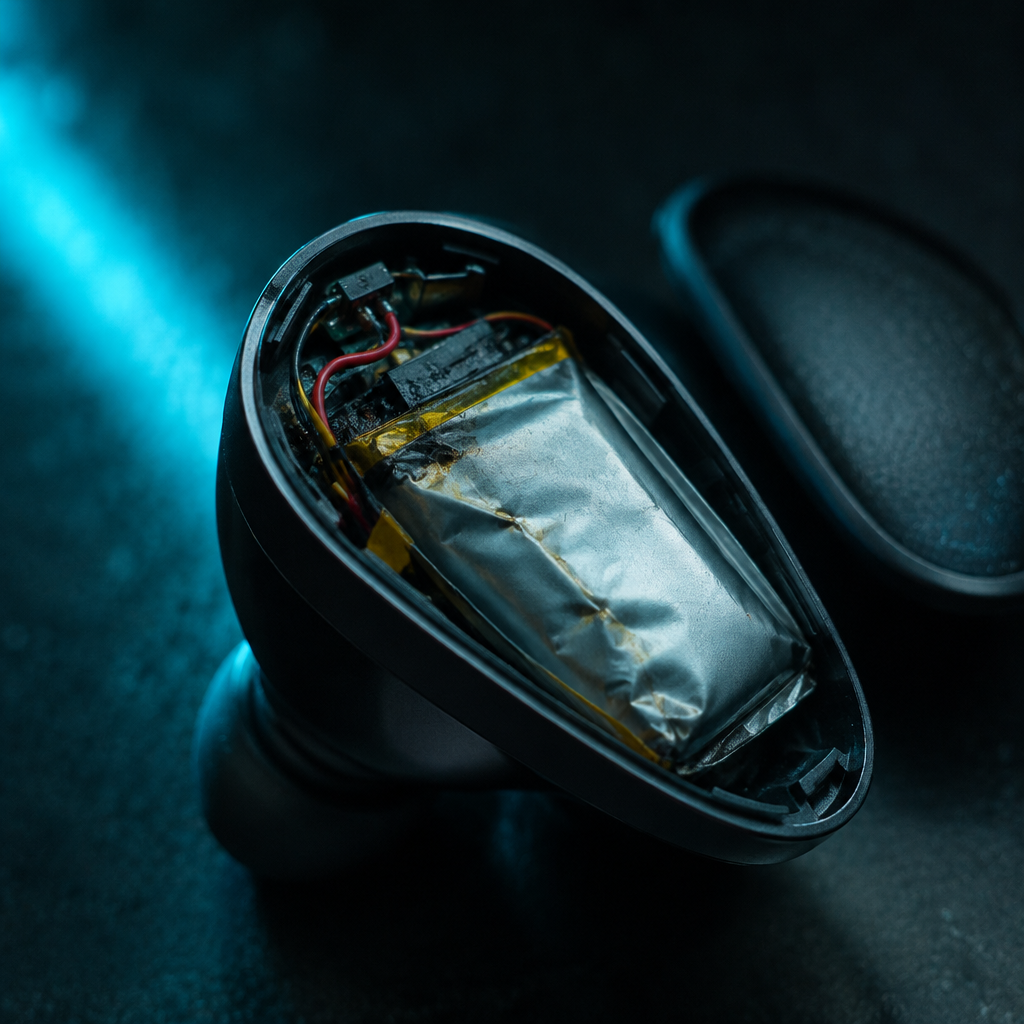
Your headphones sound exactly the same as the day you bought them. They are not the same product. The drivers, the headband, the Bluetooth chip, every part you can name still performs to spec. The part you cannot see, the flat pouch of lithium pressed against the inner wall of the left ear cup, has been quietly dying since the day it was assembled. Not eventually. Since day one.
Every wireless headphone ships with two clocks running. One is cycle aging, the wear that accumulates each time you charge and discharge the cell. The other is calendar aging, a chemical rot that proceeds whether the headphones sit on your desk, in a drawer, or in a box. The second clock is the cruel one. A pair of headphones used twice a month loses battery health almost as fast as a daily driver, and very few buyers know it.
The cell nobody designs around
Open a premium over-ear and you will usually find a single lithium-ion pouch cell, often under 1,000 milliamp-hours, tucked beside the driver or strapped along the headband arc. Some flagship models split a smaller cell into each cup for weight balance. The capacity is modest, which matters more than it seems: a small cell cycled deeply every day endures proportionally harsher treatment than a big laptop pack charged twice a week. There is no engineering magic that exempts headphones from lithium-ion physics. The same rules that killed your old phone apply here, just with worse thermal luck.
Two clocks, one battery
Cycle aging is the familiar villain. Industry convention treats a cell as end-of-life at 80 percent of rated capacity, which typical lithium-ion chemistry reaches after somewhere between 300 and 500 full equivalent cycles. A full equivalent cycle means 100 percent of capacity drawn out, however you slice it; two days of 50 percent discharge count as one. For a headphone rated at 40 hours per charge run flat daily, the arithmetic lands in under two years.
Depth of discharge changes the slope. Shallow cycles around the middle of the range are dramatically gentler than full 0-to-100 swings, because they keep the graphite anode away from the chemical extremes where damage concentrates. This is why battery nerds fuss over the 20-to-80 rule. It is not superstition. Voltage maps directly to how hard you are pushing the electrodes.
Calendar aging has no such levers, only degrees of mercy. Side reactions inside the cell steadily grow the passivation film on the anode, a structure called the SEI, or solid electrolyte interphase. Some SEI is essential; the layer forms on the cell's first charge and protects the anode from the electrolyte. The trouble is that it never stops growing, and every bit of lithium it locks away is capacity you paid for and will never see again. The process accelerates at high state of charge and high temperature. A cell held at 100 percent in a 35 degree room can lose several percent of capacity in a single season, unused.
Heat: the tax collector of ear cups
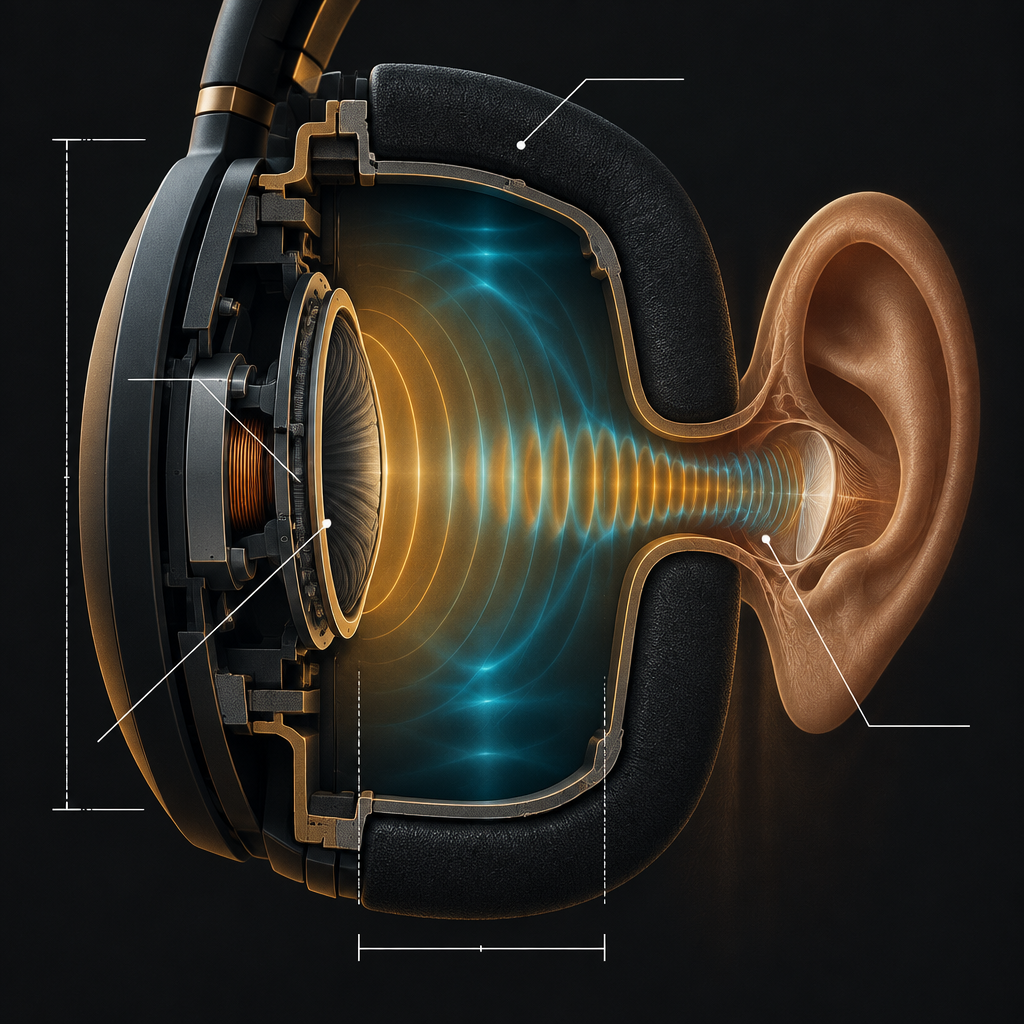
Here is where headphones take damage that phones rarely see. Everything that generates heat in a wireless headphone lives millimeters from the battery. The Bluetooth SoC, the ANC processor, the current-hungry amplifiers driving the drivers, occasionally a dedicated spatial audio DSP: all of them sit inside a sealed plastic or aluminum chamber with almost no airflow, pressed against the same wall as the cell. Active noise cancellation alone can raise power draw by 15 to 30 percent, and a meaningful slice of that exits as heat.
Lithium-ion chemistry follows the Arrhenius relationship: reaction rates roughly double per 10 degrees Celsius. A headphone cooked to 45 degrees because you wore it on a summer commute, ANC pounding, ear cup sealed against a warm scalp, ages in a week what a cool stored pair ages in a month. Long haul flights are worse. Cabin air is warm, the headphones work hardest, and the case stays zipped in a bag afterward, holding the heat in. Nobody prints this on the box.
4.2 volts of quiet stress
Most headphone cells charge to 4.2 volts per cell, sometimes 4.35. That maximum is where the fastest calendar aging occurs; cathode stress, electrolyte oxidation, and accelerated SEI growth all rise steeply near the top. A headphone left docked on its charger, or plugged into USB overnight, parks its battery at exactly the voltage the chemistry hates most, at the temperature the ear cup retains.
Idle drain makes this worse in a sneaky way. Many headphones lose a few percent a day on standby, so well-meaning owners top them up constantly, snapping the cell back to full before it dips below 80. The result is a battery that spends its whole life at 95 percent or higher: maximum voltage stress, minimum perceived inconvenience, maximum cumulative damage.
Why fast charging skipped your headphones
Phones fast-charge by pushing high current into large cells with dedicated thermal paths and aggressive throttling. Headphones have none of the infrastructure. The cells are small, high charge rates scale inversely with size, and there is nowhere to dump the heat in a sealed cup already occupied by a warm amplifier. Push a 300 milliamp-hour pouch at 3C and you shorten its life by the cycle-full; the chemistry notices, even if your charge counter does not. So most headphones charge gently overnight, which is also why a quick 10 minute top-up buys 5 hours easily, only 5 hours. The thermal budget was decided long before the marketing pdf was written.
Cold weather plays a role too. Below freezing, lithium plating risk makes charging outright dangerous, and a chilled cell briefly loses significant apparent capacity as its internal resistance climbs. Ski-lift users know the drill: warm the cup, and the missing hours come back. Cold is temporary; what it does to the gauge is not. A battery that froze at 30 percent indicated, got charged while cold, and got plated in the process takes permanent damage that no amount of warmth will refund.
The gauge that lies
One more indignity. Your headphones report remaining hours using a fuel gauge, a chip that estimates charge by counting coulombs in and out and referencing the voltage curve. As the cell ages, its impedance rises and its voltage curve shifts; the gauge, calibrated for a young battery, drifts out of agreement with reality. That is why an aging pair dies at 15 percent indicated, or claims 90 percent for an hour then collapses. The measurement lies because the chemistry changed, and headphone firmware almost never asks for the recalibration cycle that would restore honesty. You inherit the fiction.
Why the back will not come off
Given all this, you would expect replaceable batteries. Expect instead glue, ultrasonic welds, and cells with spot-welded nickel tabs soldered deep inside, customized into shapes no standard cell matches. Repair technicians charge enough to scare most owners away before the tab desoldering even begins, and every year, millions of headphones with perfectly functional drivers go to shredders because a $12 cell hit 70 percent.
That was a choice. Now it is, at least in Europe, a legal problem. Regulation (EU) 2023/1542, the battery regulation adopted in 2023, requires that portable batteries in devices placed on the EU market from 18 February 2027 be removable and replaceable by the end user. No soldering iron required. Phone-style exemptions are narrow and aimed at devices that must remain sealed for safety around moisture, and headphones sold into the EU are not among the comfortable exceptions. Global manufacturers rarely build separate hardware for Europe, so this rule will reshape headphone design far beyond EU borders: screwed rear plates, spring contacts, standard prismatic pouch cells behind a door. Buy a pair designed for this decade and 2033 might genuinely find it still playing.
Slowing the clock you can slow
Adjusting behavior softens the slope. Aim for the middle. Charging to about 80 percent and plugging in before the battery drops under 20 keeps the cell away from both chemical extremes. Skip overnight charging; disconnect when full. Turn ANC off in quiet rooms where it does nothing useful, since that single toggle removes the largest sustained heat source in the cup. Store long-unused headphones around half charge in a cool place, because a cell parked at 100 percent in a hot drawer is aging at triple time for zero listening pleasure. And if your gauge is lying, one honest way to reset it: a full, gentle discharge to shutdown followed by a full uninterrupted charge, performed two or three times a year, gives the gauge fresh reference points.
None of this grants immortality. Calendar aging runs even in an ideal world, and headphones are rarely in ideal worlds; they live in pockets, on scalps, in charging cases. But two clocks are ticking, and until replaceable cells become the norm, the difference between a headphone that fades gracefully and one that bricks itself in 2029 is mostly a matter of how kindly you treated the one component the manufacturer chose not to let you touch.