The Feature You Use Without Thinking Is the Hardest One to Build
Press the button, the world comes back. That is the entire user experience of transparency mode on a modern pair of headphones: a small click, a faint pressure change inside your ears, and the room reappears as if the cups were never there. It feels like a switch. It is actually a second audio system that has been sitting inside the same plastic shell the whole time, waiting for permission to speak.
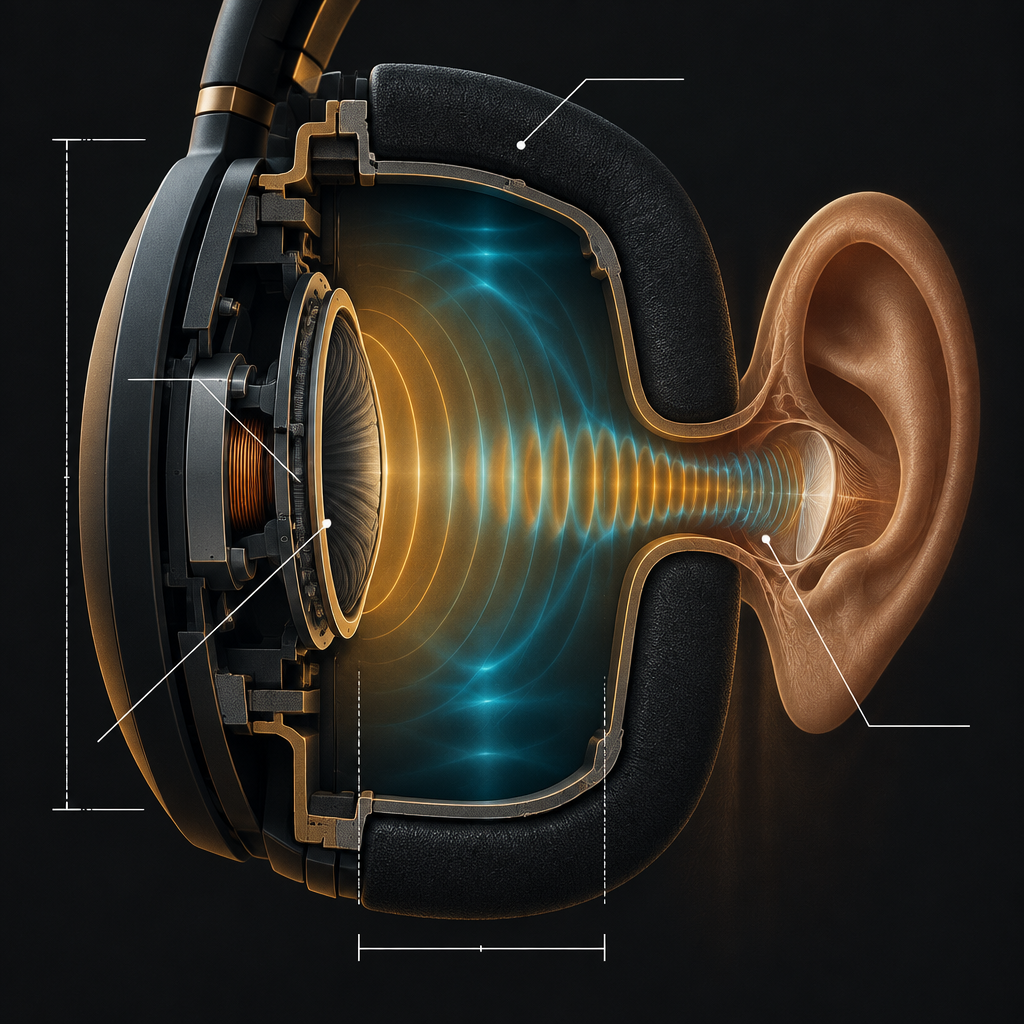
Follow the signal. A microphone on the outside of the cup picks up the room, a converter turns that into numbers, a DSP shapes the numbers, another converter turns them back into voltage, and the driver that was playing your podcast now plays the room as well. Two inputs, one diaphragm, and a few milliseconds of delay that nobody designs away, because designing it away costs more than it saves.
The delay is where the difficulty lives. Not in the microphone. Not in the amplifier. In time.
A Millisecond Is Thirty-Four Centimetres, and It Carves Notches
Sound travels about 34 centimetres in a millisecond. When the same event reaches your eardrum twice, once through the cup's sealing foam and once through the electronic path, the two copies interfere. Where they arrive in phase they add. Where they arrive half a cycle apart they cancel, and they cancel almost completely when the amplitudes match.
The arithmetic is easy to state and hard to escape. With delay d, the nulls land at odd multiples of one divided by twice d. A one millisecond path difference puts holes at 500 Hz, 1500 Hz, 2500 Hz, and onward, a comb with teeth roughly a kilohertz apart. Stretch the latency to eight milliseconds and the teeth close to about 60 Hz spacing, a dense sawtooth of narrow notches that reads as a metallic, cupped, faintly distant version of the world. Audiologists have measured this for decades in open fit hearing aids, where processing takes five to eight milliseconds and the vent admits direct sound right beside the processed sound. Their literature calls it coloration. Musicians call it phasey. Either way, it is why a cheap pass-through mode sounds like a phone call from 1998.
Headphones Cheat, and the Cup Is the Alibi
Here is what makes an over-ear headphone a different problem from an earbud or a hearing aid. A sealed cup attenuates the outside world before it reaches your ear. The direct acoustic path is not gone, since pads leak, but it sits 15 to 30 decibels down across the midrange. When one copy of a signal is that much quieter than the other, the interference stops being a cancellation and becomes a ripple. Shallow comb, shallow notches.
So the headphone engineer gets away with latency that would ruin an open fit hearing aid. Six milliseconds of delay against a direct path attenuated by 20 decibels leaves maybe a decibel and a half of ripple, which most listeners cannot pick out in a blind test. That is not elegance. It is a structural accident the industry noticed and then leaned on.
Change the structure and the accident disappears. Open back headphones leak far more, so the direct path gets loud enough to interfere properly. Open ear designs, the clip-on and ear-hook family, deliberately leave the canal uncovered, which is wonderful for comfort and miserable for the filter. Every design that lets the room in acoustically pays for it in the time domain. Nothing about that trade has been solved. It has only been priced.
Your Own Voice Is the Tell
Listeners rarely notice a decibel of ripple. They notice their own voice immediately. Speech is generated inside your head, so the internal path through bone and tissue arrives in microseconds while the microphone path arrives in milliseconds, and the two versions of the same syllable do not line up. What you get is a doubled, hollow, faintly robotic version of you, and it is the first complaint any support forum produces about any transparency implementation.
The fix is part psychology, part plumbing. Inject a little of the microphone signal back as sidetone so the late copy has company. Shape the low band so the bone conducted version is not fighting a delayed duplicate at equal level. Better systems let you hold a conversation and forget you are wearing anything at all. Worse ones make you talk quietly, because your voice sounds wrong inside your own skull.
The Gain Has to Go Somewhere, and So Does the Noise
Now the uncomfortable part. To make the room sound unattenuated, the electronics must add back exactly what the cup removed. That means 15 to 30 decibels of boost, and if the boost is applied across the band where the seal does its heaviest work, it lands squarely on the microphone's own noise floor.
Run the numbers on a competent MEMS microphone. A 64 dB signal to noise ratio against a 94 dB SPL reference puts equivalent input noise near 30 dB SPL. Ask that microphone for 25 decibels of gain in the presence of the cup and its hiss reaches your eardrum around 55 dB SPL, in the 2 to 5 kHz region where human hearing is most sensitive. A quiet room measures 30 to 35 dBA. You have just built a device that manufactures audible noise in silence and calls the result transparency.
This is why decent transparency modes are quiet but never silent, and why the hiss you hear in a library is not a defect. It is the cost of inversion. Better capsules help, and the best parts shipping now push signal to noise past 70 dB, but they cost more than the driver in a budget headset, which tells you where the money went.
Sirens, Subways, and the Limiter Nobody Mentions
Transparency also carries a headroom problem that noise cancelling can hide. City noise peaks constantly. A truck horn, a braking train, a dropped tray in a food court: 110 dB SPL events happen all day, and the microphone must survive them. Typical MEMS parts specify an acoustic overload point between 120 and 130 dB SPL. Above that the capacitive element runs out of linear travel and the output clips into grit.
So the DSP inserts a limiter, and the limiter does not care that you are listening to music. When a loud transient arrives the ambient path ducks, and because one coil has to reproduce both the room and the song, either the ducking drags the music down with it or the music gets compressed in advance to leave headroom for a sound you never asked for. Some headphones manage that gracefully. Plenty produce the audible breathing that makes a busy street sound like a compressor working overtime.
Wind is the other villain. Gusts create turbulent pressure at the microphone port, which is low frequency energy by the bucketload. High pass it and voices thin out. Leave it in and the mode rumbles like a drum. The usual answer is a second microphone and a coherence comparison between the pair, and the usual side effect is that your own voice gets briefly muted when you step outdoors.
Where the Room Comes From Matters
A microphone on the outside of a cup is not your ear. It sits a centimetre or two from where the sound you care about would have arrived, it faces a different direction, and it never benefits from the direction dependent filtering of a pinna the way your eardrum does. The pinna still shapes whatever the driver emits inside the cup, so some cues survive, but the capture point was already wrong before the processor was switched on.
Published work on hearables in transparency mode has measured the damage. Externalization and front to back discrimination degrade, and the deviation tracks processing delay, which in one study ranged from zero to nearly ten milliseconds. Subjects hear the world well enough to cross a street, while placing sounds slightly inside their head or slightly off to the wrong side. No equalization curve repairs a cue that was never captured.
It is also why the mode can sound convincing from a speaker and strange from a headphone. A loudspeaker radiates into a room and your ears do the localizing. A headphone radiates into a two centimetre cavity beside your eardrum, and the cue has to be synthesized or surrendered.
What to Test Before You Trust the Mode
Three checks, all free. Sit in the quietest room you have, engage transparency, and listen for hiss; if you can hear it without concentrating, the system is boosting noise harder than it is boosting signal. Say a sentence out loud and decide whether your voice seems to come from your mouth or from a small speaker near your ear. Then have someone stand behind you and say your name, and watch which way you turn.
After that, play music in transparency while a heavy vehicle passes. If the song breathes and dips, the limiter is wrestling the room, and no firmware update will make that graceful.
The Honest Version of the Feature
Transparency mode is not a window. It is a reconstruction: a microphone in the wrong place, a boost curve standing in for missing isolation, a limiter standing in for missing headroom, and a delay that the cup quietly disguises. The implementations worth paying for spent their budget on quiet capsules and short filters rather than on a brand name for the same trick.
Worth remembering the next time the world pops back into your ears with a click. Something did the work. It simply did not do it for free.