The Driver That Used to Be a Luxury Good
On November 19, a hundred dollar gaming headset goes on sale with the same class of transducer that used to justify a four figure price. Sony's PlayStation Pulse lands at $99.99, and the headline claim is a planar magnetic driver, larger than the one in the Pulse Elite. A costlier sibling, the Pulse Edge, waits until early 2027 with eight magnet structures per driver against the Pulse's four.
Read those two sentences together and you have the whole story of planar magnetics in 2026. Not a breakthrough in acoustics. A negotiation with the magnet budget. Meanwhile FiiO shipped the FT15 in September: a $499 open back with a 101 millimetre planar diaphragm 800 nanometres thick, diamond coated by vapour deposition, radiating across 6,443.5 square millimetres, rated 95 dB/mW at 24 ohms. That is a flagship desktop headphone. The Pulse is plastic you will drop on a carpet. Same motor principle, and the price gap is mostly a question of how much neodymium is inside.
Force Spread Across a Whole Film
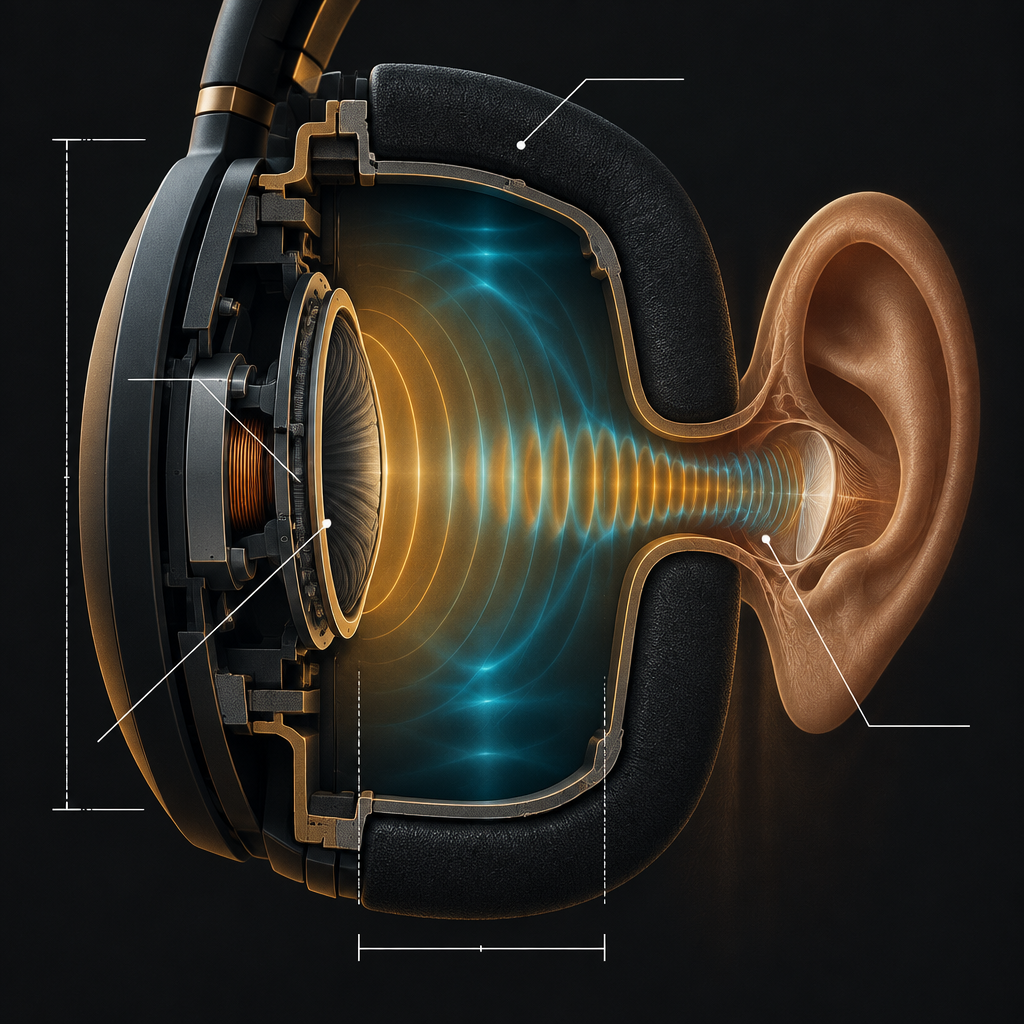
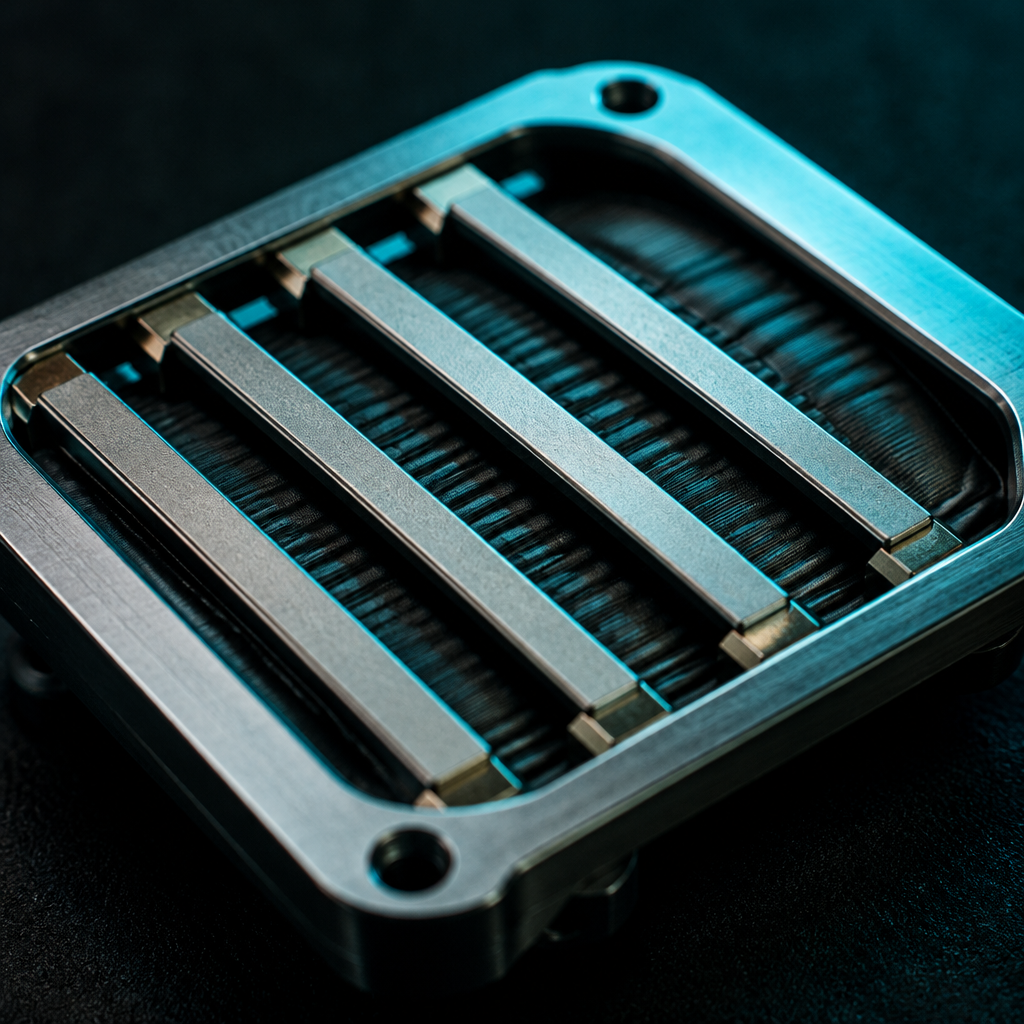
A dynamic driver concentrates its work: a coil in a narrow magnetic gap, glued to a cone, the cone held at its rim by a surround. Current flows, the motor pulls, the surround pulls back. A planar driver deletes the coil former, the surround, and the spider. The conductor is etched onto a tensioned plastic film, a serpentine path under a millimetre wide covering the surface, with permanent magnets above it, below it, or both in parallel bars. Current flows, the Lorentz force is B times I times length, and the film moves. Tension is the only restoring force.
That one architectural fact explains almost every characteristic people attribute to planars. The force factor does not change as the diaphragm moves, because the field is uniform across the small distance the film travels. A voice coil leaving its gap weakens as it extends, a distortion mechanism baked into every dynamic driver ever built. A planar has no such problem, no surround stiffening with excursion, no cone flexing into breakup modes. Drive a film uniformly and it stays pistonic far higher in frequency than a cone of the same size.
That is the midrange reputation. Not magic. The absence of several failure modes at once.
The Magnets Are Standing in Front of the Music
Here is the part the brochure skips. The magnet bars are solid metal in the acoustic path. Every square millimetre of magnet pushes sound into a wall, and the wave has to squeeze past the edges.
At 10 kHz the wavelength in air is about 34 millimetres. A magnet bar is a few millimetres wide and sits roughly a millimetre from the diaphragm. That is not a smooth path. It is diffraction, arriving as fine grain in the treble rather than a loss of brightness. HiFiMAN built a product line around this under the name Stealth Magnets, reshaping the bars so they obstruct less. Same fight as a speaker grille, ten times more severe, because the grille is a millimetre away instead of twenty.
Which gives the motor its central trade. More magnet means more flux in the gap, more force per ampere, higher sensitivity, and also more of the diaphragm hidden behind metal. You cannot buy both. Every manufacturer picks a point on that curve, and where they pick tells you who they think is buying.
One Array or Two, and Why Harmonics Care
A single sided array pulls in one direction, so the film sits biased off centre to stay in the useful part of the field, and the motion is asymmetric. Asymmetry generates even order harmonics: second, fourth, the ones that read as warmth until they read as mud. A push pull array sandwiches the film between two mirrored arrays, the field is symmetric, the even orders largely cancel. The price is twice the metal blocking the air and twice the assembly cost.
Sony's four versus eight magnet structures is that trade on a spec sheet. The Edge is not twice as good. It is twice as costly in the one dimension that governs how much voltage you need for a given loudness, which in a battery device decides everything else.
Sensitivity Is the Only Number That Matters on a Battery
Run the arithmetic, because it is unforgiving. A driver rated 95 dB/mW produces 95 decibels from one milliwatt. Music with real dynamic range wants peaks near 110 dB. Fifteen decibels above the reference is a power ratio of 31.6, so call it 32 milliwatts, which into 24 ohms is roughly 0.87 volts RMS and 36 milliamps.
None of that is impossible. A lithium cell at 3.7 volts with a boost stage handles it. Now add an ANC loop with microphones and DSP, a 2.4 GHz radio, and a battery small enough to keep the whole thing under 300 grams, and every milliwatt the driver takes is one the rest of the system does not get. A dynamic driver at 105 dB/mW needs 3.2 milliwatts for the same peaks. The planar asks for ten times the power, and the gap gets paid in runtime or in weight.
So the interesting claim in a $99 planar headset is not that it is planar. It is that the efficiency gap closed enough, through stronger magnets, thinner films, and DSP that stopped pretending the driver must be flat on its own. A manufacturing story dressed as an acoustics story.
Area Buys Bass Without Excursion
Low frequency output is displaced air. To make 20 Hz at a given pressure, a small radiator must travel a long way, and everything unpleasant about small dynamic drivers at high level traces back to that travel. The coil leaves the gap. The surround takes a set. Adhesives creep. Distortion down there is largely a story about displacement.
A 40 millimetre headphone driver has an effective piston area near 800 square millimetres. The FT15 has 6,443.5. Eight times the area means an eighth the stroke for the same output, so the film stays in the flat part of its linear range while the dynamic driver is already working. That is why large planars sound controlled in the bass rather than merely loud.
There is a quiet second effect. The gap between film and magnet is a fraction of a millimetre, and at high frequencies the air trapped there cannot escape in time. It becomes a squeeze film damper, viscous and frequency dependent, killing the resonance peak and the boxy upper bass bloom of sealed dynamic designs. It also costs efficiency, because you are damping the thing you are trying to move. Two effects, one gap, and no spec sheet says which one you are hearing.
The Film Relaxes, Slowly, in a Hot Car
A planar diaphragm is tuned by tension, and tension sets the fundamental resonance, which sets the low frequency rolloff. Polyester film under sustained tension at mildly elevated temperature creeps. Leave the headphones on a parcel shelf in July and the tension drops, the resonance shifts, and the pair no longer measures like the pair a reviewer heard.
Good manufacturers pre-stretch and heat cycle the film to stabilise it. Still, this is a wear mechanism with no real analog in a dynamic driver, and almost nobody discloses it. Buy a six year old planar and its tension is a matter of history rather than specification.
Flat Impedance Cuts Both Ways
The conductor on a planar is a resistor, not a coil, so its impedance barely moves with frequency. A voice coil's inductance raises impedance through the treble, so dynamic headphones present a load that changes character across the band.
Flat impedance is predictable. An amplifier with a careless output impedance cannot push a bass hump into the response, because there is no resonance peak for the voltage divider to work against. The cost is that the driver never presents a light load, so a weak amplifier runs out of voltage exactly where the music is loudest, with no obvious distortion to warn you, just a compressed and sagging sense of scale.
What Got Cheap, Precisely
Three things, none glamorous. Neodymium processing made shaped magnet arrays an off the shelf item rather than a machined curiosity. Thin film tooling borrowed from semiconductors made 800 nanometre diaphragms and vapour deposited diamond coatings manufacturable, and FiiO's 28 nanometre electroplated conductor comes off a chip grade line. The conductor is printed rather than wound, which removes the most labour intensive step in the old build.
The fourth unlock is software. Once a headphone carries a DSP and a factory measurement rig, the driver no longer needs to be flat on its own. It needs to be linear. Linearity is what equalisation can work with, and linearity is the planar motor's native strength. Low distortion with an uneven response is now a solvable problem. Low distortion with a flat response was, for thirty years, an expensive one.
What to Listen For Before You Believe the Label
Turn up a bass heavy track and listen for whether the tonal balance shifts. A driver running out of excursion goes thin or congested as it gets loud, and no tuning hides that. Then listen to cymbals for texture rather than brightness; diffraction off a magnet array reads as fine grain, not harshness. Push the midrange hard. That band is where a well made planar earns its price and where a cheap imitation reveals itself as a small dynamic driver with a marketing department.
And read the sensitivity figure. Not the impedance, not the driver diameter. Decibels per milliwatt tells you whether it will play at volume from the device you already own.