Put Your Hand on the Earcup. Nothing Is Moving.
Press a palm against a closed-back headphone while it plays something bass heavy and you feel almost nothing. A faint buzz, perhaps. No piston action, no thump against the skin. The driver is working hard, and the work is too small for your hand to detect.
Here is the number behind that. Ninety decibels at fifty hertz inside a fifty milliliter cavity asks the diaphragm for a peak excursion near half a micrometer, a total stroke of about one micron. A coat of paint is thicker.
Now give the same job to a room. A six and a half inch woofer producing ninety decibels at one meter, at fifty hertz, sweeps 2.6 millimeters, roughly five thousand times the headphone's stroke. Down at twenty five hertz it needs over a centimeter, which is where small speakers start to sound like they are in pain.
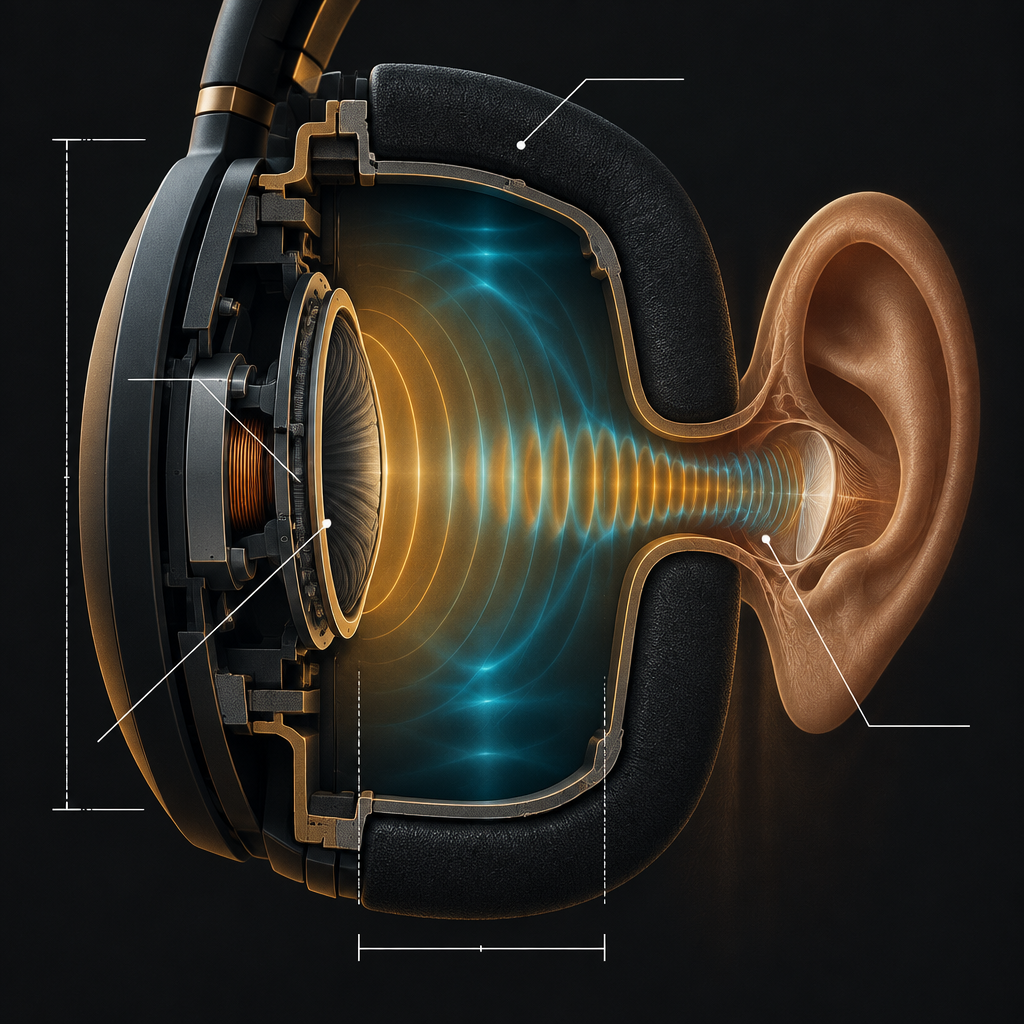
Same pressure, same frequency, wildly different mechanical demand. The difference is not driver quality. A loudspeaker launches a wave that keeps traveling. A headphone driver pushes into a sealed pocket of air, a couple of centimeters from a membrane that stops the wave cold.
A Pressure Chamber Is a Different Machine
Below its first acoustic resonance, a sealed earcup behaves as a constant pressure volume. Nudge the diaphragm forward a fraction of a micron and pressure everywhere inside rises by the same amount. No propagation, no distance term, no inverse square law. Pressure becomes a property of the whole enclosed volume rather than of a point in space.
Two consequences follow, both against intuition. Bass is flat by construction rather than tuning, because a sealed headphone does not roll off at the bottom the way a small box speaker does. And the driver's own suspension stops mattering, since the restoring force is now the stiffness of trapped air, which in a small cavity is brutally stiff.
Compare compliances to see how badly it dominates. A headphone driver's compliance, expressed the way loudspeaker engineers express it, corresponds to an equivalent volume of a fraction of a liter. The front cavity might be forty milliliters. Combined stiffness lifts the resonance by the square root of one plus the ratio. Give the driver an equivalent volume of 0.3 liters and a 40 mL cavity, and the factor is 2.9: a free air resonance of 90 Hz lands near 260 Hz once the driver is bolted into a cup.
That sounds like a disaster. It is not, because the raised resonance sits above where the bass lives. Everything below 260 Hz stays in the pressure region, flat, and the driver never travels far enough to strain.
The Ear Cup Is Not a Cylinder, and the Modes Know It
Above the pressure region the cavity stops acting like a lump of air and starts acting like a room. Standing waves appear. A short tube closed at both ends supports axial modes at the speed of sound divided by twice its length, and the space in front of a driver is short, so those modes land high. At 20 millimeters of depth the first axial mode sits near 8.6 kHz; at 24 millimeters it falls to 7.1 kHz.
Radial modes arrive lower. The first radial mode of a circular cavity follows 1.84 times the speed of sound over two pi times the radius, which for a 65 millimeter opening lands near 3.1 kHz. Real earcups are not cylinders and pinnae are not flat plates, so the actual mode map is a tangle of shifted, split resonances. The ordering holds: a broad cluster in the low kilohertz, a sharper axial feature higher up.
Apple patented a response. US 10,469,939 describes a ring of tunable acoustic dampeners around the periphery of the driver inside a closed-back earcup, placed to suppress standing waves in the front volume between driver plate and skull. The patent names the seven to nine kilohertz band, then says something more useful than the fix: the resonance varies between wearers because of anatomy, which makes it awkward to correct with a fixed equalizer.
The peak is partly in the headphone and partly in your ear. No firmware update can know where yours sits.
The Test Rig Is a Smaller Cavity Than Your Head
Headphone measurement carries a volume problem at its foundation. The standard occluded ear simulator, IEC 60318-4, presents an effective acoustic volume of about 1.26 cubic centimeters at its reference plane, over a specified range of 100 Hz to 10 kHz. That figure describes the impedance of canal and eardrum, the part downstream of whatever is being measured.
Everything upstream of that plane belongs to the headphone: pinna, pad cavity, trapped air under the cushion. On a real head that volume runs in the tens of milliliters, varying with ear size and pad depth. A fixture is only as good as its molded pinna, and a shallow one reports a headphone as even when the same headphone on your head shows a broad lift.
This is why two reviewers with different rigs publish plots that disagree by several decibels through the upper mids, and why both can be telling the truth.
Pads Change the Volume, and the Volume Changes Everything
If pressure in the sealed region scales inversely with cavity volume, compressing the pads should raise the bass. It does, though less than forum lore claims. Take a pad with a 65 millimeter outer diameter and a 45 millimeter opening, an annulus of 17 square centimeters, and squash it 4 millimeters. That displaces roughly 7 milliliters. Inside a 60 milliliter cavity pressure climbs 13 percent, a bit over one decibel.
One decibel reads as a slight thickening, not a transformation. What transforms the sound is the second thing compression does: it breaks the seal. A broken seal is not a volume change. It is a hole.
A Leak Is a Filter With a Corner You Can Calculate
Model the gap as a short tube into the cavity and you get a Helmholtz resonator. The corner sits at the speed of sound over two pi, times the square root of port area divided by port length times cavity volume. Put 0.5 square millimeters of gap, effective length 3 millimeters, into a 50 milliliter cavity and the corner lands near 100 Hz. Below it the cavity cannot hold pressure, the driver unloads, and the bottom octave drains away.
Half a square millimeter is a slot a hair wide and a centimeter long, which is what glasses arms plus a few days of stubble do to a pad seal.
Here is the awkward part. Every closed-back headphone contains a deliberate leak, usually called a barometric vent, because ears need to equalize when you swallow or ride an elevator down. Designers cover it with acoustic resistance so it behaves like a leak only at very low frequencies. Where the corner lands trades pressure comfort against sub bass. A tighter vent buys deeper bass and a plugged sensation on descent.
The Air Itself Is Not the Distortion Source
People assume a small sealed volume must be nonlinear. Run the arithmetic. At 120 decibels the pressure swing is about 20 pascals against an ambient of roughly 101,000, a fractional change of two hundredths of a percent. At 130 decibels, which hurts within seconds, it reaches six hundredths.
The gas is effectively linear across any level a person can survive. Harmonic distortion in headphones comes from the motor, the suspension, and diaphragm breakup, never from compressing air. If a pair distorts audibly at moderate volume, the fault is mechanical, and extra cup volume will not repair it.
Felt Goes Behind the Driver, Geometry Goes in Front
One more lever exists, and it works only on the back side. Filling a cavity with fibrous material pushes the compression toward isothermal, because fibers exchange heat with the gas on every cycle. The effective speed of sound drops from roughly 343 meters per second toward 291, and compliance rises by a factor near 1.4. In practice that is like finding 40 percent more volume for the price of some polyester wadding.
Loudspeaker builders have used this for decades, and the effect on a low resonance is well documented. A headphone designer cannot stuff the front cavity, because that is where your ear goes. So the rear chamber gets the damping and the front gets the shape: angled driver plates, absorbers around the rim, resistive screens over the vents, a cavity molded to spread modes apart instead of piling them onto one frequency.
Three Tests You Can Run in Ten Minutes
Play a slow sweep from 20 Hz to 15 kHz at a comfortable level and listen for a narrow ring that appears at one spot and vanishes. That is your personal cavity resonance, a joint product of earcup and pinna, and it explains how your headphones and someone else's plot can both be accurate.
Then press the cups gently inward while a bass line runs. The low end thickens slightly, then thins once the pads deform and leak. If the thinning starts early, the foam is tired.
Finally, put on glasses and repeat. The arm breaks the seal somewhere you cannot see and can barely feel, and the sub bass you lose is the price of the frame. Earpieces get all the credit for fit sensitivity. Over ears are just as exposed, and the failure is quieter, because you adapt to a thinner bottom end within seconds and then blame the recording.