The Song Leaves at 44,100 and Arrives Somewhere Else
Rip a CD, play it through a pair of wireless headphones, and three clocks end up sharing a job that a wire would have finished with one. The file stores 44,100 samples for every second of music. The radio carries frames on a schedule measured in 625 microsecond slots. The converter inside the headphone counts its own crystal, which has never been compared to the one in your pocket and never will be. Each timebase is entirely reasonable on its own. Put them in series and conversion is guaranteed, and conversion is where the small stuff lives.
None of this is a scandal. It is the ordinary cost of cutting a cable. What deserves a closer look is where the extra arithmetic happens, what it takes out of your battery and your reaction time, and which of the clicks people blame on a weak signal are actually an interpolator arguing with a buffer.
The First Conversion Happens Before Bluetooth Notices
Start at the operating system. Android, Windows, and iOS all mix audio at a rate the platform picks rather than the rate of the file in front of them. One fixed output rate lets every app share one audio device, and that rate is usually 48 kHz, because 48 divides cleanly into the timing that speech and video pipelines want. CD material at 44.1 kHz, which is to say most of the music ever recorded, gets converted before a single byte is encoded.
Which is why genuinely bit perfect playback over Bluetooth is close to impossible, and why the claim survives mostly in marketing copy. Exclusive mode audio on a desktop can slip past the mixer when the output device cooperates. The Bluetooth stack still runs on its own schedule. The sink still runs on its crystal. Two of the three clocks were never yours to control.
The Radio Has No Sample Clock at All
Bluetooth does not know what a sample is. It knows slots of 625 microseconds, and it knows packets that fit inside those slots. A codec hands the stack a buffer, the stack cuts it into frames, and the frames are packed into whatever baseband packet the link can afford. With SBC that means 128 samples per frame, which is 2.9 milliseconds at 44.1 kHz and 2.67 at 48. A 2-DH5 packet carries at most 681 bytes of payload, enough at a typical bitpool for three or four frames. Then the packets leave when the scheduler says so, subject to retransmission, subject to a channel map that shifts away from whatever the phone's own Wi-Fi is using.
The specification holds the link to within 20 parts per million of ideal slot timing. That is a bound on the radio, not a frequency reference for audio. Nothing in the transport promises that 48,000 samples go in and 48,000 come out in the same second. Approximately, yes. Precisely, never.
Then the Sink Converts Again, and This Time It Matters
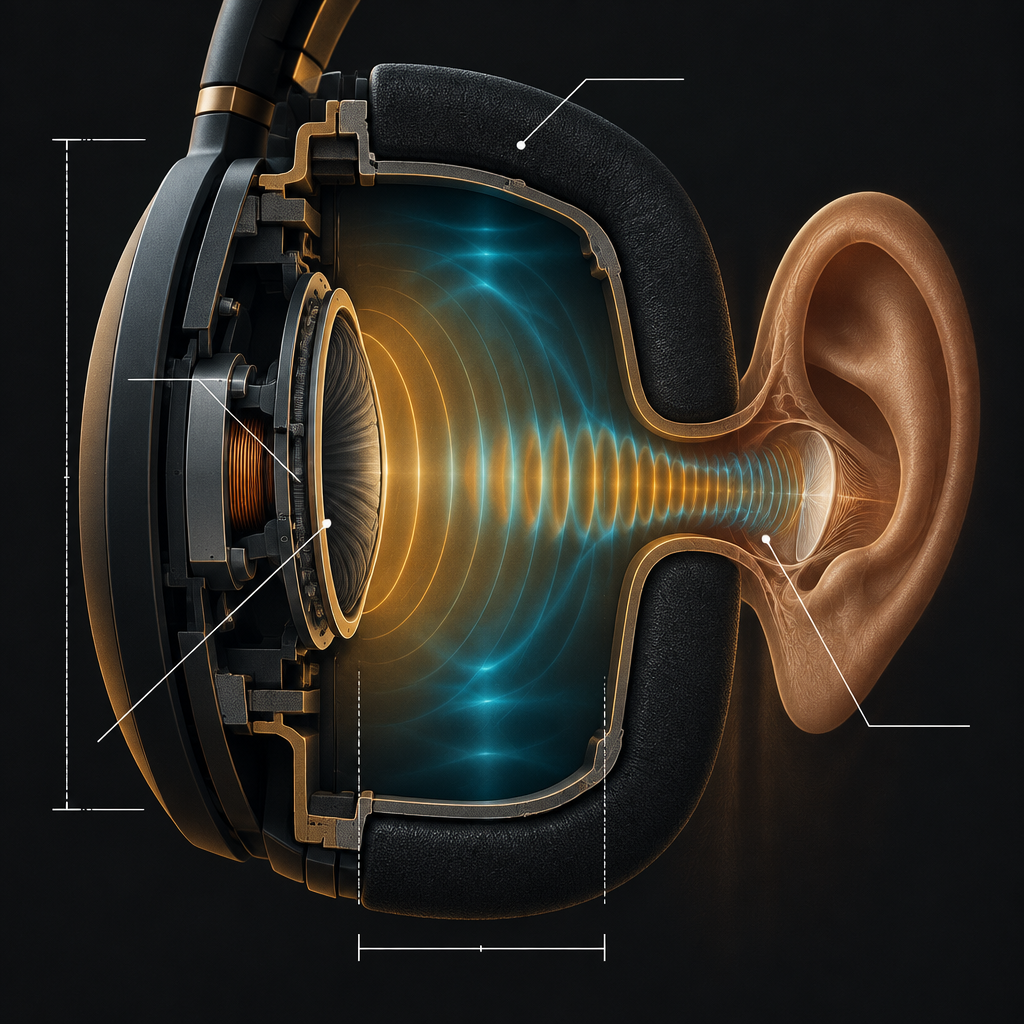
Inside the headphone there is a buffer. Behind the buffer sits a digital signal processor running filters on a fixed grid, because noise cancellation, equalization, and any crossover work all need a stable sample rate to be stable themselves. Behind that is a converter paced by a local crystal, and crystals disagree. Twenty five parts per million is an unremarkable tolerance for a cheap part, and twenty five ppm at 48 kHz works out to 1.2 samples per second of drift.
Run the arithmetic forward. The phone delivers very nearly 48,000 samples a second. The headphone consumes 48,001.2. A 60 millisecond buffer holds 2,880 samples, so it empties in roughly 2,400 seconds. Forty minutes. That is exactly the interval at which people report a faint click or a sliver of silence during a long listening session, and it is why a pair left playing overnight eventually makes a noise its owner cannot explain.
Two repairs exist. Let the buffer hit a guard band and discard a block, which is cheap and audible. Or measure the arrival rate, compare it against the local clock, and interpolate continuously at a ratio that sits a few ppm off unity, tracked in a closed loop. The listener hears nothing. Nearly every competent product takes the second road, and it is the least advertised engineering inside the thing on your head.
There is one more wrinkle worth naming. Noise cancellation and equalization frequently run at a different rate than the incoming stream, 96 kHz being common, because the feedback loop wants short periods. That is a third conversion inside a device that already converted twice, and every one of them is a place where a designer can save a filter tap and a listener can lose an octave of air.
What a Cheap Resampler Costs You
Interpolation is not free, either in arithmetic or in accuracy. A decent polyphase implementation at 48 kHz stereo runs a few hundred filter taps, and 48,000 samples times two channels times 256 taps lands near 24.6 million multiply accumulates every second, all of it burning whether or not music is playing. On a hearing aid class DSP that is a meaningful slice of the power budget, and inexpensive silicon answers the problem by shortening the filter. Short filters leak. Images fold back just below Nyquist, the passband sags earlier than it should, and what you get is a faint grey haze over cymbals that nobody can point at but plenty of people can hear.
Precision matters as much as length. A resampler carrying 24 bit internal data pushes its arithmetic products down near 120 decibels below full scale, comfortably beneath the noise floor of any converter you will actually own. A 16 bit internal path leaves them near 96 decibels, and at that level the error stops being theoretical. Two headphones with the same driver, the same codec, and the same tuning target can sound different because one of them spent forty cents more on the interpolator.
The Latency Ledger Nobody Prints
Add the stages and the famous 200 milliseconds of Bluetooth audio stops being mysterious. The platform mixer contributes a buffer, often 20 to 40 milliseconds. The codec contributes one frame, 2.7 for SBC. Packetization and the retransmission allowance add somewhere between 5 and 20. The sink buffer is the big line item, and it is deliberate: 30 milliseconds is fragile, 150 is indulgent, and most shipping products sit between 40 and 80. The DSP takes a few more, the converter a fraction.
The profile does have a way of admitting all this out loud. AVDTP delay reporting lets the headphone tell the source how late it will render, and the source can then hold video back to match. That is why lip sync on a phone usually works while lip sync on a bargain transmitter often does not. The delay was never hidden. It was declared.
The Click, the Haze, and the Thirty Second Stutter
People blame interference for artifacts that come from timing. A microwave, a packed platform, a phone in a pocket behind a hip: those cause real packet loss, and concealment fills the hole by extrapolating the last good frame. That sounds like a soft smear rather than a tick. A tick tends to be a clock making a decision.
The stutter some users report at regular half minute intervals is the mirror problem, a buffer filling rather than draining and getting corrected in bulk. Correct one sample at a time with proper dither and nobody notices. Drop a whole millisecond and everyone does.
LE Audio Changes the Shape, Not the Physics
Isochronous channels tidy this considerably. LE Audio defines a presentation delay, a render time the stream commits to, and the transport delivers inside a flushing period instead of hoping. LC3 runs on 7.5 or 10 millisecond frames at 48 kHz, and a super wideband call holds 32 kHz speech near 32 kilobits. What the redesign does not do is delete the second crystal. A Connected Isochronous Stream still hands samples to a local converter on a local clock, through an ISOAL layer built precisely to reconcile frame boundaries with sample boundaries. The resampler did not vanish. It moved, it got specified, and it became somebody's named responsibility.
Three Tests You Can Run Tonight
Play a 40 Hz tone for ten minutes and listen for a repeat or a gap; undithered correction shows up as a faint buzz or a click. Then alternate between a 44.1 kHz file and a 48 kHz file of matched loudness and decide whether the top octave changes; cleaner on the second suggests the first conversion in your chain is lazy. Finally, leave an hour of quiet music running with the headphones on a table. Anything periodic you catch is the buffer, not the recording.
Bit Perfect Was Always a Category Error
Wireless audio is a series of conversions dressed as a pipe. The useful questions are not about bit depth printed on a box but about whether the interpolator is long enough, whether the buffer policy is smooth, and whether the designer treated that second oscillator as an engineering problem or an annoyance. Those answers rarely reach a product page, which is why this particular difference has to be heard rather than read.