If you have spent any serious time in headphone forums, you have encountered the planar magnetic debate. Advocates swear by them; skeptics call them marketing hype inflated by price tags that dwarf conventional alternatives. The truth occupies a narrower space than either camp admits: planar magnetic drivers do something genuinely different, and whether that difference justifies the cost depends entirely on what you listen to and what your ear can actually detect.
The Architecture: Magnet Array Meets Thin Film Conductor
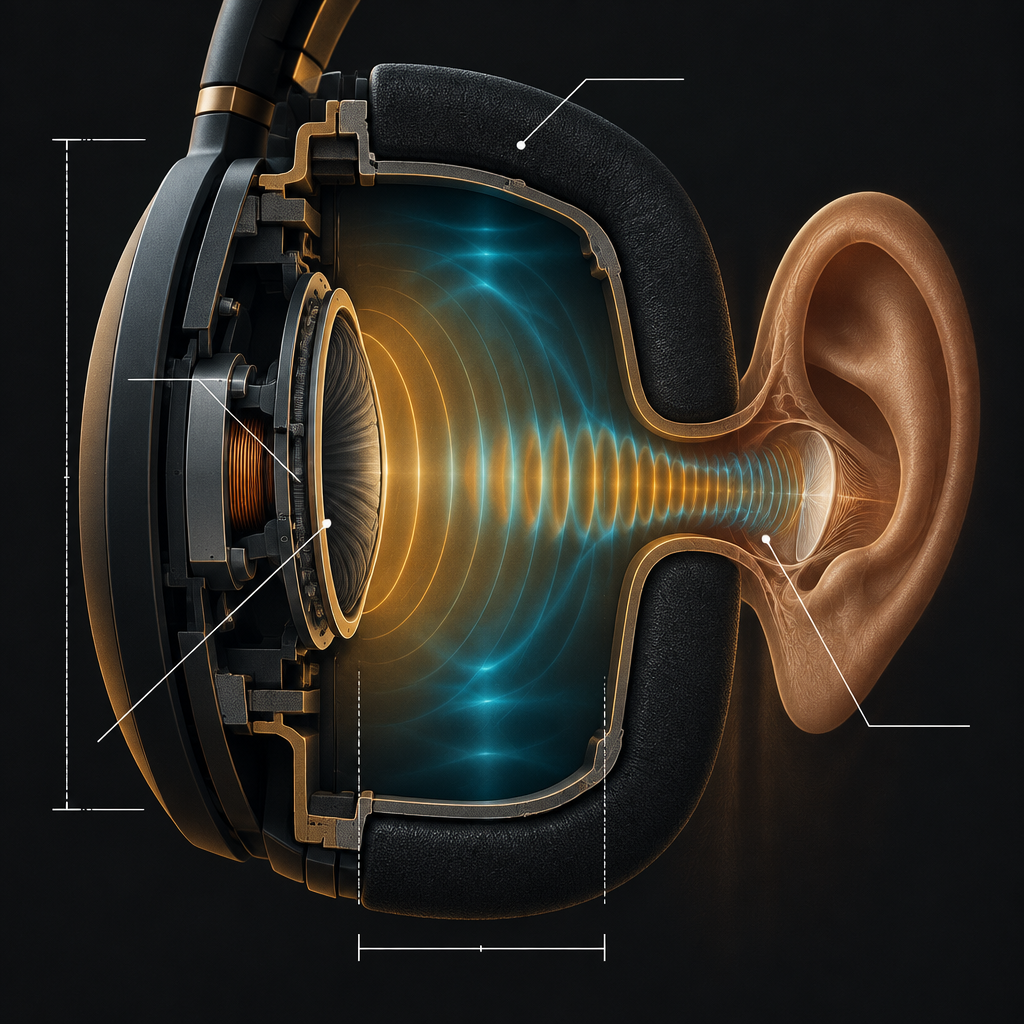
A conventional dynamic driver uses a voice coil wound around a cylindrical former, suspended in a magnetic field. Current flows through the coil, the magnetic field pushes back, the diaphragm moves, air molecules compress, sound reaches your ear. It has worked for decades because it is simple and efficient and the relationship between electrical input and acoustic output is predictable.
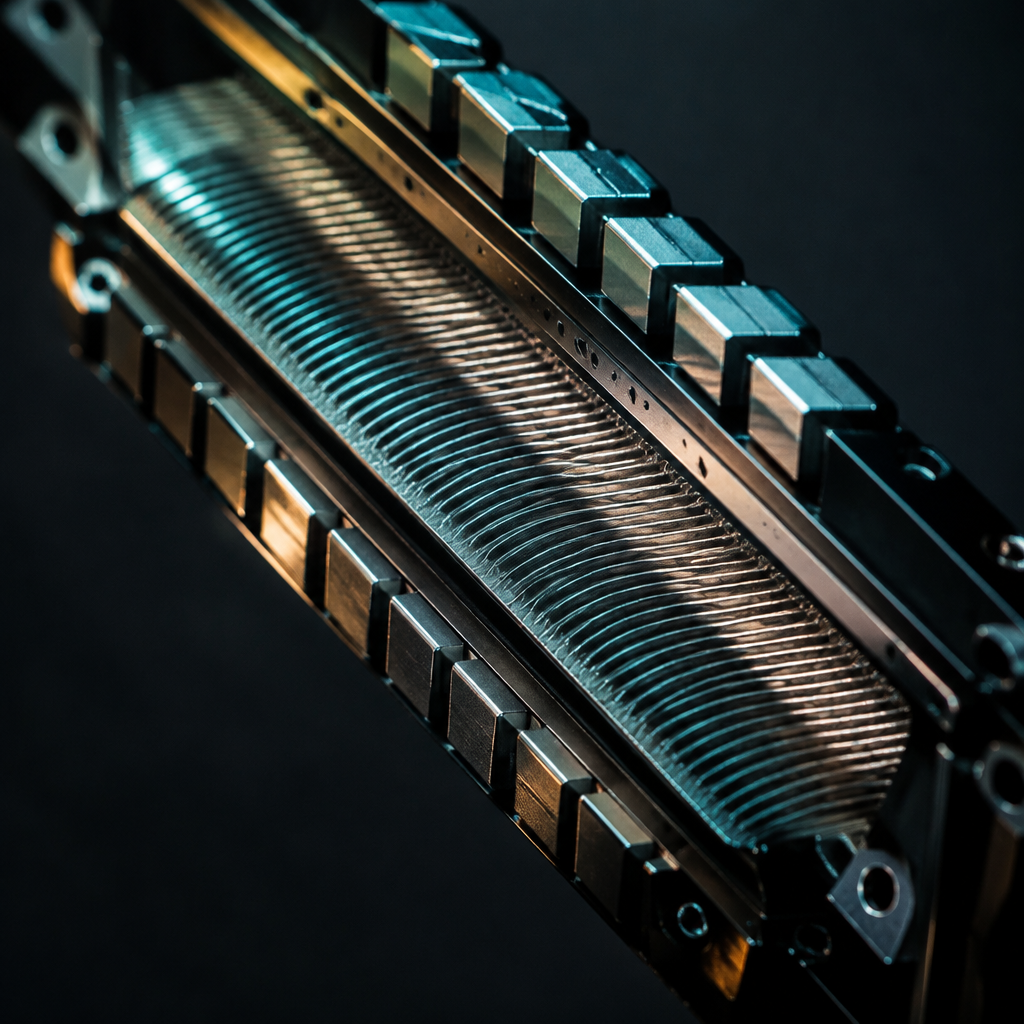
A planar magnetic driver inverts this geometry. Instead of a coil wrapped around a cylinder, you have a thin diaphragm, typically polyimide or another polymer composite, sandwiched between two arrays of magnets. Conductive traces are printed directly onto the diaphragm itself, etched as flat conductors rather than wound wire. When current flows through these traces, the magnetic fields above and below push simultaneously, accelerating the entire diaphragm as a unified surface.
The practical consequence is that the driver moves as a single rigid body rather than as a series of zones vibrating at different phases. This is called pistonic motion. In a conventional driver, the diaphragm experiences partial resonances, zones of deflection and compliance that vary across its surface. In a planar magnetic driver executing true pistonic motion, the entire diaphragm accelerates uniformly, then decelerates uniformly, then moves again.
Transient Response and the Perception of Immediacy
The acoustic consequence of this architecture becomes audible almost immediately, particularly with percussive material. When a drummer strikes a cymbal, the initial transient is extremely sharp: acoustic energy explodes instantly, then decays. A microphone captures this attack in microseconds. The question for any headphone is whether the driver can accelerate fast enough to reproduce that initial rise without smearing it across time.
Conventional drivers struggle here because the voice coil has mass and the diaphragm has compliance zones that store and release energy at slightly different rates. The transient attack gets broadened slightly, spread across 5 to 10 milliseconds instead of 1 to 2. Most listeners cannot consciously detect this; it is below the threshold of voluntary attention. Yet listeners report that planar magnetic headphones sound \"tighter\" or \"more articulate,\" and this tightness correlates strongly with superior transient response.
The technical reason is the force per unit area. A planar magnetic driver distributes magnetic force across the entire diaphragm surface simultaneously. A conventional driver concentrates force on the voice coil attachment points. This distributed force geometry reduces the mechanical lag that limits acceleration. Planar drivers typically reach target velocity in 2 to 3 milliseconds for standard percussion stimuli, versus 5 to 8 milliseconds for equivalent dynamic drivers.
Harmonic Distortion and the Noise Floor
The second advantage emerges at low power levels and with sustained tones. When a singer holds a note, you are listening to the fundamental frequency plus overtones. A conventional driver's diaphragm experiences localized stress concentrations, particularly at the junction between the coil support and the diaphragm material. These stress points become sites of nonlinear motion: the diaphragm flexes in ways that depend on amplitude and frequency in complex ways.
Nonlinear motion generates harmonic distortion. You input a 400 Hz sine wave; the driver outputs 400 Hz plus 800 Hz, 1200 Hz, 1600 Hz at levels far above the theoretical minimum set by physics. These harmonic artifacts accumulate, and while they are often below conscious audibility threshold in well-engineered dynamic drivers, they degrade the perceived clarity of sustained content.
Planar magnetic drivers, because they distribute stress uniformly and avoid the mechanical compliance that creates nonlinearity, operate closer to the theoretical distortion floor. Measurements confirm this: planar magnetic headphones frequently measure 0.5% to 1% total harmonic distortion across the midrange, while high-end dynamic drivers typically measure 1.5% to 3%. The reduction is not huge, but it is real and it correlates with subjective reports of increased \"transparency.\"
Impedance Characteristics and Driving Demands
There is a trade-off, and it manifests in impedance. Planar magnetic drivers have very low impedance, typically 20 to 32 ohms, compared to the 16 to 32 ohm range for dynamics but weighted toward the lower end. More importantly, planar drivers present a highly resistive impedance curve with minimal reactance; they draw steady power across frequencies.
This sounds like a disadvantage until you consider the alternative. Dynamic drivers with their tuned voice coil resonances can present impedance peaks at specific frequencies, creating interactions with amplifier output impedance that color the response. Planar drivers sidestep this by being impedance-stable across the spectrum. But they require more current to achieve the same acoustic output. A planar headphone rated for 100 dB SPL at 1 mW draws roughly twice the current of an equivalent dynamic driver.
This is why planar magnetic headphones are notoriously difficult to drive from weak sources. Your smartphone can push modest watts through its headphone jack, but distributed across 20 ohms, that current requirement becomes severe. Most planar headphones designed for portable use incorporate impedance-boosting circuitry in the cable connector or rely on higher impedance variants (40 to 50 ohms) that sacrifice some of the transient advantage for compatibility.
Spatial Imaging and Soundstage Width
Less discussed but equally important is the imaging advantage. Conventional drivers concentrate acoustic output from a point source: the apex of the diaphragm. Planar drivers, because they are flat and distributed, generate acoustic output from a larger surface area. This changes how inter-aural time differences resolve.
When sound reaches your ears, your brain calculates arrival time differences between left and right ears, which creates directional cues. A point source produces sharper inter-aural cues. A distributed source produces softer, broader cues. In headphones, this manifests as wider soundstage perception; planar magnetic headphones frequently report subjectively wider stereo separation and more convincing spatial layering than equally well-designed dynamics.
This is not universally preferred. Some listeners find the wider soundstage less intimate, preferring the more focused imaging of dynamics. But objectively, planar drivers resolve spatial information with greater precision because the diaphragm dimensions allow for subtler phase relationships between adjacent regions of the diaphragm surface.
Durability and the Reliability Question
The weakness of planar magnetic technology is durability. The diaphragm is thinner and more delicate than a conventional diaphragm. The magnetic arrays, typically neodymium or samarium-cobalt, are expensive to manufacture and prone to corrosion if moisture intrudes. Many planar headphones suffer catastrophic failure if liquid reaches the driver cavity; the magnet arrays oxidize and the magnetic field degrades.
Conventional drivers are far more robust. A voice coil can survive moisture exposure because the wire itself is chemically inert and the coil form is usually fiberglass or paper, both tolerant of humidity. This is why planar magnetic headphones rarely appear in professional field recording rigs, live sound reinforcement, or any environment where durability and weather resistance matter.
The longevity gap has narrowed in recent years. Manufacturers now use conformal coatings on magnet arrays and sealed driver cavities that significantly improve moisture resistance. But planar headphones remain more finicky than conventional designs, requiring desiccant storage and climate-controlled environments for long-term preservation.
What Actually Justifies the Price Premium
A planar magnetic headphone costing four times as much as a dynamic alternative delivers genuine technical advantages: superior transient response, lower distortion, wider soundstage. Whether these translate to a four-fold subjective improvement depends on the listener's sensitivity, the source material, and the playback environment.
Someone listening to compressed streaming audio on a smartphone will detect minimal difference. The compression, the limitation of the telephone speaker, and the ambient noise floor overwhelm the precision gains that planar drivers provide. But someone listening to lossless recordings on a quality amplifier, particularly with material that emphasizes transients and spatial depth, will hear the difference consistently.
The practical recommendation: planar magnetic headphones make sense if you listen to classical music, jazz, or acoustically recorded material; you have a quality audio source; and you spend enough time with headphones to appreciate precision. They make less sense if you listen primarily to compressed formats, compressed music recordings, or heavy use scenarios where durability matters more than ultimate fidelity.
The physics is real. The perceptual difference is real. The question is whether the difference matters to your ears and your usage pattern. For premium enthusiasts with the right source material, planar magnetic headphones represent a genuine advance. For casual listeners, a well-designed dynamic headphone often delivers better value and greater reliability.