For most of wireless audio's short history, there has been a quiet agreement nobody liked to say out loud. Bluetooth headphones were convenient; wired headphones were for sound quality. The enthusiast who wanted both lived a split life, a good pair of over-ears plugged into a DAC at the desk and a pair of ANC cans tossed in the bag for the commute. That split is now being dismantled, not by a single engineering breakthrough but by the patient, methodical convergence of driver technologies that spent decades developing in separate universes.
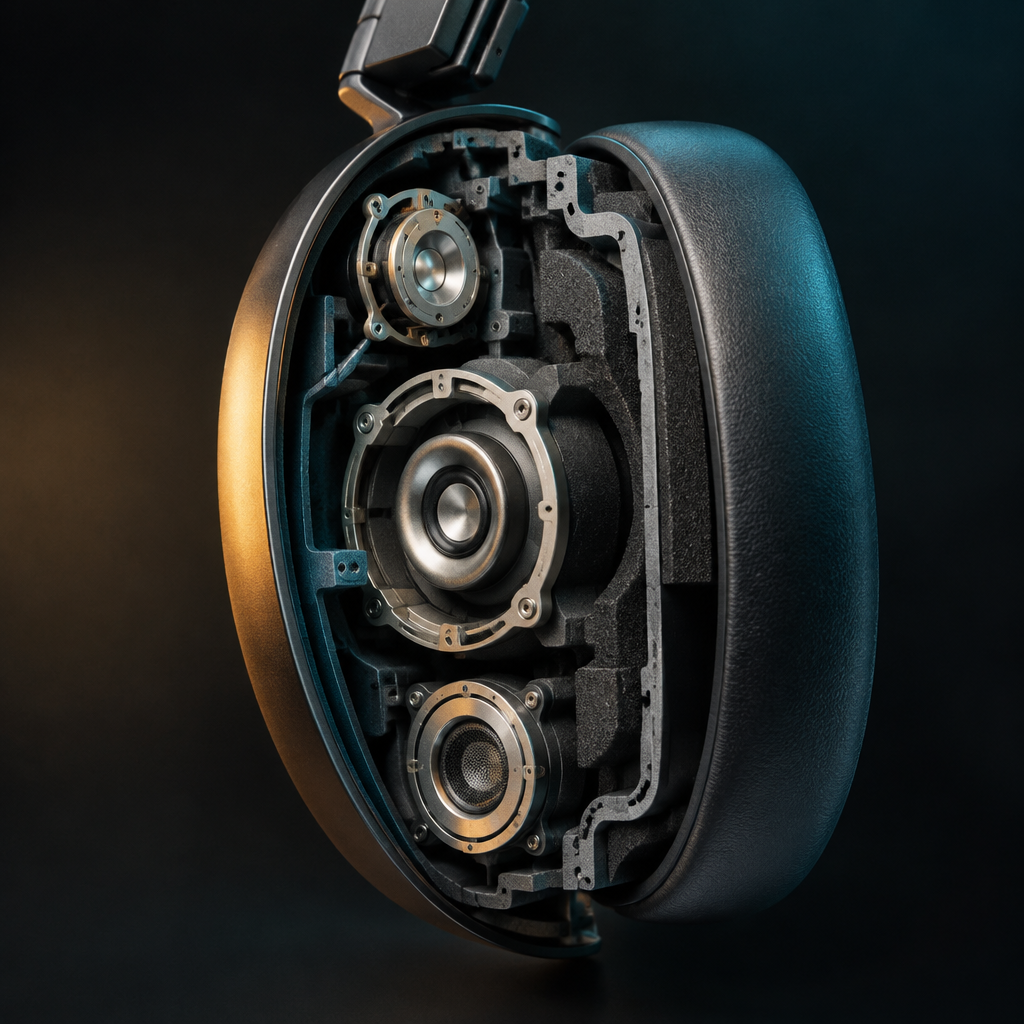
In early June 2026, Noble Audio announced the FoKus Artemis, a wireless over-ear headphone that combines a dynamic driver, a planar magnetic driver, and a balanced armature driver in a single Bluetooth chassis. The price is $899. It ships in July. These are the raw facts. What they represent is bigger than a product launch; they represent the moment the wireless headphone stopped chasing wired performance and started building its own architecture from the ground up.
Three Drivers, Three Jobs
To understand why this matters, you have to understand what each driver type does well, and more importantly, what it does poorly. No single driver technology is perfect across the entire audible spectrum. Physics simply will not allow it.
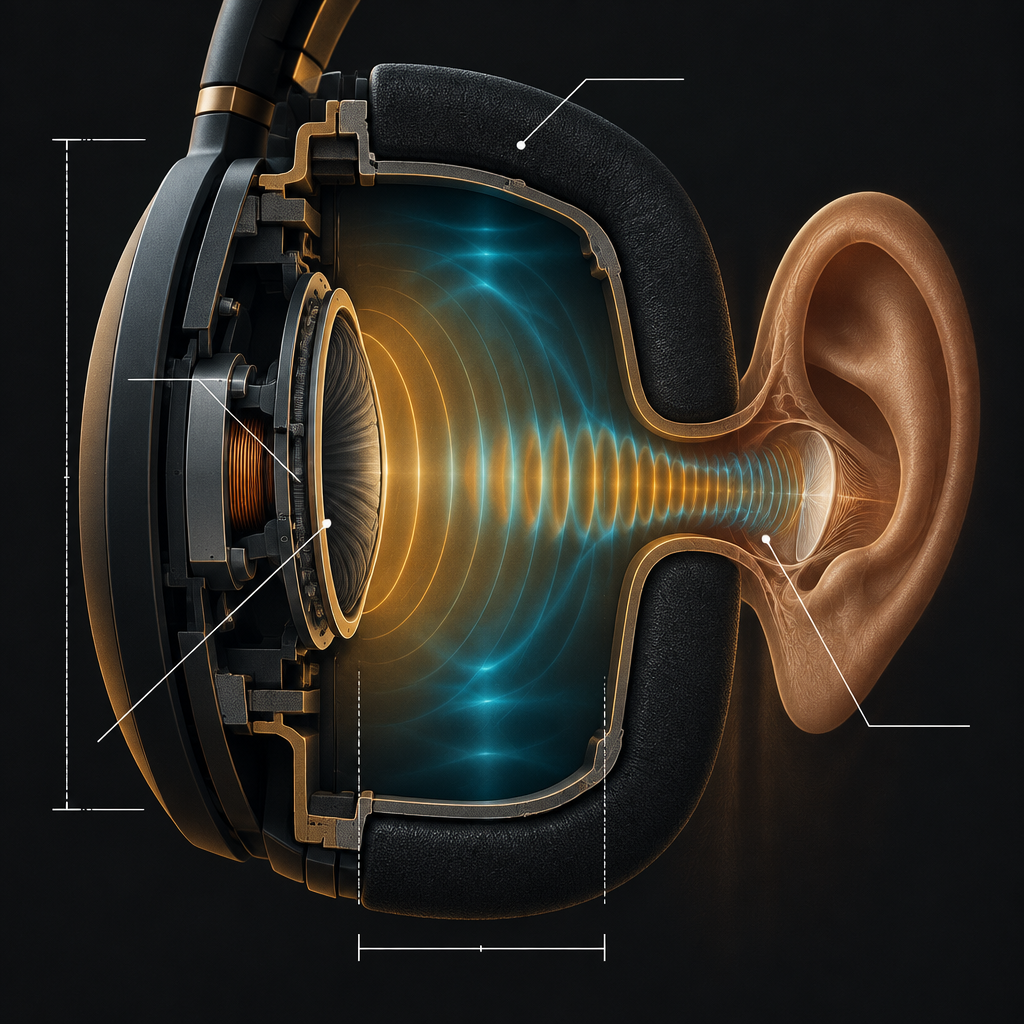
A dynamic driver is a miniature speaker cone. A voice coil sits inside a magnetic field; current through the coil moves the diaphragm; the diaphragm moves air. Dynamic drivers excel at bass because they can displace a meaningful volume of air. They produce weight and warmth and the physical sensation of pressure that makes kick drums feel like they are happening inside your chest. Their weakness is mass. A dynamic driver's diaphragm and voice coil have inertia. When a transient hits, a snare crack or a cymbal shimmer, the dynamic driver is still settling from the last waveform it reproduced. The result is a slight softening of attack, a rounding-off of the sharpest edges in the treble region, which is why pure dynamic headphones often get described as "smooth" or "musical" when what we really mean is "slightly blurry at the top."
A planar magnetic driver works differently. Instead of a cone with a coil attached, it uses a thin, flat diaphragm with an embedded conductive trace suspended between arrays of magnets. The entire diaphragm surface is driven evenly, which means it starts and stops with far less inertia than a dynamic cone. The result is speed: transients snap into place, instrument separation improves, and the treble extends with a clarity dynamic drivers cannot match without help. The tradeoff is bass impact. Planar diaphragms do not move as much air volume as a dynamic cone of equivalent size, so the low end can feel precise but weightless. Fast, yes. Present, yes. But the gut-punch of a well-timed kick drum often goes missing.
A balanced armature driver is the odd one out. Originally developed for hearing aids, BA drivers use a tiny reed balanced between magnets inside a sealed housing. When current flows, the reed pivots, driving a diaphragm through a connecting rod. Balanced armatures are extraordinarily efficient; they can resolve microscopic detail in the upper midrange and treble with a precision that neither dynamic nor planar drivers can touch. But they struggle with bass extension, and because their output is tuned by acoustic damping inside the housing, they can sound clinical or thin when asked to cover too much of the frequency range alone.
Now put all three in one headphone. The dynamic driver handles sub-bass through lower mids; the planar driver covers the midrange and presence region with speed and openness; the balanced armature takes over for the highest octaves where precision matters most. Each driver operates in the frequency band where its physics are optimal. The result is not just a headphone with three different drivers stuffed inside; it is a headphone where no single driver is being asked to perform beyond its natural limits.
The Crossover Problem Nobody Talks About
Making three different driver types play nicely together is a crossover design problem, and crossover design in headphones is vastly harder than in speakers. In a loudspeaker, drivers are physically separated, sometimes by several feet. The crossover can compensate for phase alignment because physical distance translates to time delay in a predictable way. In a headphone, all three drivers sit a few millimeters from the ear, and their acoustic outputs sum almost instantly. Any phase mismatch between drivers, any timing error in the crossover network, produces comb filtering that eats holes in the frequency response.
Worse, each driver type has a fundamentally different impedance curve. Dynamic drivers have a rising impedance at resonance and another rise at high frequencies due to voice coil inductance. Planar magnetics are almost purely resistive, flat across the spectrum, which is lovely for amplifiers but means the crossover cannot rely on the driver's natural roll-off to do any of the filtering work. Balanced armatures have wild impedance swings, sometimes varying by a factor of ten across their operating range. Designing a passive crossover that accounts for all three of these behaviors simultaneously, while maintaining phase coherence, while fitting inside a closed headphone cup, while running on battery power, is not a solved problem. It is an active area of engineering research, and it is one of the reasons hybrid wireless headphones at this level did not exist before now.
The Artemis almost certainly uses active DSP crossover filtering rather than a passive network, which is where the Qualcomm QCC3095 platform comes in. Digital crossovers can be phase-linear, meaning they can split the frequency bands without introducing the phase shifts that plague passive designs. But DSP crossovers consume processing cycles, add latency, and require more amplification channels. In a battery-powered wireless headphone, every milliwatt counts. The fact that Noble is targeting 50-plus hours of playback with ANC off, and 35-plus with ANC on, suggests the power budget has been managed carefully enough to make a three-way active system viable in a daily-use product.
Why This Wasn't Possible Five Years Ago
The wireless headphone market of 2021 was dominated by single dynamic driver designs. The Sony WH-1000XM4, the Bose QC series, the AirPods Max; all used variations of a single dynamic driver per ear. The reason was not a lack of ambition. It was that Bluetooth codecs available at the time imposed a hard ceiling on what any headphone could resolve. If your source material is being compressed to 256 kbps AAC or 328 kbps SBC, adding a second driver type does not buy you much; the codec has already discarded the fine detail that a planar or BA driver would reveal.
Three things changed. First, the arrival of higher-bandwidth codecs; LDAC, aptX Lossless, and the LC3 codec in Bluetooth LE Audio all pushed the ceiling higher, delivering more information to the headphone. Second, chipset makers like Qualcomm built platforms with enough onboard DSP horsepower to run real-time active crossovers, ANC, and personalization simultaneously without crushing battery life. Third, and perhaps most importantly, the supply chain for planar magnetic and balanced armature drivers matured to the point where integrating them into a mass-manufacturable wireless product became economically feasible. Ten years ago, planar magnetic drivers were largely limited to boutique wired headphones from Audeze and Hifiman costing north of a thousand dollars. Today they appear in $150 wireless earbuds. The democratization of transducer technology is what makes the Artemis possible.
Audiodo and the Personalization Layer
There is another piece to this that is easy to overlook. The Artemis includes Audiodo Personal Sound, a hearing-personalization system that maps the user's unique hearing profile and adjusts playback accordingly. This is not a five-band graphic EQ with some presets for "rock" and "jazz." Audiodo runs a calibrated hearing assessment that measures hearing thresholds across multiple frequencies, then generates a compensation curve specific to that listener's ears.
In a headphone with a three-driver hybrid design, personalization becomes more than a convenience feature; it becomes a calibration tool. Every listener's ear canal shape, every individual's high-frequency hearing loss curve, changes how the driver outputs sum at the eardrum. With a single-driver headphone, you get what you get. With a multi-driver system and a personalized DSP profile, the headphone can be tuned to the listener rather than the other way around. It is the difference between buying a suit off the rack and having one altered by a tailor who measured your shoulders.
The Price of Progress
At $899, the Artemis lands in a price bracket that used to belong exclusively to wired audiophile headphones. The Sennheiser HD 800 S, the Hifiman Arya, the Audeze LCD-X; these are the headphones that defined what serious listening meant for the last decade. None of them have Bluetooth. None of them have ANC. None of them have a built-in DAC or amplifier. The Artemis competes with them not by being a better wired headphone but by being a different category entirely; a self-contained listening system that requires nothing but a phone and a streaming subscription.
Whether the Artemis succeeds will depend on execution. Noble's track record with the FoKus Apollo, the world's first wireless headphone to combine dynamic and planar magnetic drivers, suggests the company knows what it is doing. But the Apollo had two driver types; the Artemis adds a third. Every additional driver is another variable in the crossover, another amplifier channel to manage, another opportunity for phase error. The engineering difficulty scales faster than the driver count.
What matters for the rest of us is that someone is trying. The wireless headphone market has been stagnant at the high end for years, iterating on ANC strength and battery life while the fundamental transducer architecture stayed the same. The Artemis, and whatever follows from competitors who are certainly watching, signals that the next wave of wireless headphone innovation will not be about codecs or noise cancellation. It will be about the drivers themselves; about putting transducer technologies that were developed for wired reference headphones into a form factor you can wear on a plane, connect to two devices at once, and run for a full work week on a single charge. The wireless headphone is growing up. Finally.