The Hidden Cost of Two Ears and One Pipe
Every time you slip on a pair of wireless headphones, a quiet negotiation happens. One side becomes the boss. The phone pairs with the left earbud, the left earbud receives the full stereo signal, and then it spins off a compressed copy across the top of your skull to the right earbud. The right side never talks to your phone directly. It waits. It listens. It renders what arrives, late, secondhand, and rendered through a link that was never designed for it.
This is the relay model. It has powered Bluetooth headphones for the better part of two decades, and it works well enough that most people never think about it. But "well enough" carries a tax. The primary earbud burns through battery faster because it handles two radio jobs instead of one. The secondary earbud introduces latency that the primary does not experience. The inter-earbud link is a second point of failure; if it stutters, your stereo collapses into a mono artifact. And the whole architecture locks you into a single audio source at a time because the primary earbud simply cannot manage two incoming streams on a Classic Bluetooth ACL link.
LE Audio's multi-stream capability, built on Connected Isochronous Streams, rewrites this from the ground up.
What Changed: From One Pipe to Many
Bluetooth Classic audio used A2DP, the Advanced Audio Distribution Profile. A2DP streams over a single asynchronous connection-less link. One stream, one direction, one path. When true wireless headphones arrived, manufacturers had to get creative. Some used a second Bluetooth radio to relay the signal from the primary bud to the secondary. Others let the secondary bud eavesdrop on the same connection, snatching packets from the air without an established link. Both approaches are proprietary hacks bolted onto a protocol that was never built for independent stereo delivery.
LE Audio takes a structurally different approach. It introduces isochronous channels in Bluetooth Core 5.2, a completely new transport layer designed for time-sensitive, synchronized data. Isochronous means "happening at the same time," and it is the key to understanding why multi-stream is not just an incremental improvement but a rethinking of the data path.
Within isochronous channels, there are two flavors. Connected Isochronous Streams, or CIS, are point-to-point, bidirectional, and acknowledged. Broadcast Isochronous Streams, or BIS, are one-to-many, unacknowledged, and designed for Auracast broadcast scenarios. For the relay problem in headphones, CIS is the one that matters.
Here is how it works. Your phone acts as the central device. It establishes a separate Connected Isochronous Stream to each headphone. Each headphone is a peripheral. Both CISes are bundled into a single Connected Isochronous Group, or CIG. The CIG is the synchronization layer; it shares timing reference data between the streams so the left and right headphones render audio in lockstep without any inter-earbud relay. The phone talks to both sides. Directly. Independently. At the same time.
What the Subevent Timing Actually Does
Each CIS is divided into subevents. A subevent is a timing slot where the central transmits a packet and the peripheral responds. The specification allows up to 31 CISes in a single CIG, though for headphones you typically need two: one per side. The subevent structure is where the real engineering lives.
Consider what happens with packet loss. Under the relay model, a lost packet on the phone-to-primary link means the primary must request a retransmission before it can relay to the secondary. Two hop latency: phone to primary, primary to secondary. If the secondary misses the relayed packet, it is gone. There is no acknowledgment on the secondary link in most proprietary implementations because the standard does not define one for A2DP relays.
With CIS, each stream has its own acknowledgment and retransmission window within its subevents. The phone sends a connected isochronous PDU to the left headphone during the first subevent. If the left headphone does not acknowledge, the phone retransmits during the next subevent. Same process for the right headphone, independently. The CIG coordinates timing so the phone can service both sides within a single SDU interval without serializing the retransmissions through a relay hop. The result is lower end-to-end latency and a fundamentally different error recovery model.
The SDU interval itself is configurable. A Service Data Unit interval of 7.5 milliseconds is possible, though most implementations use 10 milliseconds for music streaming. At 10ms, the phone sends new audio data ten times per second, per headphone, with retransmission opportunities packed into each subevent slot. Compare that to A2DP, where the typical interval is closer to 20ms and the relay adds a variable second hop on top.
Battery Life: A Problem That Solves Itself
The relay model creates an asymmetry that headphone manufacturers have tried to mitigate for years. The primary earbud depletes faster than the secondary because it maintains two active radio links: phone-to-primary and primary-to-secondary. Some products rotate the primary role between the two sides across charging cycles to even out wear. Others accept the asymmetry and ship a larger battery in the primary position. Both are workarounds for a protocol limitation.
Multi-stream dissolves the asymmetry. Each headphone maintains exactly one radio link, the one to the phone. Neither side relays. Both consume roughly the same power. LE Audio also runs on the Low Energy radio, which uses less power per transmitted bit than Classic BR/EDR, and the LC3 codec it carries delivers better quality at lower bitrates than the SBC codec used in Classic audio. Lower bitrate means fewer packets transmitted per second, which means less radio-on time, which means longer battery life. The Bluetooth SIG estimates that LE Audio can roughly double playback time on the same battery capacity, and multi-stream removes the relay overhead on top of that.
For over-ear headphones that are physically connected by a cable, the relay problem does not exist; a single cable carries the signal. But for true wireless headphones, which represent the fastest-growing segment of the headphone market, the battery benefit is substantial. Eliminating the relay link removes an entire radio path from the power budget.
Concurrent Sources: The One Nobody Mentions
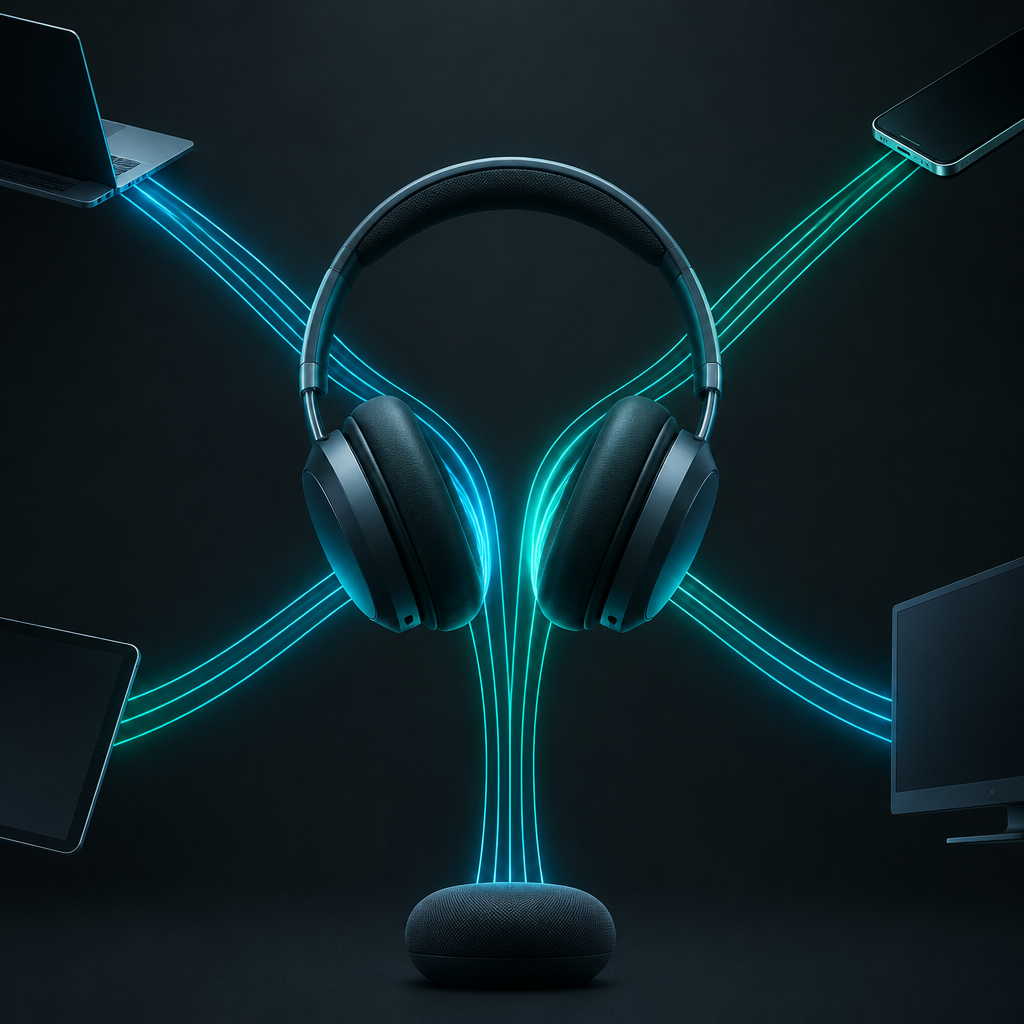
Multi-stream does not only mean two streams to two headphones. It means multiple streams, full stop. Under A2DP, your headphones could connect to multiple source devices, but only one could stream audio at a time. A call from your phone interrupted music from your laptop; that was the protocol, and you had to live with it.
With LE Audio's BAP, the Basic Audio Profile, the phone and the laptop can each establish their own CIS within (or alongside) a CIG. Your headphones can play music from the laptop while simultaneously receiving a notification chime or voice prompt from the phone. The streams are independent. They do not interrupt each other because they occupy distinct isochronous paths. This is the kind of capability that sounds like a minor convenience until you have used it, and then you cannot go back to the interrupt-driven Classic model.
For gaming headphones, the implications are sharper. Modern multiplayer games already separate voice chat from game audio on the software side. With multi-stream, the phone (or console, or PC) can send game audio and voice chat as two independent CISes to the same pair of headphones. The headphone firmware can mix them locally with independent volume controls, zero cross-stream interference, and no protocol-level interruption when Team Speak packets arrive mid-explosion.
Where Adoption Actually Stands
The specification is finished. The profiles are published. BAP, TMAP (Telephony and Media Audio Profile), and the isochronous channel architecture are all defined and certified by the Bluetooth SIG. Chipset vendors including Qualcomm, Broadcom, and Nordic Semiconductor have shipped LE Audio capable silicon for over three years now. Qualcomm's Snapdragon Sound platform bundles LE Audio with aptX Lossless and explicitly supports multi-stream in its reference designs.
But the headphone market does not move at silicon speed. It moves at consumer speed. A2DP headphones still dominate shelves because Classic Bluetooth is universal, interoperable, and costs next to nothing to implement. LE Audio requires new chips, new firmware, new profiles, and new conformance testing on both the source and the headphone side. A phone that supports LE Audio and a headphone that supports LE Audio must both implement the same profiles correctly, and the Bluetooth SIG's testing infrastructure has been catching up to the specification for the last two years.
The combination that matters for multi-stream is the one most people shopping for headphones will not see on a spec sheet: a phone running LE Audio with BAP and a pair of headphones doing CIS over a CIG to both cups simultaneously. When you find that combination, the relay tax is gone. Latency drops because there is no second hop. Battery evens out because neither side is working double duty. Sources stop fighting because each gets its own isochronous stream.
It took Bluetooth two decades to engineer its way out of a bottleneck that most listeners never knew existed. LE Audio's multi-stream did not arrive with a banner or a headline feature on a product box. It arrived as a protocol detail, buried in Core 5.2, that quietly makes the next pair of headphones you buy feel different in ways you cannot immediately name but will absolutely notice.