The Fade That Is Not Your Imagination
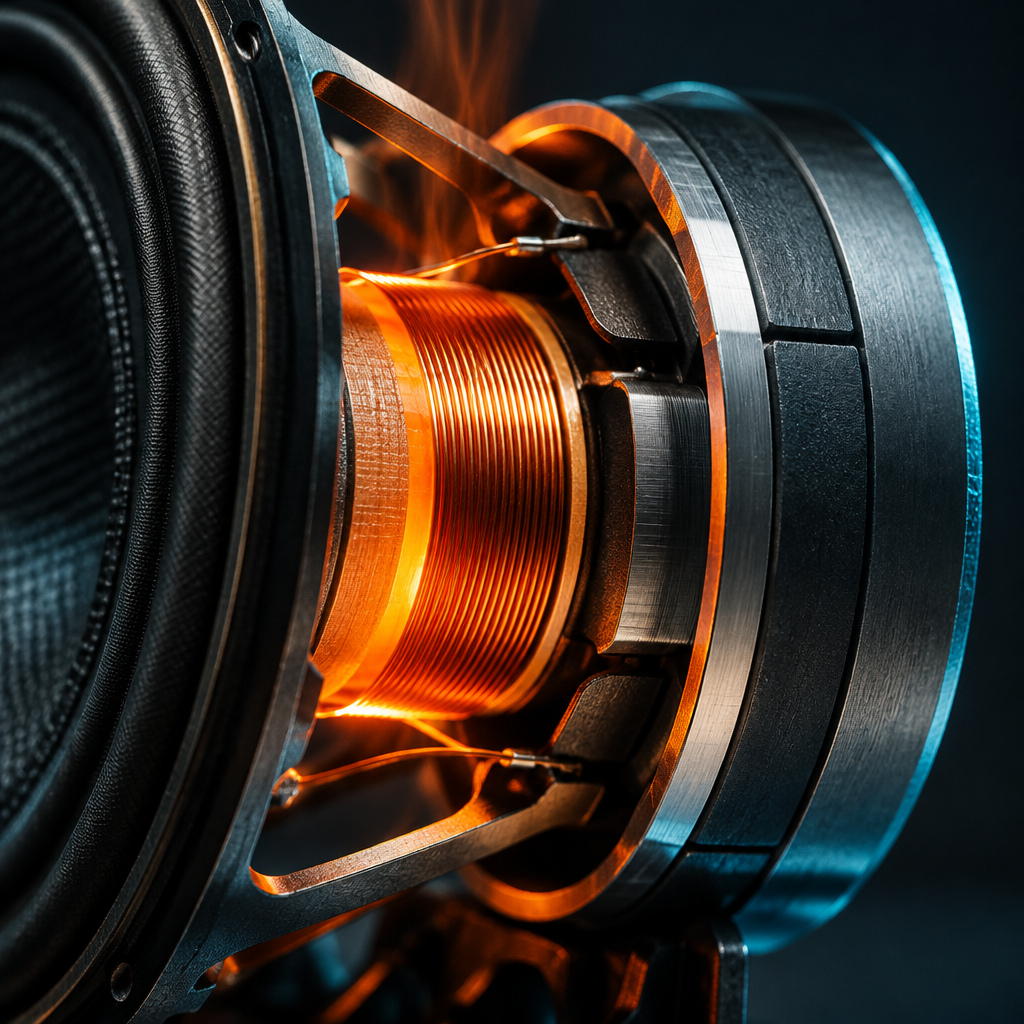
Turn a pair of headphones up to eleven and listen for ten minutes. Something drifts. The first minute hits hard; by the fifth the impact thins out; by the tenth you are reaching for the volume wheel again, chasing a loudness that moved. Most people blame their ears, which do adapt, or the recording, which did not change. The third suspect gets almost no attention. Inside every dynamic driver sits a coil of copper wire a few millimeters across, and that coil has a physical disorder: the louder it plays, the hotter it runs, and the hotter it runs, the worse it does its job. Engineers call the result thermal compression, and it is as real as frequency response and as repeatable as a lab measurement. Nobody prints it on the box, because the box quotes sensitivity at one milliwatt, cold.
Copper Confesses Under Questioning
The physics is almost embarrassingly simple. Copper's electrical resistance rises with temperature at roughly 0.4 percent per degree Celsius. That number looks harmless. Run the arithmetic. A voice coil that heats from a 20 degree room to 200 degrees, a temperature professional drivers genuinely reach when abused, sees its resistance climb about 72 percent. A more modest 150 degree rise still costs 59 percent. Resistance sits in the denominator of the whole motor: at a fixed drive voltage, current is voltage divided by resistance, and the magnetic force that swings the diaphragm is proportional to current. More resistance, less current, less force, less sound.
Loudspeaker measurement labs document the effect directly. Klippel, whose distortion analysis rigs sit in most driver factories, lists compression of the fundamental as a standard nonlinearity check, caused precisely by the rise in coil resistance as the winding heats. In sound reinforcement the accumulated loss goes by the name power compression, and over a long show it can eat several decibels of output from a PA stack, forcing engineers to ride gains upward all night. Headphones are smaller and gentler, but they are not exempt. They run the same copper under the same physics.
The Feedback Loop That Eats Itself
Here is the part that makes it sneaky. Thermal compression is not a one-time tax. It is a loop. You turn the volume up to compensate for the lost level. More voltage drives more current, which dissipates more heat in the coil, which raises resistance further, which costs you more output, which invites you to turn it up again. Every decibel you claw back is borrowed against the next one. The loop terminates somewhere ugly: at the amplifier's ceiling, at the coil former's temperature rating, or at the adhesive holding the winding together.
Music makes the loop lopsided. A recording's peaks tower 10 to 20 decibels above its average level, so a coil cruising at modest heat gets slapped with short bursts of much higher dissipation on every kick drum hit. Modern mastering, squeezed for loudness, narrows that gap and raises the average power delivered continuously. Two coils playing a 1985 master and a 2025 master at the same perceived volume are doing very different amounts of thermal work. The modern one is working harder and losing more.
Doing the Decibel Arithmetic
The losses are small on paper and audible in practice. Sound pressure from the motor tracks current, so a 20 percent resistance rise costs about 1.6 decibels of output, which a coil reaches after warming only 50 degrees above ambient. A 59 percent rise, the 150 degree case, costs a full 4 decibels. That is not a subtle audiophile nuance; that is the difference between a comfortable listening level and reaching for the slider. What makes it worse than the raw numbers is where it lands. The compression is not flat. The coil heats most during the loudest passages, so the dynamics you turned the volume up to hear are exactly the dynamics the fever eats first.
Two Clocks, One Coil
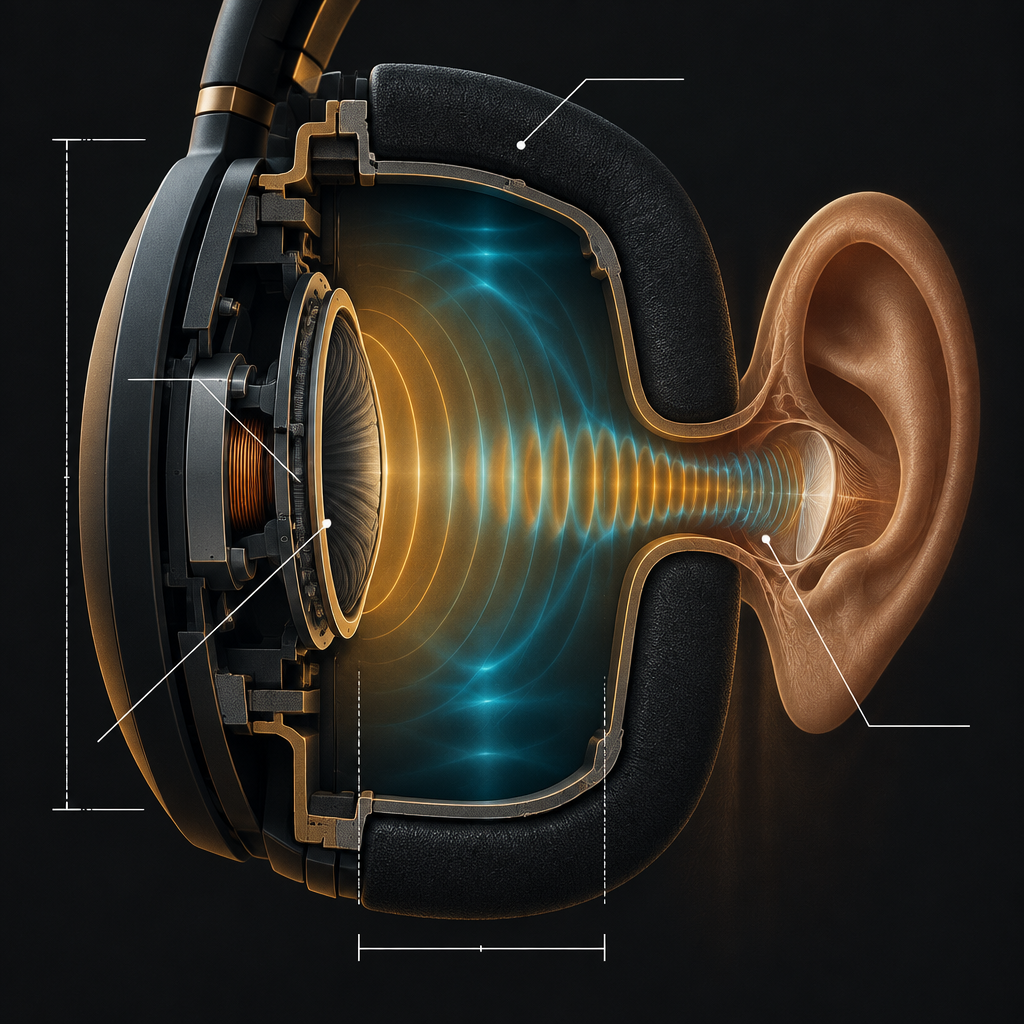
Voice coil heating runs on two timescales at once. The fast clock is the winding's own thermal mass, which responds within seconds; it rounds off transients and quietly attenuates peaks. The slow clock is the whole motor structure soaking, the magnet assembly and surrounding metal acting as a heat sink over minutes. Over-ear headphones add a third factor: a sealed plastic cup around each driver, insulated by padding, with no airflow. Your ears warm it from one side and the coil warms it from the other. The enclosure becomes an oven with a headband.
The problem scales down but does not vanish in earpieces. Balanced armature receivers, the tiny sealed cans that drive most in-ear monitors, wind their coil around a stationary armature inside a metal housing with almost no airflow, and the enclosure that gives an armature its isolation also traps whatever heat the coil makes. Size buys you less power and less heating, which is mercy of a kind. It buys you no escape. The same 0.4 percent per degree applies inside a hearing aid shell as inside a subwoofer motor; only the magnitudes change.
Measurement standards make the problem invisible. Sensitivity specs are quoted at 1 milliwatt, a power level at which the coil barely warms at all. The number is honest and useless in equal measure. It tells you how the driver behaves on the bench, cold. It says nothing about the driver you own, hot, forty minutes into a flight, at the volume you actually use.
Why Wireless Headphones Have It Worse
Bluetooth headphones stack three additional burdens on the same physics. First, the amplifier runs from a battery, and a lithium cell's output voltage sags both under load and as it discharges. Less rail voltage means the amp clips earlier, at exactly the moment you are asking for more level to fight the compression you already have. That is why headphones sound harsh specifically at high volume on a low battery: the peaks flatten against a ceiling that keeps dropping.
Second, firmware knows this, so it defends itself. DSP limiters sit ahead of the amplifier, watching for the combination of high drive and sagging rail, and tuck the signal down before the amp can clip audibly. You experience the limiter as a song that seems to stop getting louder past a certain slider position. That is not your imagination either. It is a protection circuit silently negotiating with a coil that keeps reporting a higher temperature by proxy.
Third, active noise cancellation puts the same driver to work twice. The ANC loop adds anti-noise to the music signal, raising the coil's average duty cycle, and on an airplane, where cabin roar forces the countermeasures hardest, the driver spends the entire flight producing sound you never asked to hear. The fade you blame on jet fatigue is partly a small motor running warm for six hours.
How Engineers Fight a Warm War
Driver designers fight heat with geometry. A larger voice coil spreads the winding over more surface area, giving heat somewhere to go and adding thermal mass; this is one quiet reason flagship drivers grow. The former, the tube the wire wraps around, comes in aluminum, which conducts heat away but adds eddy current losses, or Kapton polyimide, which insulates electrically and tolerates serious temperature. Winding material matters too. Pure copper conducts best. Budget drivers sometimes save money with copper-clad aluminum, which is lighter and cheaper and worse at shedding heat, an economy you pay for at volume.
The exotic weapons live elsewhere. Dome tweeters in hi-fi and studio gear often suspend ferrofluid in the magnetic gap, a magnetic liquid that whisks heat off the coil into the magnet structure and, as a bonus, centers the coil in the gap. Planar magnetic drivers attack the problem with topology: their conductor is not a coil but traces spread across the whole diaphragm, distributing the electrical work over a huge area with excellent heat dissipation, one reason planars hold their composure at sustained high levels. The newest weapon deletes the mechanism entirely. Piezoelectric MEMS micro-speakers fabricated in silicon carry no current-carrying coil at all, so there is no resistance to rise and no fever to run.
What You Can Actually Do
You cannot firmware-update copper, but you can starve the loop. Keep the battery charged before long sessions; a full cell holds its rail voltage up and keeps the amplifier's ceiling high. Give over-ears ventilation breaks on flights, a few minutes off the ears, which dumps heat from the cups and the coils together. If a session demands loud, prefer tracks with dynamic range to tracks mastered at a wall; the coil cares about average power, not peak excitement, and it will repay you with output that holds steady. And when a pair of headphones sounds suddenly lifeless at a volume that worked last month, consider the mundane explanation before the mystical one. It is not burn-in running backward. It is a warm coil doing exactly what physics told it to. The headphones you bought are still in there. They are just running a temperature.