The Number You Read and the Number That Decides Your Bass
Somewhere on a spec sheet you skimmed once, your headphones are described as 32 ohms. Or 300. That figure is a convenience, and like most conveniences it hides the interesting half of the story. Sweep a moving coil driver across the audible band and its impedance refuses to sit still. It bottoms out through the midrange, climbs by half again or more down where the diaphragm's own resonance lives, then drifts back up through the treble as the voice coil's inductance begins to bite. The drivers in your ears are not resistors, whatever the marketing copy implies.
Sound on Sound's engineering survey of the problem puts typical moving coil behavior at more than 1.5 times the nominal figure at the driver's self resonance, which usually lands near 100 Hz. Sennheiser's HD 550 makes a clean illustration: about 170 ohms at 1 kHz, about 320 ohms at 70 Hz. The older HD 800 swings harder still, from the mid 300s up to roughly 650 ohms at its bass peak. None of this contradicts the printed number. The printed number was taken near 1 kHz, the calmest stretch of the curve.
So what? Plug a driver like that into an amplifier whose output impedance is not zero, and you have built a frequency dependent volume control without meaning to.
The Divider Nobody Asked For
Every amplifier presents a source impedance, the resistance the signal has to push through before it reaches your cable. Most modern amplifiers hold it below an ohm. Some do not. The math is the oldest trick in circuit theory: the voltage that actually arrives at the load is the source voltage multiplied by load impedance divided by the sum of load and source impedance. Because the load impedance moves with frequency and the source impedance does not, the attenuation moves too.
Headphones.com worked a clean example. Take a headphone that reads 100 ohms at 1 kHz but reaches 300 ohms at 100 Hz. Drive it from a 1 ohm dongle and the bass gets 2.99 of 3 volts while the midrange gets 2.97. That is six hundredths of a decibel, which is nothing. Drive the same headphone from a motherboard output measuring 75 ohms and the numbers become 2.40 volts at 100 Hz against 1.71 volts at 1 kHz. Nearly 3 dB of relative bass boost, generated by an amplifier that never intended to equalize anything.
Three decibels is not a subtle audiophile complaint. It is the difference between a reference monitor and a party speaker. And it arrives silently, with no switch, no indicator, and no warning in the manual.
Where 120 Ohms Came From, and Why It Refuses to Die
This is not new territory for standards bodies. The IEC 61938 standard, published in 1996, recommended that a headphone output be built around a 120 ohm source impedance. The reasoning was practical rather than acoustic. A resistor after the amplifier output limits current into sensitive, low impedance loads, so a stray volume sweep cannot cook a pair of in-ears. It also cuts hiss and buys back a usable amount of volume pot travel.
Those are real benefits. The cost is exactly the interaction described above. Feed 120 ohms into an in-ear whose impedance dips toward single digits and you have installed a substantial, arbitrary EQ curve. Most of the industry quietly walked away from the recommendation; the portable audio world now expects source impedance near zero, and the buyers who check rarely accept anything above a couple of ohms. But 120 ohm outputs still turn up in interfaces, mixers, and older studio gear, which is why a pair of in-ears can sound correct on a phone and wrong on a console.
Within the industry the shorthand is the one eighth rule: keep source impedance below one eighth of the headphone's nominal impedance and the damping factor stays at eight or better. Run the arithmetic on a typical curve and the residual deviation comes out under half a decibel even at the bass peak. It is a rule of thumb, not a law, and it is generous to headphones that behave.
The Multi Driver Mess
Single driver headphones are the gentle case. In-ear monitors with passive crossovers are where this stops being academic. Sonarworks, which has measured impedance for 797 headphone models, found that 57 percent show meaningful impedance variation with frequency, and the worst offenders are multi driver designs whose crossover networks add their own dips and peaks on top of the drivers'.
The Shure SE535 is the standard teaching example. Nominal 32 ohms, but it plunges toward 9 ohms somewhere in its band. Measured across sources from 1 ohm up to 50 ohms, its frequency response shifts by as much as 7.5 dB. Seven and a half. That is more tonal change than most listeners would accept from a deliberate EQ preset, and it comes free with the wrong dongle.
Worse, the crossover itself was tuned against an assumed load. Change the source impedance and the filter's turnover points shift along with the driver levels, so the two halves of the design no longer blend where the engineer intended. A hybrid with a dynamic woofer and balanced armature tweeters can end up with a bass hump and a scooped presence region from one amplifier and a flat response from another. Same earpieces. Same music. Different electronics.
The Damping Argument, Honestly Stated
Textbook treatments blame high source impedance for reduced electrical damping: the amplifier can no longer brake the driver's resonance, so Q rises, bass gets boomy and slow. For loudspeakers that is uncontroversial. For headphones, engineers have argued about it for years, and the skeptic's case is decent. A headphone diaphragm is small, heavily damped acoustically by the pad and the trapped air volume, and its motor is weak compared with a speaker's. The voltage divider effect is measurable and large; the damping effect is small and often swamped by it.
Which means the honest answer is the boring one. Most of what you hear when a headphone changes character across sources is unequal attenuation, not loose control. If you want to know whether a source will change your headphones, you need two pieces of information: the source's output impedance, and the shape of the driver's impedance curve. No amount of listening vocabulary substitutes for those.
Why Wireless Skipped This Entire Problem
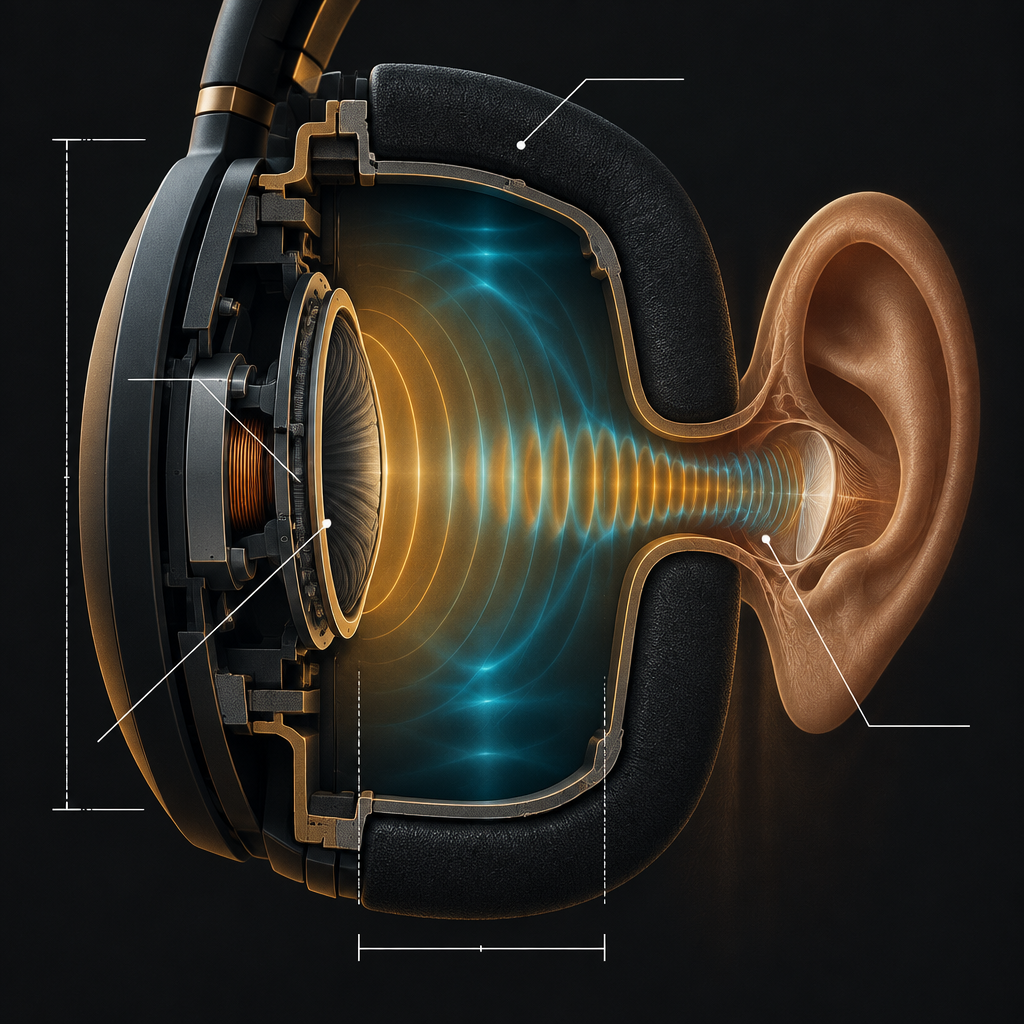
Here is the twist that matters for anyone reading a Bluetooth site. Everything above describes a system split across two companies: someone built the driver, someone else built the amplifier, and neither controlled the interface. Active wireless headphones delete that seam. The amplifier sits inches from the driver inside the cup, specified by the same team that specified the driver, and the two are tuned together as one acoustic object.
That is a genuine engineering advantage, and it is bigger than most feature lists admit. A designer working inside the cup can measure the finished assembly, compensate for the impedance curve in firmware, and adjust the DSP until the measured result matches the target. They can even run the driver at a drive level chosen for linearity rather than convenience. When a reviewer says a wireless model sounds consistent across phones, this is the reason. The phone stopped mattering the moment the DAC moved inside.
The tradeoff is that you cannot fix what you cannot reach. A passive headphone with an awkward impedance curve can be rescued by a better amplifier, and a planar magnetic model barely notices which one you use because its etched conductor traces present a nearly flat, resistive load. A sealed wireless headphone with a sour tuning has no such escape hatch. The amp you were told to worry about is already inside, and it is not going anywhere.
What to Do With All This
Check your source before you check your headphones. Anything that lists output impedance below about 1 ohm will leave almost every headphone alone, and a well reviewed USB-C dongle often measures under 1 ohm while another popular model measures above 7. That gap is audible with sensitive in-ears and invisible with high impedance over-ears.
If a pair of headphones sounds bassy and thick on a laptop but clean on a phone, trust the phone. The laptop jack is adding the bass. If in-ears sound harsh in the upper mids on one device, suspect a source impedance interaction before you blame the tuning. And if you are deliberately chasing that shift, note that impedance adapters sold for exactly this purpose are just resistors in a plug. You can buy the effect. Just do not pretend it was there all along.
One last piece of arithmetic worth carrying around. The 32 ohm figure on the box is a single point on a curve, and the amplifier's contribution is a second point you were never shown. Between them they decide your tone more reliably than any of the adjectives on the packaging.