Your headphones already have microphones, accelerometers, and noise cancellation chips. By the end of 2026, some of them will also have electroencephalography sensors pressed against your temporal bone, quietly reading the electrical activity of your brain.
This is not a thought experiment. At CES 2026 in Las Vegas, HyperX and a neurotechnology startup called Neurable demonstrated a working prototype: gaming headphones with EEG sensors woven into the earpad fabric. No gel. No skull cap. No laboratory. You put on the headphones, close your eyes for ninety seconds, and a swirl of blue dots on a screen collapses into a single point as your brain enters an optimal focus state. Then you play.
The demo was not subtle. Journalists who tried it reported roughly 40 to 50 millisecond reaction time improvements after a priming session. In competitive first-person shooter terms, that is the difference between hitting a target and getting hit.
What EEG sensors are actually doing in an earpad
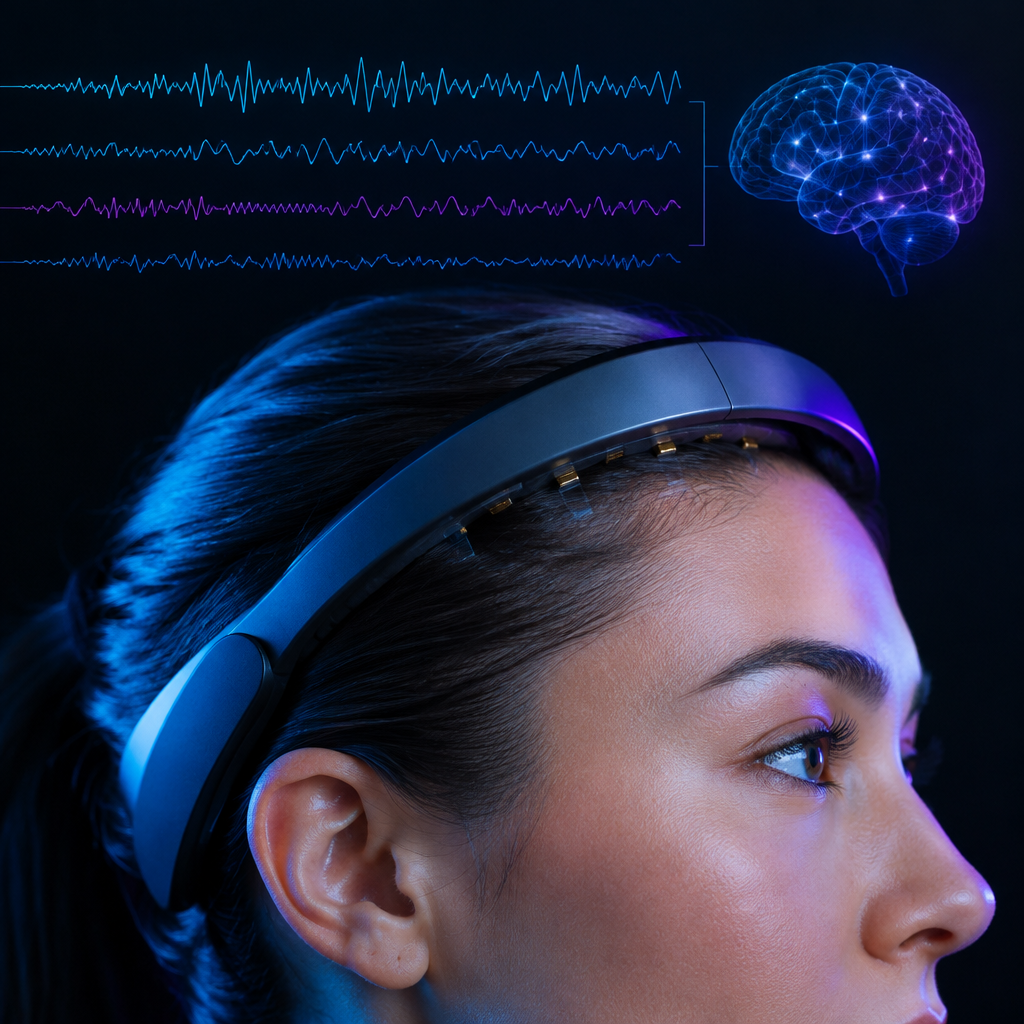
Electroencephalography has been around since 1924. The technique measures voltage fluctuations caused by ionic current flows in the neurons of the brain. Traditional EEG uses wet electrodes, metal discs attached to the scalp with conductive gel, arranged in a 10-20 international system pattern that maps the entire cortex. Clinical setups use 19 to 256 channels, and the gel preparation alone can take half an hour.
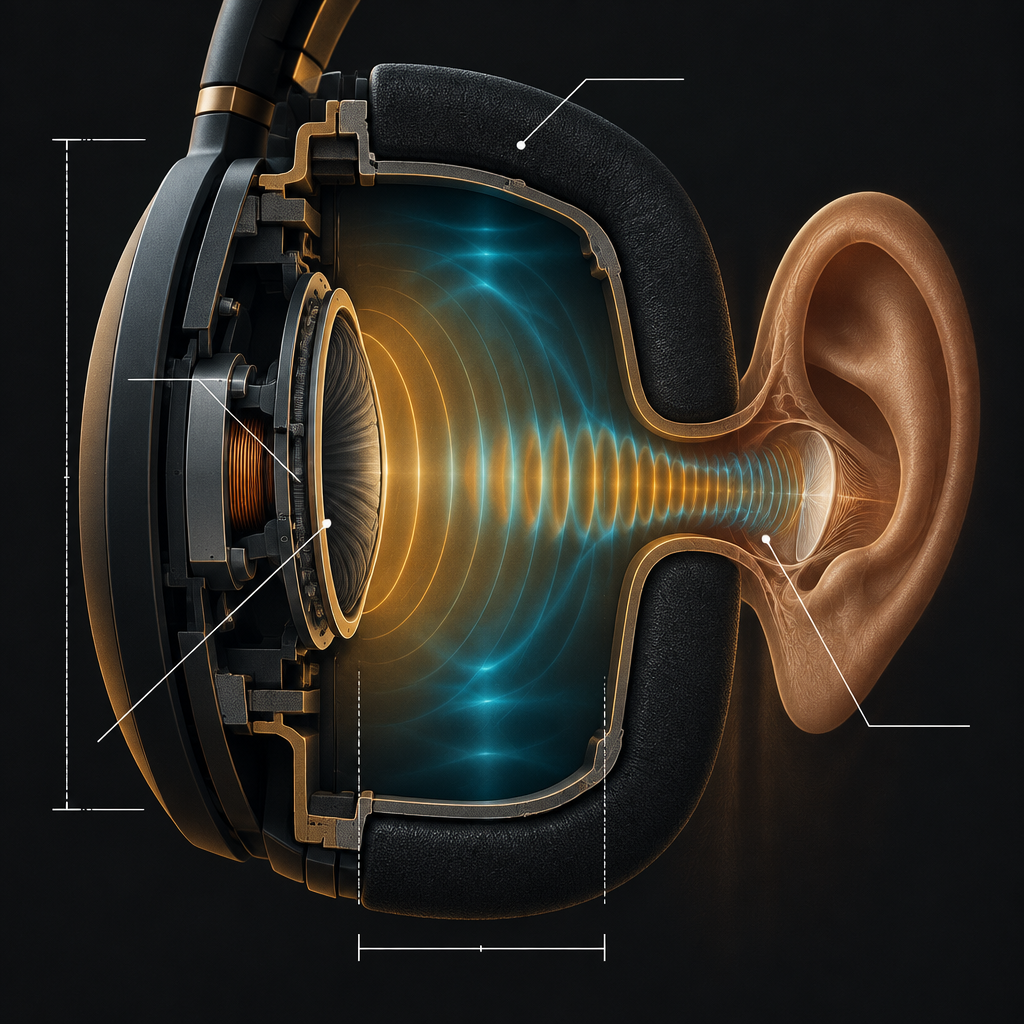
The sensors in these headphones use dry electrodes, which skip the gel entirely. They press against the skin near the temporal region, the area above and slightly behind your ears. This part of the cerebral cortex governs attention, auditory processing, and memory encoding. It is also the most accessible part of the brain from a headphones form factor, which is not a coincidence. The earcup is already positioned against the temporal bone. Neurable did not choose this location for convenience alone; they chose it because the strongest focus-related signals they care about can be captured there.
Dry electrodes are noisier than wet ones. That is the fundamental trade. A wet electrode creates a low-impedance contact with the scalp, sometimes under 5 kilohms, which means clean signal with minimal interference. A dry electrode pressing through hair or against skin might sit at 50 to 100 kilohms or higher. The signal is fainter, dirtier, and riddled with artifacts: jaw clenching, blinking, head movement, the microphonics of headphone drivers firing millimeters away.
This is where AI enters the picture. Neurable's core intellectual property is not the sensor hardware, which has existed in research labs for years. It is the signal processing pipeline that takes a noisy dry electrode signal and extracts meaningful cognitive state data from it in real time. The company trained its models on brainwave data recorded by clinical EEG gel caps, then distilled that knowledge into algorithms that work with a fraction of the channels and a fraction of the signal quality.
The signal is small. The processing is not.
EEG signals from the scalp are measured in microvolts. A billionth of the voltage that powers your headphone amplifier. To capture them, the headphones need an analog front end with extremely high gain and extremely low noise figures. The amplifier must boost the microvolt signal to something a digitizer can read, while rejecting interference from the 60 Hz power line, the Bluetooth radio operating inches away, and the audio drivers vibrating the earpad against the sensor.
Once digitized, the signal goes through a cascade of filters. Notch filters strip out power line interference. Bandpass filters isolate the frequency bands that matter: alpha waves (8 to 12 Hz, associated with relaxation), beta waves (15 to 30 Hz, associated with active concentration), and theta waves (4 to 8 Hz, associated with drowsiness and fatigue). The relative power of these bands shifts as your cognitive state changes. When you are focused, alpha power drops and beta power rises. When you are fatigued, theta creeps in and reaction time follows it down.
Neurable's software interprets these spectral shifts and converts them into the metrics their app displays: focus level, cognitive speed, and a composite they call brain battery, which estimates how much mental fuel you have left before your performance degrades. The conversion is not a lookup table. It is a machine learning model trained on hundreds of hours of EEG data correlated with known cognitive tasks.
Why headphones, and why now
Neurable's first consumer product was the MW75 Neuro, built with Master & Dynamic in 2024. That headphone was a luxury object: $449, handcrafted leather earpads, active noise cancellation, and EEG sensors hidden inside. It tracked focus during work sessions and study sessions. Elegant, but a conversation piece for executives, not a vehicle for mass adoption.
The HyperX partnership changes the angle. Gaming headphones are already large, already heavy with padded earcups, already populated with sensors and radios. Adding a dry electrode layer and an analog front end is a smaller design compromise than it would be in a minimalist commuting headphone. Gamers tolerate bulk. They also spend money on performance: the gaming wearables market is projected to grow from $5 billion today to nearly $20 billion by 2034. If a brain sensor can improve your reaction time by 40 milliseconds, that is a quantifiable competitive advantage. Gamers have bought mechanical keyboards, high-refresh-rate monitors, and 8,000 Hz polling mice for smaller gains.
There is also a Bluetooth angle that is easy to overlook. The EEG data and the audio stream share the same physical device, but they travel different paths. The MW75 Neuro used a standard Bluetooth connection for audio, with EEG data processed on-device and results sent to the companion app. The HyperX prototype follows a similar model. The earcups handle the analog and digital signal processing, the app on your phone or PC receives the cognitive metrics, and the audio stream continues over Bluetooth independently. This separation matters because EEG signals are sensitive to radio interference. Housing the analog front end inside the earcup, as close to the sensor as possible, minimizes the trace length and the antenna pickup. The Bluetooth radio is already there anyway, handling audio. Adding a few extra kilobytes of processed cognitive state data to the BLE connection does not strain the link.
What priming does, and what it does not
The PRIME feature that Neurable demonstrated at CES is a neurofeedback protocol, not a stimulant. It does not pump anything into your brain. It shows you a real-time visualization of your cognitive state, and you use that feedback to guide your mind toward focused. The dots converge because your brain waves are converging.
Neurofeedback as a technique has clinical roots stretching back to the 1960s. The novelty here is the delivery mechanism: a two-minute warm-up done with headphones you already wear, in a form factor that requires no lab equipment, no gel, and no specialist. The fact that it seemed to work in a noisy CES demo room is either a testament to the signal processing or a testament to the placebo effect. The preliminary data from Neurable's study with semi-professional esports athletes suggests the former: across daily sessions, average reaction times dropped 43 milliseconds in casual players and 38 milliseconds in collegiate and professional players, with accuracy gains of 2.7% at the top tier.
The privacy question is structural, not rhetorical
Any device that reads brain waves raises a privacy question that headphones have never had to answer. Your audio habits are one thing. Your cognitive state data is something else entirely. Who is holding it. Whether it is being used to train models. Whether it could be subpoenaed or sold.
Neurable states that it does not store personal brain data without permission and does not sell personal data, brain or otherwise. The only personal information the MW75 Neuro app retains is a first name, birth year, and handedness. This is corporate policy, not regulation. The United States has no federal framework governing consumer EEG data. The European Union's GDPR covers biometric data, but whether brain data qualifies as biometric data under the statute is still being argued. Until a legal precedent or statute clarifies that, consumers are trusting a company's terms of service with data that has no historical precedent in consumer electronics.
Where this goes beyond gaming
The gaming demo is the headline. The broader trajectory is more interesting. If EEG sensors become cheap enough to embed in mass-market headphones, the applications multiply. Focus tracking for remote workers. Fatigue alerts for drivers. Cognitive load monitoring for surgeons, pilots, air traffic controllers. Master & Dynamic's MW75 Neuro already targets knowledge workers, and Neurable's research kits and developer SDKs are in use at academic and defense institutions for brain health monitoring.
The Bluetooth SIG does not include an EEG profile in its specifications. There is no working group drafting a cognitive sensor GATT service. The data path, for now, goes through the manufacturer's app and whatever cloud they choose. This is a gap that will not matter until someone plugs headphones into a third-party system and discovers that the cognitive data pipeline is entirely proprietary. The audio industry has standardized codecs, profiles, and protocols. The brain data industry has not.
For now, the technology is a prototype. There is no product name, no release date, no price. What exists is a proof of concept that brain state data can be captured, processed, and made useful through the same padded earcups that deliver your music. The signal is faint. The processing is heavy. The privacy landscape is unsettled. And a 40-millisecond reaction time improvement after a two-minute warm-up is exactly the kind of marginal gain that built a $20 billion industry on mechanical keyboard switches and high-refresh-rate panels.