Headphone marketing loves a large number. Forty-millimeter drivers. One hundred decibels of noise reduction. Forty hours of battery life. A codec name that sounds like it was invented by a committee of engineers and a committee of lawyers.
But the most important number in a pair of headphones is usually missing: how closely does the acoustic system match the person wearing it?
That question is pushing premium headphone design in a new direction. The next generation of personal audio is less interested in treating the listener as a generic test fixture. It is measuring fit, ear shape, leakage, head movement, and listening level, then using digital signal processing to compensate. The driver still matters. The enclosure still matters. The amplifier still matters. None of them exists in isolation anymore.
A Headphone Is Not a Speaker on Your Head
A loudspeaker in a room has a relatively predictable relationship with its listener. Move six inches and the sound changes, but the speaker does not suddenly lose its bass because your jaw moved or your glasses lifted the ear cup by two millimeters.
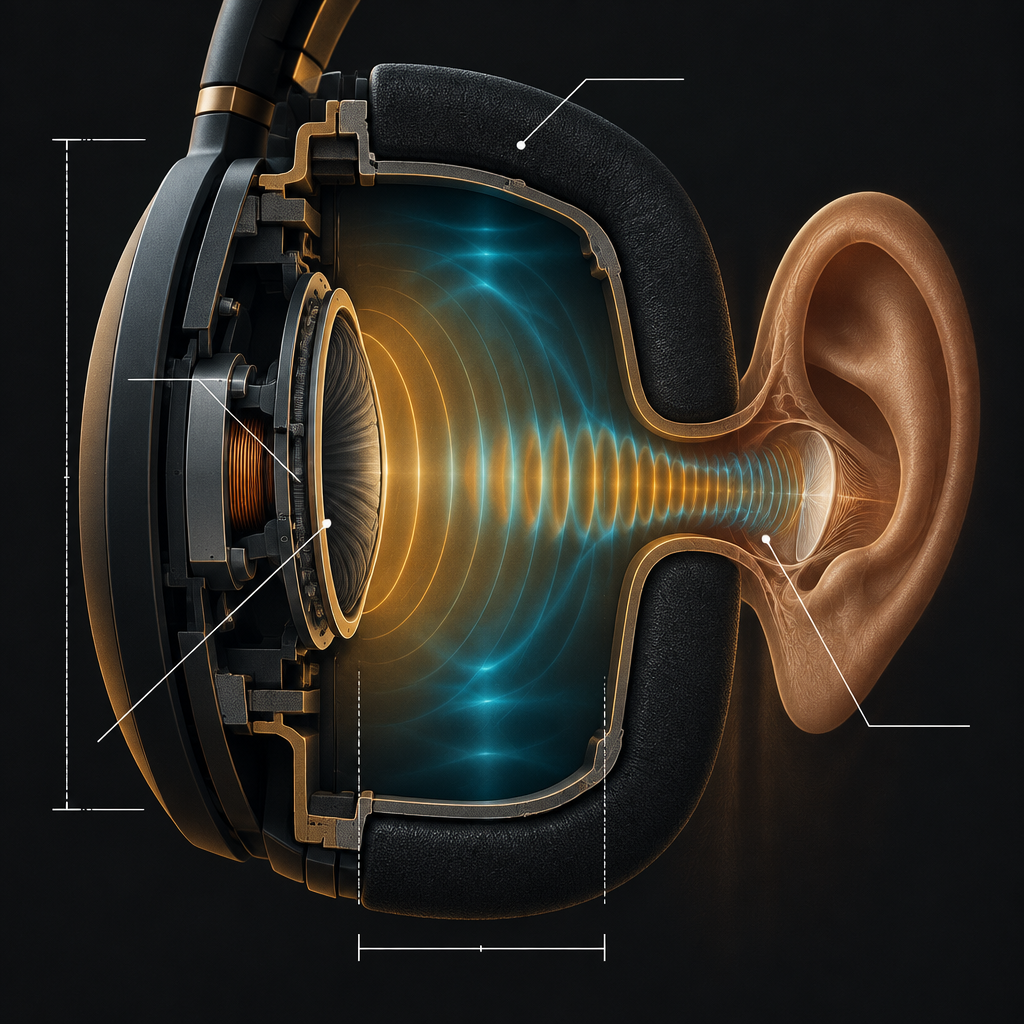
Headphones are much less stable. A closed-back ear cup depends on a seal around the ear. That seal changes with hair, glasses, skin, pressure, pad compression, and the shape of the wearer's head. A small leak can reduce low-frequency energy dramatically. The listener may respond by turning up the volume, while the headphone is technically working exactly as designed.
This is why two people can put on the same model and describe completely different products. One hears a full, controlled low end. The other hears a thin presentation with too much upper midrange. Neither listener is necessarily wrong. They are interacting with different acoustic loads.
The Pad Is Part of the Tuning
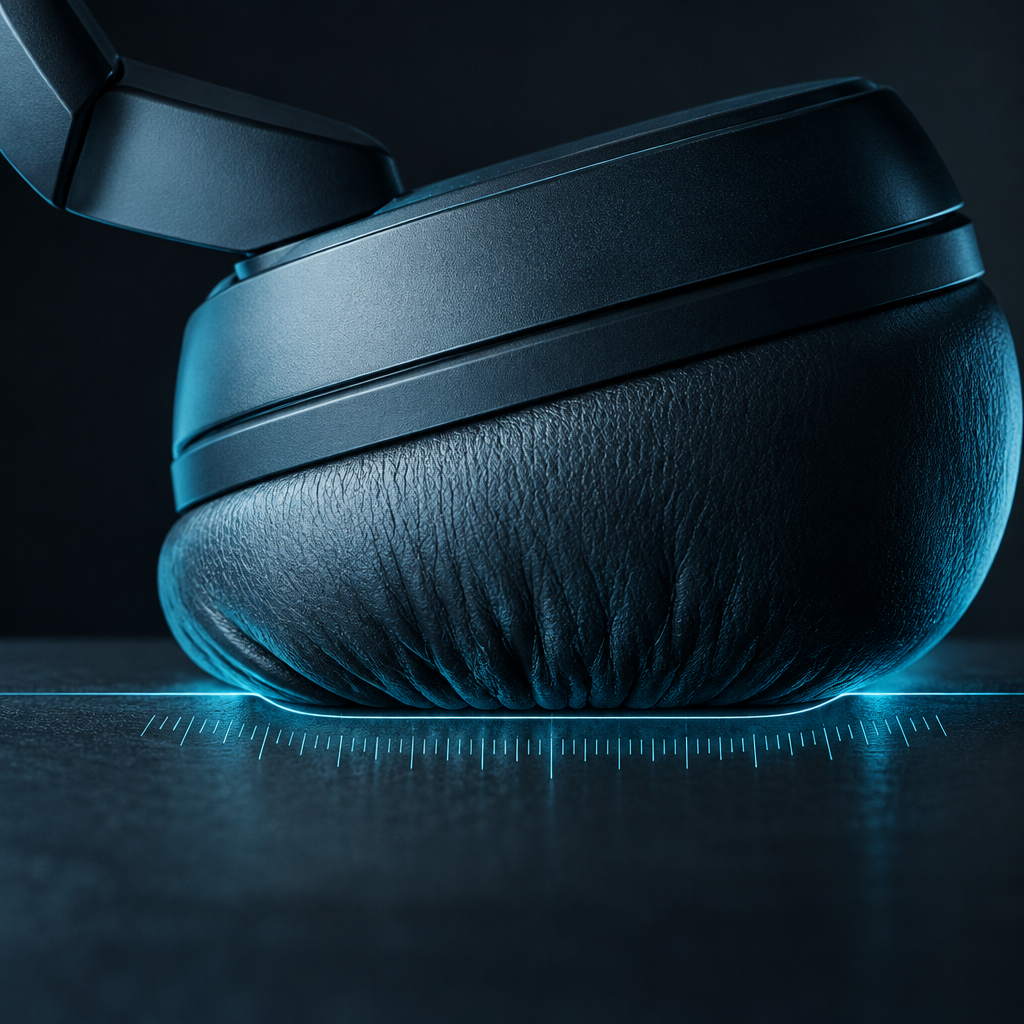
Enthusiasts often talk about ear pads as comfort accessories. They are not. Pads are acoustic components, and changing them can alter the frequency response more than changing a cable ever will.
Pad thickness changes the distance between the driver and the ear. Pad firmness changes the seal. The material covering the pad absorbs and reflects different parts of the spectrum. Even the angle of the driver can change the way high frequencies arrive at the pinna, the outer ear structure that helps the brain locate sound.
Memory foam is useful because it conforms to the head, but conformity is not identical to consistency. Foam ages. It takes a set. It responds to temperature. A headphone that measures one way on a new pad can drift as the pad collapses after months of use.
Designers are beginning to treat this variability as data rather than inconvenience. Pressure sensors, microphones inside the ear cup, and fit calibration routines can estimate whether the intended acoustic environment is actually present. The goal is not to make every listener sound identical. It is to keep the headphone from losing the characteristics the designer intended because of a small physical mismatch.
Why Leakage Confuses Noise Cancellation
Active noise cancellation is often described as a battle between a microphone and the outside world. In reality, it is a control system with a difficult target. The headphone must measure unwanted sound, calculate an inverse signal, and produce that signal through the driver before the noise reaches the eardrum.
A poor seal makes the system harder to control. Low-frequency noise can enter around the pad instead of through the expected acoustic path. The result is not just less isolation. It changes the relationship between the feedforward microphone, the feedback microphone, and the ear itself.
Modern headphones use combinations of feedforward and feedback microphones because each position sees a different part of the problem. The outer microphone can anticipate an approaching airplane engine. The inner microphone can check what remains near the ear. The processing loop then has to avoid becoming unstable, amplifying errors, or introducing a sensation of pressure that some listeners find uncomfortable.
Better systems are adapting to the seal. They can detect changes in the acoustic response and alter the cancellation filter. That is a far more meaningful improvement than simply claiming a larger decibel figure under one laboratory condition.
Your Ears Are Not Factory Standard
The pinna is not decorative anatomy. Its ridges filter incoming sound in a direction-dependent way, creating cues that the brain uses for elevation and front-back localization. A generic head-related transfer function, or HRTF, assumes an average listener. Average ears are convenient for software. They are not especially common in nature.
Spatial audio systems use HRTFs to make a sound appear to come from a point in space rather than from the left or right ear cup. When the profile matches the listener, a voice can sit above the screen, a guitar can occupy a stable position, and a game sound can seem to originate behind the player. When it does not match, the image may collapse toward the center or drift when the listener turns their head.
Personalization can happen through photographs, ear scans, short hearing tests, or behavioral tuning. None of these approaches is magic. A photo can estimate geometry but cannot perfectly capture the acoustic effect of every fold. A hearing test measures sensitivity, not the complete spatial filtering of the ear. A scan may describe shape while missing the way a pad seals around it.
Still, imperfect personalization can outperform a one-size-fits-all profile. The important shift is conceptual: headphones are becoming systems that measure the listener instead of assuming the listener is the system.
Head Tracking Turns Calibration Into a Moving Target
Head tracking adds another layer. With inertial sensors, a headphone can estimate rotation and maintain a fixed virtual soundstage while the listener looks around. This is useful for movies, games, and spatial music, but it also exposes weaknesses in the model.
If the virtual room is anchored to the phone rather than the listener, the image can feel wrong. If the tracking drifts, the singer appears to swim through the room. If latency is too high, the brain notices a mismatch between the movement of the head and the movement of the sound field. The result is a subtle form of digital seasickness.
The best systems therefore combine several tasks. They track orientation, estimate the acoustic response, manage latency, and decide how much spatial effect to apply. More processing is not automatically better. A stable, slightly restrained image is often more convincing than an enormous room that shifts every time the listener scratches their cheek.
Personal EQ Is More Than a Bass Slider
Consumer equalizers usually present a handful of broad bands. Raise the bass. Lower the treble. Save the preset. That interface is approachable, but the underlying problem is more complicated.
A useful correction profile may need narrow adjustments caused by resonances in the ear cup, broad changes caused by the seal, and level-dependent changes caused by human hearing. At low listening levels, the ear is less sensitive to bass and extreme treble. As level rises, the perceived balance changes. A fixed EQ cannot understand whether a missing bass response comes from the headphone, the recording, the seal, or the listener's current volume.
Newer personalization systems can use short listening comparisons to estimate preferred tonal balance. The danger is overcorrection. If the test is noisy, the listener is tired, or the recording is unfamiliar, the algorithm may create a profile that looks precise and sounds strange.
Good personalization should therefore be reversible, explainable, and conservative. A headphone should not quietly turn into an entirely different product because a ten-second test caught the listener on a bad day.
The Measurement Hardware Is Moving Inside
One reason this field is accelerating is that microphones and inertial sensors have become small, efficient, and inexpensive enough to distribute throughout a headphone. Internal microphones can monitor the sound near the ear. External microphones can identify the environment. Motion sensors can capture head rotation. Pressure or proximity sensing can estimate whether the ear cup is seated correctly.
These components create a feedback architecture. The headphone can observe its own output, the outside world, and the listener's movement. It can then change filters, transparency behavior, spatial rendering, and voice pickup. The device stops being a passive endpoint for Bluetooth audio and starts behaving like a small acoustic computer.
That phrase matters because the engineering tradeoffs are shifting. Battery life now pays for algorithms. Memory stores models. Wireless bandwidth carries metadata and multichannel streams. The driver is still the final actuator, but much of the product experience is being designed in code.
What Still Cannot Be Fixed With DSP
There is a temptation to treat digital processing as a universal repair kit. It is not.
DSP cannot make an uncomfortable clamp disappear. It cannot fully correct a pad that leaks because the frame is the wrong shape. It cannot eliminate distortion created by a driver pushed beyond its excursion limits. It cannot turn a cheap hinge into a durable one. The physical design sets boundaries, and algorithms operate inside them.
That is why the strongest products will combine careful mechanics with responsive software. A well-shaped pad gives the processor a stable starting point. A quiet amplifier leaves room for correction. A low-distortion driver responds predictably when the filter changes. Personalization is not an excuse to neglect the fundamentals. It makes the fundamentals more valuable.
The New Headphone Spec Sheet
In a few years, shoppers may care less about a single driver diameter and more about questions that sound almost clinical. How does the headphone detect a poor seal? Does it use an internal microphone? Can the spatial profile be exported? What happens when the pads age? Is the correction stored locally, or does the device send ear data to a server? Can the owner disable adaptive processing and hear the unaltered signal?
Those are not glamorous questions. They are better questions.
The future of headphones will not be defined by one miraculous transducer. It will be defined by how intelligently the entire acoustic chain responds to a real human wearing it in a real room. The best pair may not have the most dramatic factory tuning. It may be the one that notices your glasses, your ear shape, your movement, your room, and your listening habits, then makes a series of small corrections you never consciously hear.
That is the strange destination of personal audio. The more precisely a headphone measures you, the less you should notice the measurement. The technology succeeds when the hardware disappears, the sound stays put, and the music feels as if it was waiting for your ears specifically.