The Component No Spec Sheet Admits To
Every headphone review on earth will tell you about the driver. Forty millimeters. Free edge. Graphene, beryllium, some rare word borrowed from aerospace. Almost none of them will tell you about the ring of foam and vinyl pressed against your skull, the part that decides how much of that driver ever reaches your eardrum. It has no headline spec. It has no marketing name. It is dying anyway, from the day it leaves the factory.
Audiophiles spend whole forums arguing about burn-in, the belief that a driver loosens up and sounds better after a hundred hours of play. The measurable truth runs in the opposite direction. Your headphones really do change over the months you own them, and not because the copper learns to relax. The pads compress. The vinyl cracks. The foam undergoes a slow chemical rot that no amount of gentle play can pause. The sound you fell in love with in week one sits on a consumable, and nobody put a service interval on the box.
One Ring, Four Acoustic Jobs
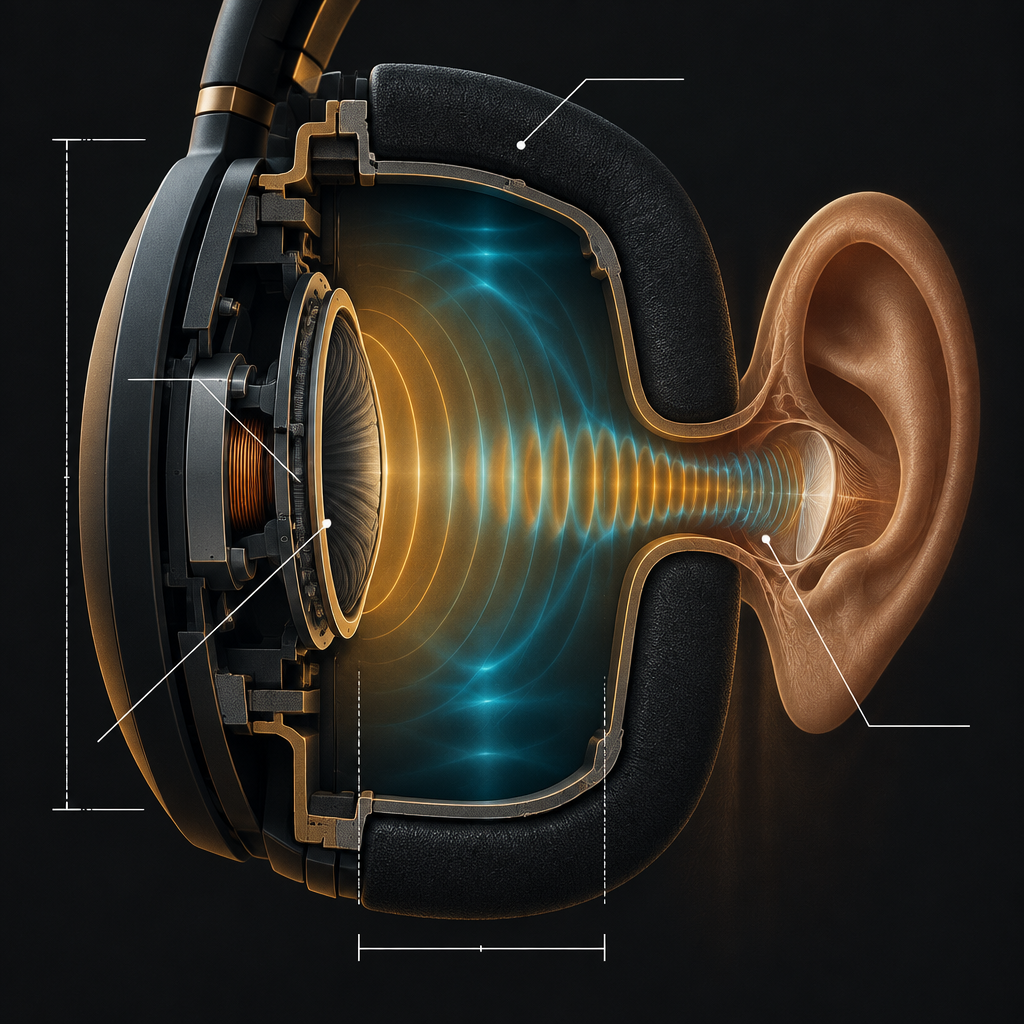
An ear pad looks like upholstery. It behaves like half the speaker. Four distinct jobs hide inside that donut.
First, the gasket. A sealed over-ear headphone is a small pressure vessel. The driver pumps against a trapped cushion of air between the diaphragm and your eardrum, and the low end you hear is largely a product of that trapped volume staying trapped. Second, the suspension. The pad sets driver angle and driver distance. A two millimeter change in height measurably reshapes the response, which is why pad depth shows up in frequency plots at all. Third, the damping. The foam itself absorbs chassis resonance and combats shell ringing, quietly. Fourth, the seal line. The pad is the only component engineered to conform to an irregular, oily, slightly convex human surface, and it has to keep conforming across glasses arms, hair, jaw movements, four hours of a hot afternoon.
A gap the width of a human hair near the cheekbone is enough to vent the pressure chamber below a few hundred hertz. When the seal goes, the driver unloads. Excursion climbs for the same perceived loudness, distortion follows, and the bass you paid for leaks out through the leak.
A Polymer That Ships With a Countdown
Flexible polyurethane foam, the squish inside nearly every pad made this century, is a web of long polymer chains stitched together by urethane linkages and blown full of cells by water and catalysts during the reaction. The urethane bond is convenient to manufacture and nervous around moisture. Water molecules attack it; hydrolysis, the chemists call it. One bond at a time, humidity nicks the polymer backbone, and the foam that was specified at a certain firmness drifts softer, then weaker, then crumbly.
The formulation details decide the failure mode. Polyester-based foams stay springy and strong but surrender to hydrolysis fastest; polyether-based foams shrug off water and take damage from oxidation and ozone instead. Viscoelastic memory foam, the premium squish marketed as luxury, sits in the same chemical family and ages by the same rules. There is no everlasting variant. There is only stubborn chemistry and how much moisture you allow it. Furniture and mattress makers publish hydrolysis aging charts for exactly this reason; headphone makers publish none, and the pad inherits the chemistry without the disclosure.
Compression set finishes the job. Foam is an arch of gas trapped in walls; hold it crushed under a head for a few hundred hours and the walls stop rebounding. The pad goes thin in the middle, the seal line migrates, the driver sits closer to your skin. Nothing about this is visible while the headphones are on your head. You adapt, second by second, to a slowly sagging response curve.
Your Head Is the Accelerant
The environment inside a pad is worse than the shelf it came from. Skin runs near 35 degrees Celsius. Sweat arrives with a pH between roughly 4.5 and 6, mildly acidic, and polyurethane soaks it up like a dish sponge; some foams hold several times their weight in water before they feel soaked. Sebum attacks the vinyl wrap from the outside, harvesting its plasticizers, the very molecules that keep the coating supple. As a loose chemical rule, reaction rates climb steeply with temperature; add ten degrees and decay roughly doubles its pace.
Now total it up. Four hours a day, three hundred days a year, mild acid, body heat, trapped humidity, constant mechanical crush at a few newtons of clamp force. The head is an aggressive acceleration rig, and the pad is the only part of the product designed to spend its whole life inside one.
What the Theft Actually Sounds Like
Pad wear does not announce itself with a fault light. It shows up as vague dissatisfaction. The sub bass you demoed in the store stops arriving; you turn the volume up two notches to find it, and now the mids feel shouty. The noise cancellation that hushed an airplane cabin seems to have lost interest in engine drone.
Neither impression is your imagination. As the seal degrades, the low frequency shelf sags, typically measured in the range of three to six decibels below about 200 hertz by the time pads are visibly flattened, sometimes more. Worn pads were measured in labs again and again before anyone marketed the science publicly, and the effect is repeatable. Meanwhile the noise control system was tuned assuming a specific leakage profile; open a gap and its carefully balanced feedforward and feedback microphones find themselves compensating for a chamber that no longer exists. Bass cancellation decays first, in the exact band an airplane lives in. Worn flagship headphones can measure worse at passive isolation than a cheap new pair, because the cheap pair still has its gasket intact.
Protein Leather and the Flake You Notice First
So people replace the pads, sometimes after years, and report the same strange thing: the headphones sound better than they remember, almost new, and suspiciously more alive in the bass. Forums chalk it up to imagination. It is not imagination. It is the original response curve reassembling itself behind a competent gasket, and the shortest listening test you will ever run on gear you already own.
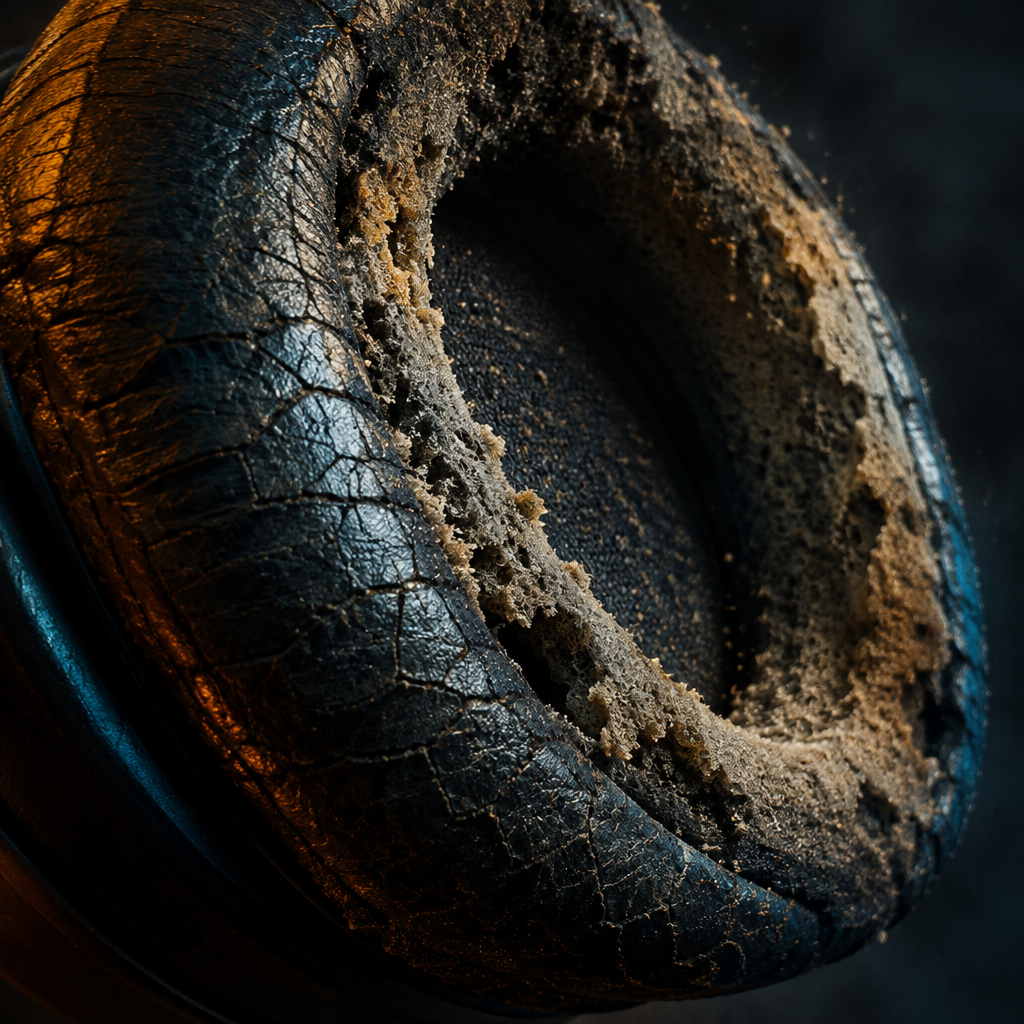
Before the acoustic damage ever becomes audible, there is a decent chance you will see the cosmetic version. Most modern pads wear protein leather, which contains no leather and no protein. It is a polyurethane coating spread over a knit backing, chosen because it survives sweat better than real hide and costs less. Its weakness is plasticizer migration: skin oils and constant flexing pull the softening agents out of the film, the surface stiffens, microcracks join into flakes, and one day your headphones are snowing black dandruff onto a white shirt.
The flake gets all the attention because it photographs badly. The foam death happening underneath is silent, invisible, and vastly more consequential. Velour pads dodge the flaking and breathe sweat out faster, at the price of a looser, leakier, less controlled seal. Every wrap is a trade, and every trade contains a clock.
The Aftermarket Trap Smart Buyers Avoid
So the pads die. You order replacements, third party, half the manufacturer's price, same shape, five star average. You snap them on. The headphones sound wrong now: brighter, thinner, or boomy in a tubby way. This is the most common outcome in the entire story of worn pads.
The reason is that pads are matched parts, not fashion. Density, wall stiffness, depth, inner diameter, and wrap material all sit inside the tuning equation the original engineers signed off on, and aftermarket makers reverse-engineer the shape while guessing at the inside. Measured comparisons of clone pads have shown swings of several decibels against originals from the same models. When the manufacturer sells replacements, buy theirs; Beyerdynamic, Sennheiser, and Sony have run pad programs for years precisely because the parts are acoustic components. If your model has no official spare, the maker has quietly declared the product disposable, and the honest purchase decision would have included two sets of pads in the lifetime budget.
Buying Time Without Buying Nonsense
A realistic service interval for daily-driver headphones is eighteen to thirty six months per set of pads, longer with lighter use and careful storage. Wipe the pads after sweaty sessions; a dry cloth, nothing chemical. Let them air out before storage, and store them somewhere cool, dry, and out of sunlight, because UV drives the oxidation branch of the rot. Never leave them in a hot car, which is a hydrolysis pressure cooker with a dashboard. Replace in matched pairs from one batch, since a new left pad and an old right pad form a mismatched speaker system aimed at your brain.
None of this makes your headphones immortal. It makes a consumable honestly consumable, like brake pads or guitar strings, the cheapest parts of a machine quietly holding its performance together. The driver deserves its rare words borrowed from aerospace. The twenty dollars of foam deciding how much of it you hear deserves a line in the spec sheet, and a reminder on your calendar.