You've got your headphones paired to your phone, laptop, and tablet. A call comes in on your phone. The music should pause, the call audio routes to the headphones, and everything works seamlessly. That's the promise of Bluetooth multipoint in 2026. The reality, for millions of users, is audio dropouts that last 2-3 seconds, calls that route to the wrong device, or the headphones that simply stay locked on the device you were listening to 5 minutes ago.
This is not a spec problem. Bluetooth 5.4 and newer chips support multipoint flawlessly on paper. The problem lives in the implementation gap between what the specification allows and what manufacturers actually do with their firmware.
Why Multipoint Switching Fails
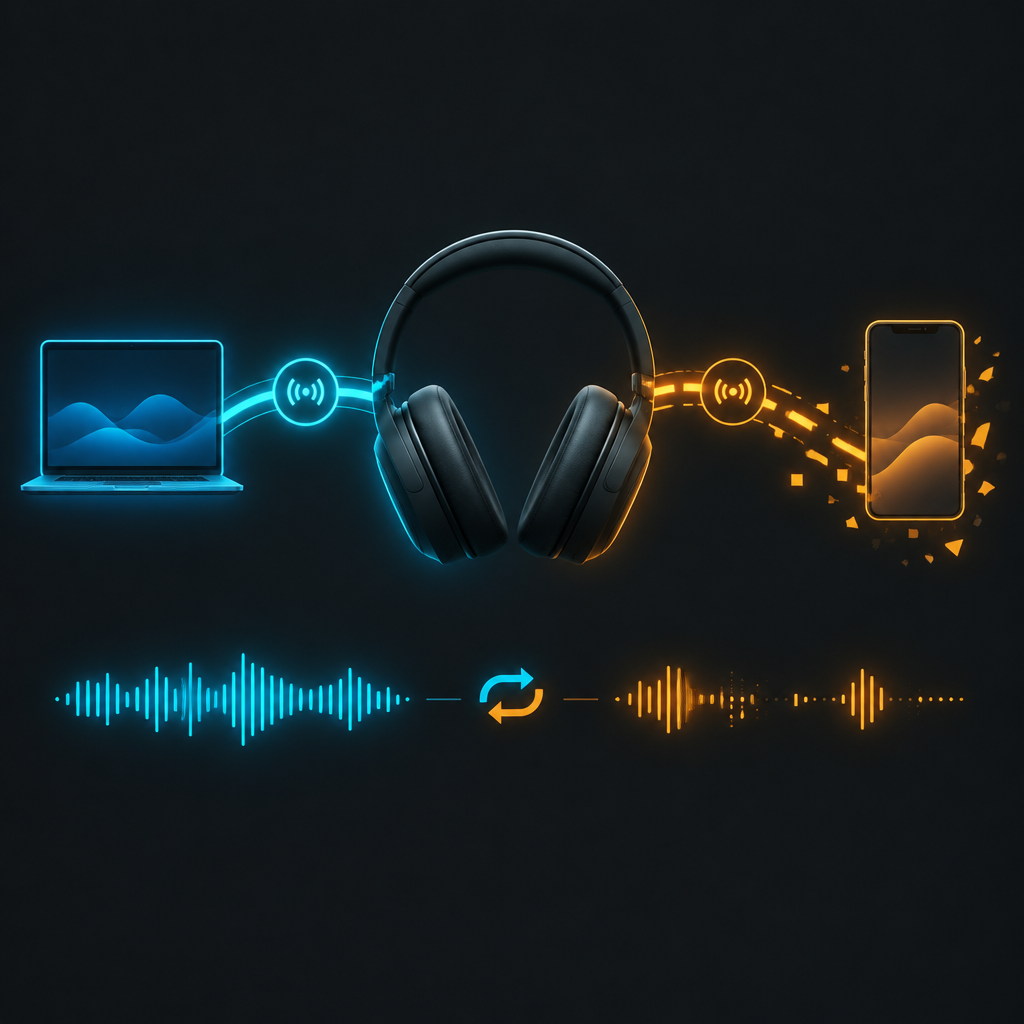
When your headphones are paired to multiple devices, they maintain a low-power Bluetooth link to all of them simultaneously. The moment one device has audio to play, the headphones need to interrupt their connection state, negotiate audio parameters with the active device, and drop the audio stream fast enough that you don't hear the gap. That handoff takes milliseconds. In a quiet environment, a 200-millisecond gap is barely noticeable. In a crowded coffee shop with Wi-Fi interference on the 2.4 GHz band, that gap can stretch to 1-2 seconds.
The multipoint issue breaks down into three distinct failure modes that exist in summer 2026.
Switching latency. Some headphones take 300-800 milliseconds to detect that audio is available on Device B while connected to Device A, acknowledge the switch request, renegotiate codec parameters, and start playback. Sony WH-1000XM6 units handle this in under 150ms when everything cooperates. Cheaper multipoint headphones from brands that rushed to market with the feature often top out around 500ms. For phone calls, this is maddening. For music playback, it's a minor annoyance that adds up.
Codec re-negotiation stutters. When you switch from a device using aptX Adaptive on your gaming laptop to a device using SBC on your phone, the headphones have to drop the high-bandwidth codec, settle on a lower common codec, and restart the audio stream. That renegotiation is where the 1-2 second dropout happens. Apple's AirPods Max handle this better than most because Apple controls both ends of the ecosystem. Android headphones vary wildly.
Device lock-in. Some headphones prioritize whichever device connected first, meaning they'll ignore incoming audio from Device B until you manually interrupt playback on Device A or forget and re-pair. This defeats the entire purpose of multipoint and is a firmware laziness issue, not a hardware limitation.
Where the Bandwidth Crunch Actually Happens
The Bluetooth 5.4 spec allows dual-channel audio; your headphones can technically listen for audio from two devices on separate subchannels. Most manufacturers don't implement this because it drains battery faster and requires more sophisticated antenna design. What they do instead is use time-division multiplexing; the headphones allocate time windows to each paired device and rapidly switch between them.
That works fine until Wi-Fi interference (particularly Wi-Fi 6 and newer equipment running on adjacent 2.4 GHz channels) forces the Bluetooth stack to retransmit packets. Each retransmit steals time from the switching window, and when the headphones miss their window to listen to Device B, they don't hear the audio request until the next cycle 50-200 milliseconds later. Add codec renegotiation on top, and you've got the 1-2 second drop that feels like a hardware failure.
Why This Still Isn't Fixed
The Bluetooth Special Interest Group updated the specification again in 2025 with better multipoint guidance, but specification is not implementation. A chipmaker like Qualcomm can release a reference driver that handles multipoint correctly, but a headphone manufacturer like Anker or JBL has to actually use it. Many don't. They ship with firmware that treats multipoint as a checkbox feature, not a core experience.
The incentive structure doesn't push them to fix it either. Multipoint is a feature that sells headphones. Once sold, the manufacturer has limited motivation to push firmware updates that improve something users already consider acceptable. You bought the headphones with multipoint; you're already the customer.
Apple's AirPods and Sony's premium lines are the notable exceptions. Both companies push OS-level updates that improve multipoint behavior, treating it as a core feature of the ecosystem rather than a checkbox.
What Actually Works in 2026
Apple AirPods Pro 2 and Max. If you're in the Apple ecosystem and all your devices run current OS versions, multipoint works well. Switching between iPhone, iPad, and Mac is nearly seamless. The caveat: if one device is running an older OS version, the behavior degrades. If you mix Apple and Android, multipoint breaks entirely.
Sony WH-1000XM6. Sony has invested in multipoint firmware updates over the past two years. The XM6 switches between devices cleanly in most scenarios. The Headphones Connect app shows which device is active and allows manual prioritization. Switching speed isn't quite AirPods territory, but it's acceptable and improving with each firmware release.
Sennheiser Momentum 4 and Momentum 3. Both handle multipoint better than the price point suggests. Switching is smooth, and the headphones don't lock onto the first connected device. These are reliable multipoint headphones if you're not chasing the absolute lowest latency.
For gaming and latency-sensitive work: Dedicated gaming headsets from Corsair, SteelSeries, and ASUS often sacrifice true multipoint to maintain sub-50ms latency on a primary device. They'll pair to your phone, but audio prioritizes the PC. This is a valid trade-off for their target market.
The Practical Workaround
Until firmware across the industry improves, the multipoint experience is best thought of as a convenience feature rather than a reliability feature. Pair your headphones to your main device first. If you need to switch to a secondary device, manually pause audio on the primary device before playing on the secondary. This adds a few taps but eliminates the dropout problem entirely.
For people managing multiple devices throughout the day, the manual approach is tedious but stable. The promise of automatic multipoint switching is real and coming; the current implementation in most headphones is good enough to sell but not good enough to trust completely.
What changed between 2024 and now is clarity. Two years ago, multipoint switching had more excuses because the hardware was newer. In 2026, it's been two full years of driver updates, firmware patches, and specification refinements. That most headphones still struggle suggests the issue is deliberate firmware compromise, not a technical ceiling.
The Coming Wave
Bluetooth 6.0 hardware is shipping now (Samsung Galaxy S25 Ultra, iPhone 16 Pro), and the spec includes stronger multipoint guarantees. Chipsets that implement the spec fully will ship in mid-2027. Until then, expect multipoint to remain a feature you can enable but not necessarily trust in critical moments. For music and podcast listening it's fine. For calls and real-time meetings, manual device switching is still the safer bet.