The Trick You Use Every Day Without Knowing Its Name
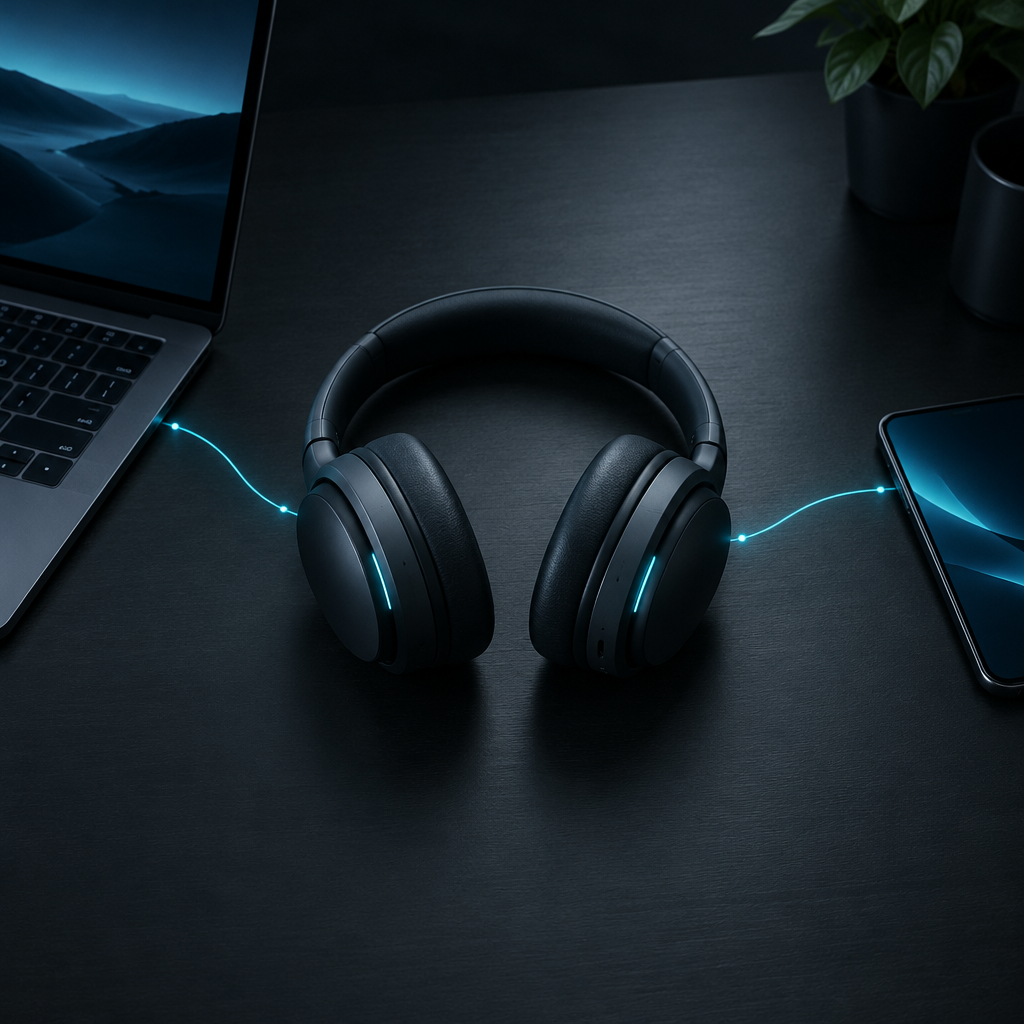
Your headphones are connected to your laptop. A podcast plays. Then your phone rings, and the audio jumps to the call without you touching a thing. Hang up, and the podcast slides back in. That is multipoint, and it is the single most requested headphone feature that nobody can explain.
Here is the strange part. Your headphones contain exactly one radio. Bluetooth shares a single antenna and transceiver across every connection the device maintains, and that transceiver is half duplex: it can send or receive in a given moment, never both. Two devices, each convinced it owns the headphones, are being served by hardware that can only talk to one of them at any given instant. Multipoint is not a parallel connection. It is an illusion, sustained by brutal, microsecond-level time slicing.
One Radio, Two Piconets
To understand the trick, you need the word piconet. A piconet is a tiny Bluetooth network: one central device and up to seven or so peripherals sharing a hopping sequence across the 2.4 GHz band. Classic Bluetooth divides time into 625 microsecond slots, and the whole network hops channels 1,600 times per second to dodge interference from Wi-Fi, microwaves, and every other Bluetooth device in the room.
With multipoint, your headphones belong to two piconets at once. Say the laptop is the central device on the first link and the phone is the central device on the second. The headphones are a peripheral on both. A device participating in multiple piconets forms what the spec calls a scatternet, and here is the catch that never appears on the box: the two piconets know nothing about each other. The laptop's hopping clock and the phone's hopping clock are unrelated. The headphones' controller has to interleave slots for both masters, racing between two independent timing references with a single radio.
That interleaving lives in the link controller, the low-level silicon that operates below the operating system's Bluetooth stack. The host, meaning the phone or laptop software, mostly has no idea the schedule is this chaotic. It simply sends audio down its link and assumes someone is listening.
Sniff Mode: The Schedule That Makes It Survivable
If the headphones had to listen to both links on every slot, the battery would die by lunch. They do not. Idle connections drop into sniff mode, a negotiated agreement where the peripheral only wakes up on designated listen slots. The headphones might check the laptop every 300 milliseconds and the phone every 500, sleeping through everything else. The controller overlays these two calendars, wakes the radio exactly when a listen slot arrives on either link, and goes dark between them.
This is why the feature costs battery even when nothing is playing. A single-link pair of headphones holds one sniff calendar. A multipoint pair holds two, and every extra wake-up burns current. Vendors rarely quote a number because it varies with the negotiated sniff intervals, the radio's wake latency, and how chatty the far devices are. Users consistently report shorter standby time with multipoint enabled, which is exactly what the physics predicts.
Why the Handoff Stutters
Now the half-second mute. When a call arrives, the phone must switch the link from A2DP, the stereo music profile, to HFP, the call profile, which carries narrowband speech over a synchronous connection with reserved slots. This is not a gentle transition. It is a teardown and rebuild of the audio pathway on that link, and on a multipoint device the controller is also holding the laptop's music stream open the entire time.
Some implementations pause the laptop stream cleanly. Some let it keep playing into a buffer that will be discarded. Some drop a beat of the call while renegotiating. And a few, infamously, route the call audio and leave the laptop convinced it is still streaming, so the music is technically playing while you hear none of it. Every one of these behaviors is a firmware decision, not a spec requirement, which brings us to the messier truth about multipoint.
The Pairing Ritual Matters More Than You Think
How you set multipoint up shapes how it behaves for the life of the connection. The first device you pair becomes the anchor, the link the headphones fall back to when policy gets ambiguous. Pair the laptop first, then the phone, and the firmware treats the phone as the newcomer whose streams must argue for priority. Some models also cap the codec on both links to whatever the weaker device can sustain, so a phone that only negotiates SBC can drag your laptop's listening quality down with it. The fix is unglamorous: clear the pairing table, start over with the device you care about most, and re-add the second one after the first link is solid.
Play and pause commands ride a separate channel from the audio itself, through AVRCP, the control profile that carries transport buttons and metadata. Multipoint headphones listen for these commands on both links, which is occasionally why a stray play command resurrects the wrong device's queue at full volume. Every multipoint user has a story like this. Now you know which layer to blame.
Every Multipoint Is a Snowflake
The Bluetooth Core Specification defines the machinery, the slots and links and modes, but it never standardized multipoint behavior at the profile level. Which device wins when both play audio? Does the call preempt a movie, or does the movie pause, or does the device with the more recent user touch take priority? Every vendor answers differently. One pair of headphones puts phone calls above everything. Another prioritizes whichever device started playing most recently. A third exposes an app toggle for call priority because the default guess infuriated its users.
This is why multipoint reviews read like folklore. Users swear one pairing works and a near-identical pairing fights. Those reports are real, and they describe scheduling policy mismatches, not defective hardware. Two devices that each demand aggressive sniff intervals, or a phone that grabs the link for its own ringing, can produce a headphone that spends its radio budget on negotiation instead of audio. Adaptive frequency hopping helps dodge the spectrum collisions, but policy collisions are firmware's problem to solve.
LE Audio Redraws the Map
Classic multipoint is a scheduling hack bolted onto a 1990s radio architecture. LE Audio, built on Bluetooth LE and the LC3 codec, was designed with concurrent streams in mind, and the difference shows up in the plumbing. Where A2DP pushed a one-way stereo stream with no delivery guarantees, LE Audio uses Connected Isochronous Streams: each stream carries explicit quality metadata, an SDU interval, retransmission limits, and a transport latency floor. The controller schedules isochronous data around anchor points, and every stream declares what it needs before it starts.
For multipoint, that changes the conversation from hopeful guesswork to arithmetic. A controller holding two isochronous links can look at the declared intervals and retransmission budgets, then build a schedule that provably fits, or refuse the second stream before it ruins the first. Framed PDUs and per-packet retransmission give the link a recovery path that classic A2DP never had; a lost packet can be resent within its flush window instead of simply vanishing into a gap in the music.
There is a sibling concept worth separating. Auracast, the broadcast side of LE Audio, is one transmitter reaching unlimited receivers; multipoint is two transmitters competing for one receiver. Different problems, different machinery, and the two will coexist in headphones over the next few hardware generations. Some models will juggle a phone call, a laptop stream, and a silent Auracast subscription at the same time. The scheduler in that device deserves a raise.
Living With Multipoint Without Losing Your Mind
A few practical rules make the feature behave. Pair and connect the second device before you need it, because the initial link setup is where most policy confusion happens. If calls are pulling audio priority at bad times, look for the call priority toggle in the vendor app; several major brands shipped one after user complaints. If you notice standby drain, remember that a second link means a second wake-up calendar, and disabling multipoint when you travel is a legitimate battery strategy. And if one specific pairing fights constantly, the culprit is usually a device that renegotiates its link parameters aggressively, which is that device's firmware misbehaving, not your headphones.
The deeper story is what multipoint reveals about Bluetooth itself. The protocol was born for cable replacement, one link, one profile, low ambitions. Users then demanded that a single pair of headphones behave like a conference bridge, and the industry delivered it with careful scheduling on silicon that was never promised for the job. The next time your music ducks for a ringtone and returns without losing its place, spare a thought for the link controller dividing 625 microsecond slots between two oblivious masters, a thousand times every second, flawlessly enough that you never noticed.