For years, buying Bluetooth headphones meant comparing a familiar stack of numbers: battery hours, active noise cancellation, driver size, and perhaps an impressive codec logo. The connection itself felt settled. Your headphones paired with one device, received a compressed stream, and played it through two tiny speakers.
That model is beginning to look dated. Bluetooth LE Audio is moving wireless listening onto a new technical foundation, and the most interesting part is not simply that it can sound good while using less power. LE Audio changes the shape of the connection. It can send separate streams to left and right headphones, synchronize many listeners to one broadcast, and make latency a design variable rather than an unavoidable annoyance.
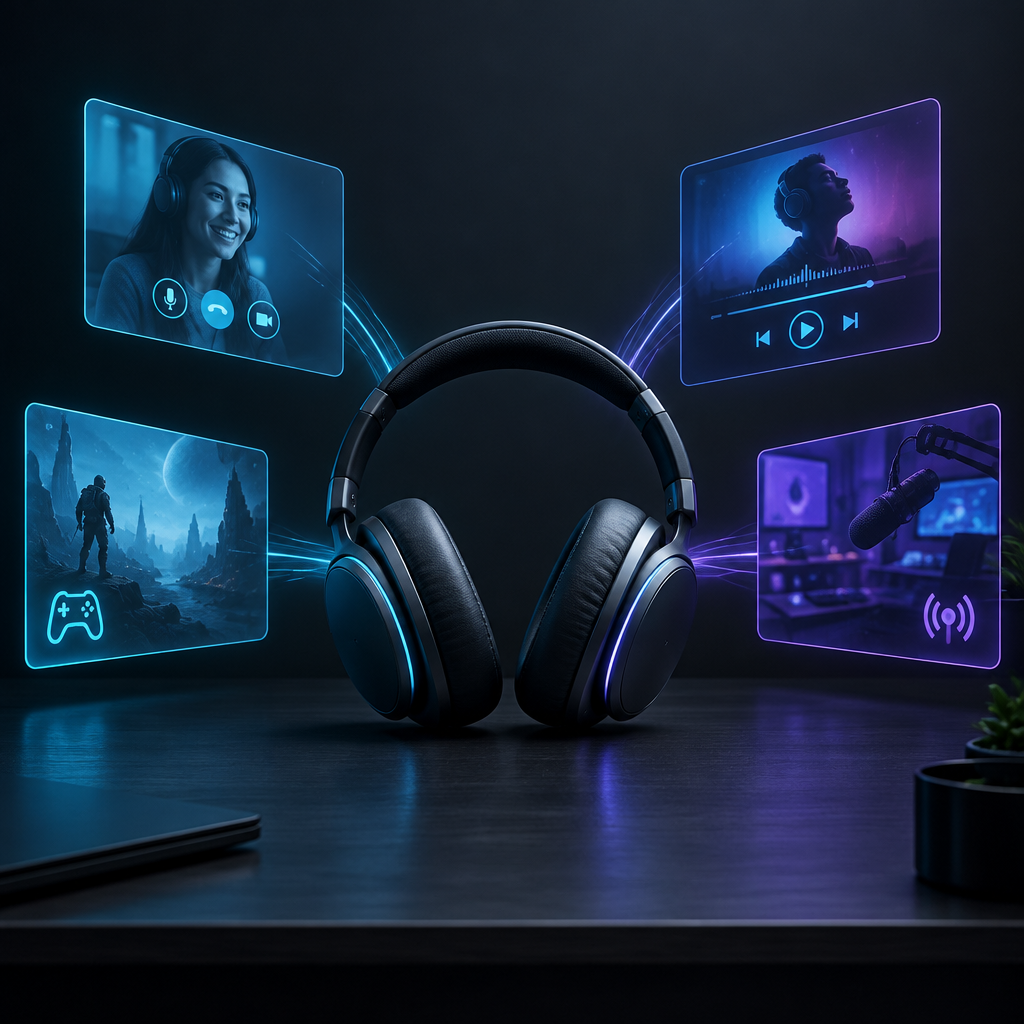
The result is a future in which headphones are not only personal music players. They become adaptable audio endpoints for games, televisions, classrooms, airports, museums, and live events.
The old Bluetooth audio bargain
Classic Bluetooth audio generally relies on the Advanced Audio Distribution Profile, or A2DP. A source such as a phone takes the original audio, compresses it with a codec such as SBC, AAC, or another optional format, then sends the result over a Bluetooth Classic link. The headphones decode the stream and turn it back into sound.
This arrangement works remarkably well, but it carries historical baggage. The protocol was designed around a continuous connection between one source and one sink. Stereo audio is commonly treated as one combined program. If a manufacturer wants lower delay, better resilience, or longer battery life, it often has to work around assumptions that were never designed specifically for modern earbuds and headphones.
LE Audio starts with Bluetooth Low Energy, but it is not merely an audio application poured into an older pipe. It uses a new architecture built around isochronous communication. Isochronous channels reserve the timing needed for periodic audio packets, giving the system a predictable rhythm without requiring every packet to arrive perfectly or be retransmitted forever.
That distinction matters. Audio is time-sensitive data. A missing packet may create a brief defect, but a packet that arrives too late is often useless. LE Audio can make an informed choice between retransmitting a packet, concealing the loss, or moving on to the next frame.
LC3 is designed for imperfect radio conditions
At the center of LE Audio is the Low Complexity Communication Codec, better known as LC3. Calling it a replacement for SBC is accurate, but incomplete. LC3 is designed to maintain useful audio quality across a range of bit rates while keeping the computational burden modest.
That gives headphone designers more room to choose. A product can spend bits on fidelity when the radio environment is clean. It can reduce the bit rate when interference increases, preserving the connection and saving power. The codec can also operate with smaller audio frames, which helps reduce the time between capture, encoding, transmission, decoding, and playback.
Lower complexity does not mean lower ambition. The engineering target is graceful degradation. A wireless link is not a studio cable, and the best codec is not the one that sounds perfect for three seconds before collapsing when the listener walks behind a concrete pillar. A codec that remains intelligible and stable at a sensible bit rate often creates a better real-world experience than a more demanding codec that needs ideal conditions.
LC3 also gives packet-loss concealment a more important role. When a packet disappears, the decoder can estimate what the missing audio should resemble based on nearby frames. It cannot recreate the exact lost waveform, but it can prevent a small radio problem from becoming an obvious click or hole in the music.
Two headphones, two streams
One of LE Audio's most meaningful changes is multi-stream audio. Instead of treating a pair of headphones as a single stereo endpoint, a source can coordinate distinct streams for the left and right sides.
This sounds like a minor implementation detail. It is not. Separate streams can improve synchronization between the two sides and simplify the path to features such as independent volume control, spatial rendering, and more flexible device behavior. The source knows that it is managing a coordinated pair rather than blindly sending one block of stereo information into a black box.
Multi-stream designs may also improve the handoff between devices. A headphone system that understands its left and right components as related but individually addressable endpoints has more options when one side is removed, reconnected, or used for a phone call. The user does not need to think about any of this, which is the point. Good radio engineering disappears into ordinary behavior.
There is a tradeoff. More flexible coordination creates more opportunities for manufacturers to implement things inconsistently. A phone, operating system, and headphone firmware may all support portions of LE Audio without exposing the same features to the user. The logo on the box tells only part of the story. Actual compatibility depends on profiles, operating-system support, firmware, and the exact job the listener wants to perform.
Latency becomes a product decision
Bluetooth audio delay has been tolerated because music hides it. A song can be late relative to a tap on the phone and nobody notices. Video is less forgiving. Games are harsher still. When an on-screen action and its sound arrive at visibly different times, the headphones feel disconnected from the world.
LE Audio can reduce the delay by using more efficient framing and a transport designed for scheduled audio. LC3 can operate with short frames, while the system can tune buffering and retransmission behavior for the application. The lowest possible latency is not always the best choice, because smaller buffers leave less room for radio interference. The useful goal is a stable delay that does not suddenly balloon.
For gaming headphones, that creates a more interesting design space. A manufacturer can favor rapid delivery during interactive play, then increase resilience during a movie or switch to a higher-quality mode for music. Whether products actually expose those choices will depend on operating systems and vendor software, but the underlying architecture makes the compromise more deliberate.
There is no magic setting that eliminates physics. Radio packets still need time to travel. Audio still needs to be encoded and decoded. Noise cancellation and spatial processing add their own stages. LE Audio simply gives engineers a cleaner set of levers instead of forcing every use case through one inherited pipeline.
Auracast turns headphones into broadcast receivers
The most visible change may come from Auracast, Bluetooth's broadcast audio capability built on LE Audio. Traditional Bluetooth audio usually asks a source to establish a private connection with a listener. Auracast changes the question to this: what if an audio source could transmit a program that many compatible headphones may discover and join?
Imagine a television in an airport lounge. Rather than pairing with one person, it can advertise an audio broadcast. Travelers wearing compatible headphones could select that broadcast, much like choosing a Wi-Fi network. A museum could offer alternate-language narration. A classroom could stream a teacher's microphone. A stadium could transmit commentary or assistive listening audio without handing out proprietary receivers.
Technically, the broadcast is not an unlimited free-for-all. The source advertises information about the stream, including details needed for a listener to identify and decode it. Public broadcasts can be open, while private broadcasts may use encryption or an access code. Discovery and joining must be simple enough for ordinary people, otherwise the feature remains a trade-show demonstration rather than infrastructure.
Auracast also has implications for accessibility. Hearing assistance has often depended on dedicated systems installed in particular venues, with specialized receivers that visitors may not carry. If public spaces adopt standardized Bluetooth broadcasts, a person's own headphones or hearing devices could become the receiver. The benefit is not just convenience. It can reduce the social friction of asking for equipment and make assistive audio feel like a normal feature of the environment.
Why adoption will be uneven
New Bluetooth features rarely arrive as a clean switch from old to new. Phones may support LE Audio while a particular laptop does not. Headphones may advertise LC3 but omit broadcast reception. A television may transmit Auracast but provide a confusing setup screen. Some devices will support the radio capability only after a firmware update, while others will never receive one.
Battery behavior will vary too. LE Audio can be more efficient, but the final result depends on antenna design, radio scheduling, codec settings, digital signal processing, and how aggressively a manufacturer tunes sleep states. A product with impressive theoretical efficiency can still have mediocre endurance if its noise cancellation processor or spatial audio engine dominates the power budget.
There is also a naming problem. Consumers understand stereo, wireless, and noise cancellation. They do not necessarily know whether LC3, LE Audio, and Auracast refer to the same thing. They do not. LE Audio is the broader audio system, LC3 is its baseline codec, and Auracast is a broadcast use case built on that system. Clear product labeling will matter as much as technical capability.
The headphone is becoming an audio interface
The deeper story is that headphones are shifting from passive endpoints into programmable audio interfaces. They still play music, of course, but their relationship with the source is becoming more flexible. They can receive independent streams, adjust to radio conditions, prioritize timing, and subscribe to broadcasts that were never paired with them individually.
That shift may change what buyers value. Battery life will remain important, but so will reliable switching between phones, computers, televisions, and public broadcasts. A headphone that sounds excellent yet cannot join a venue's audio system may feel less capable than one with slightly less exotic hardware and much better interoperability.
LE Audio will not make every pair of headphones sound better automatically. It will not repair poor acoustic tuning, weak microphones, bad ear pads, or careless firmware. What it does is give designers a more suitable foundation for the way people actually use wireless audio now, with several devices, crowded radio environments, real-time media, and a growing expectation that sound should follow them without friction.
The next generation of headphones may therefore be judged less by the codec badge printed on the package and more by how gracefully they handle the world around them. One listener, one television, one lecture hall, one broadcast. The headphones will not just connect to sound. Increasingly, they will choose how sound reaches us.