How Bluetooth 6.0 Channel Sounding Could Make Headphones Genuinely Location-Aware
Bluetooth headphones have been guessing where your phone is for years. They do it with RSSI, received signal strength indicator, a number that tells the headset roughly how loud the radio signal seems to be. The estimate is crude. Walk a few paces and the signal strength bounces around like a seismograph during a minor tremor. Walls, bodies, microwaves, and even the headphones' own housing shift the reading. Yet this is the measurement that decides when your headphones connect, when they hand off to a laptop, and sometimes when they disconnect entirely.
Bluetooth 6.0 introduces something called Channel Sounding. It is easy to mistake this as a feature for car keys and luggage tags, because the Bluetooth SIG has spent most of its messaging on Find My devices and digital lock security. But Channel Sounding is a distance measurement system, and distance is the missing variable in almost every awkward headphone handover you have ever experienced.
Why RSSI has been hiding the real problem
Received signal strength is a proxy. You cannot measure distance from signal strength without making assumptions about the environment, and those assumptions fail constantly indoors. A phone sitting 30 centimeters from your headphones behind a couch cushion can look identical to a phone three meters away in the same room. The signal attenuates differently depending on whether the obstacle is drywall, a human torso, or a refrigerator door.
Headphone firmware deals with this ambiguity by applying thresholds and timeouts. If RSSI stays above a certain level for a certain duration, the headset assumes the phone is close enough to pair or switch. If it drops below another threshold, the headset assumes the phone has left. Those rules work most of the time. The failures are the ones you remember: headphones that refuse to connect when the phone is in your pocket, or headphones that switch to a laptop the moment you walk past your desk without sitting down.
The problem is not that engineers are lazy. They are working with a signal that genuinely cannot distinguish "close and blocked" from "far and clear." Channel Sounding was built to close that gap.
Two ranging methods, working in parallel
Channel Sounding does not rely on signal strength. It uses two distinct techniques, and the combination is what makes it durable.
The first is phase-based ranging, or PBR. The initiating device transmits a radio signal to the receiving device, which reflects it back. This happens across a sweep of frequencies. The distance between the two devices shifts the phase of the returned signal in a predictable way: a higher frequency produces a different phase shift than a lower one, and the pattern of those shifts encodes the physical separation. Stack enough frequency measurements and you can solve for distance with sub-meter precision. Early implementations are already reporting accuracy in the range of plus or minus 20 centimeters, according to the Bluetooth SIG.
The second technique is round-trip time, or RTT. The initiator sends cryptographically scrambled packets; the reflector returns them; the system measures how long the exchange took and divides by the speed of light. RTT is not as precise as PBR on its own, but it serves a different purpose. It is a secure distance bound. An attacker cannot simply replay a strong signal from nearby to make a far-away device appear close, because the travel time would give away the actual distance. This defeats the relay attacks that have plagued keyless entry systems, and it gives headphone manufacturers a cryptographic guarantee that the source device is where it claims to be.
Neither method would be convincing alone. PBR gives accuracy. RTT gives trust. Together they turn a noisy guess into a measured fact.
What centimeter-level distance could mean for headphones
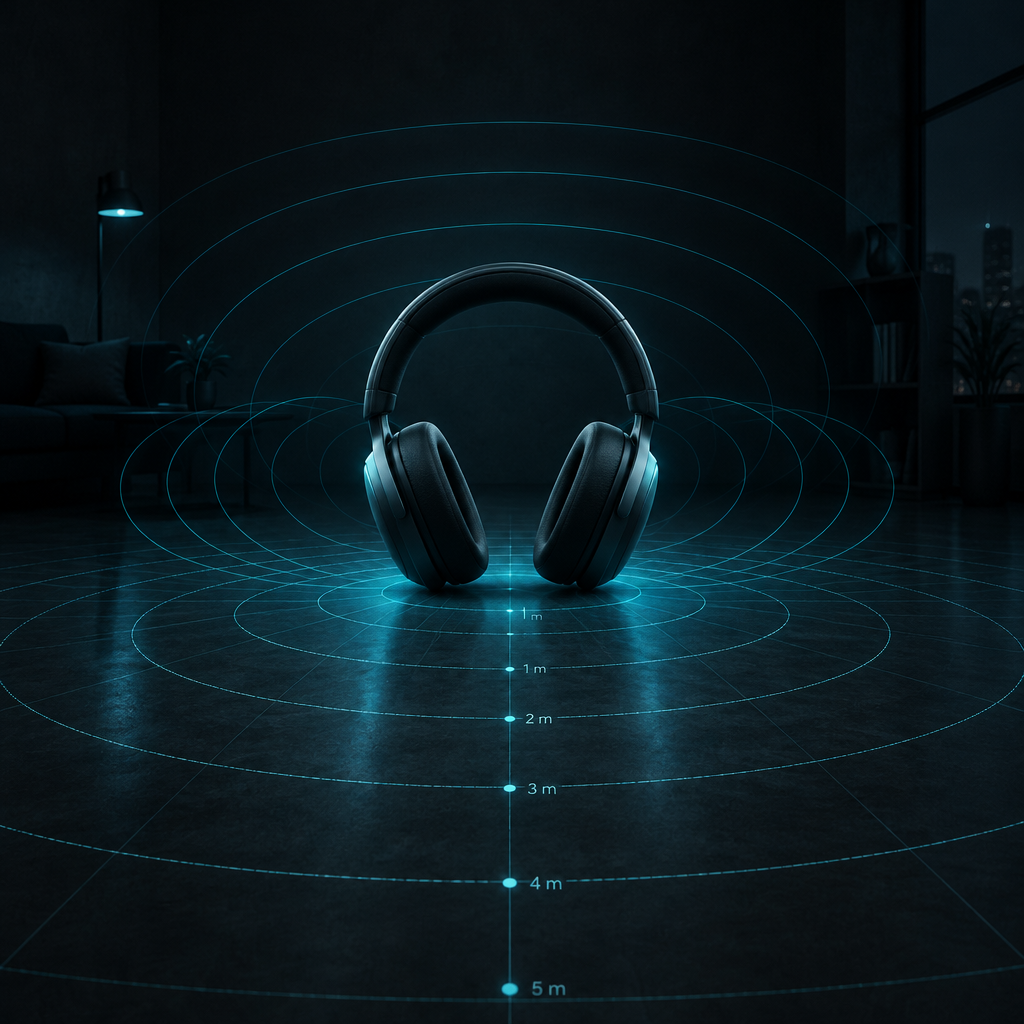
Imagine walking into your office with headphones on. Your phone is in your pocket, your laptop is on the desk, and your tablet is charging on the shelf behind you. Today your headphones might pick the laptop because RSSI happened to be high after you set the phone down, or they might stubbornly cling to the phone because the laptop is not in the paired cache. With Channel Sounding, the headphones could measure the actual distance to each source. The phone is 40 centimeters away. The laptop is 60 centimeters. The tablet is 2.4 meters. The choice becomes geometric instead of probabilistic.
The implications extend beyond device switching. Proximity could gate features that currently require manual toggles. Headphones sitting on your desk, one meter from the phone, could enter a low-power standby mode because the distance sensor confirms nobody is wearing them. Move them to your ears and the distance drops to near zero; the sensor triggers wake. No infrared proximity sensor needed, no accelerometer heuristic, no touch panel. The Bluetooth radio that is already running handles it.
There is also a security story. Relay attacks against Bluetooth pairing have been a known vulnerability for years. An attacker relays the pairing handshake from a victim device to an attacking device, making them appear adjacent when they are not. RTT makes that trick visible, because the relay introduces measurable latency that the distance bound exposes. Headphones that verify proximity via Channel Sounding before completing a pairing handshake would be significantly harder to fool.
Room awareness and the spatial audio connection
Channel Sounding measures distance, not angle. Bluetooth separately supports direction finding through antenna arrays and angle-of-arrival or angle-of-departure calculations. Combine the two and a headphone could know not just that a source is near but where it sits relative to the listener.
That matters for spatial audio. Current head-tracking implementations rely on inertial measurement units inside the headphones. These sensors track head rotation but lose absolute position over time due to drift. They do not know where the speaker is in the room. Distance and direction from a Bluetooth source could anchor the virtual soundstage. The headphones could compensate for head movement with a reference point that does not drift, because it is measured rather than integrated.
This is speculative. No product ships with this combination yet. But the specification makes it possible, and the incentives line up. Spatial audio is one of the strongest selling points for premium headphones, and the IMU-only approach has well-known limitations that a radio-based reference could address. A drift-free anchor would let headphones maintain a stable soundstage during long listening sessions, where today the virtual speaker positions slowly creep as sensor error compounds. Gamers and film viewers would feel the difference first; music listeners might never notice until they try walking around a room with the audio fixed in place.
The uncomfortable catch
Channel Sounding requires a new physical layer and protocol stack. In practice that means new silicon. The Bluetooth SIG is explicit about this: existing devices generally cannot be upgraded via firmware, because the feature needs hardware support at the integrated circuit level. Headphones you own today will not gain Channel Sounding through a software update.
The chipset ecosystem is moving. Silicon Labs, Nordic Semiconductor, NXP, and others have announced or are shipping Channel Sounding compatible Bluetooth LE SoCs. The first consumer products to use the feature are appearing in 2026, primarily in Find My accessories and smart locks. Headphones will follow, but the integration cycle for audio products is slower. The analog front end, the DSP, the codec stack, and the Bluetooth controller all need to coordinate, and distance measurement adds processing load that competes with audio rendering for battery and compute budgets. A hearing aid manufacturer that already optimizes for microwatt-level power draw might find this easier than a consumer headphone brand trying to keep a 40-hour battery claim intact.
The other question is whether headphone manufacturers will choose to implement it. Channel Sounding is optional within the Bluetooth 6.0 specification. A product can claim Bluetooth 6.0 compliance without supporting Channel Sounding at all. Shoppers who want the feature will need to look for explicit mentions, not just the version number.
What to watch for
If you are buying headphones in 2026 or 2027, Channel Sounding is unlikely to be a headline feature on the box. It will show up first in indirect improvements. Smarter device switching that actually works. Fewer false disconnects. Pairing that resists relay attacks. Look for manufacturers who describe "secure proximity pairing" or "distance-aware switching" in their spec sheets.
The deeper question is how long it takes for a Bluetooth feature to become a baseline expectation rather than a premium differentiator. Bluetooth LE Audio took several years from specification to meaningful product availability. Channel Sounding will follow a similar curve, but the payoff for headphones is more specific and more immediately felt than most protocol upgrades. Distance is the variable that headphone firmware has been trying to infer for a decade. For the first time, the radio can measure it directly.