The first Bluetooth specification arrived in 1999 as a solution to the cable problem. Wireless, short-range, license-free. Point-to-point audio from a phone to a headset. Simple. For twenty-five years, it worked.
But simplicity has limits. A single headphone pair can talk to your phone from maybe 240 meters in open air, less through walls, less still in a city with ten thousand other radio transmitters fighting for the same 2.4GHz band. You can't link two pairs of headphones to play the same song simultaneously without audio lag that would make a movie unwatchable. And if someone walks out of range, the connection drops cold.
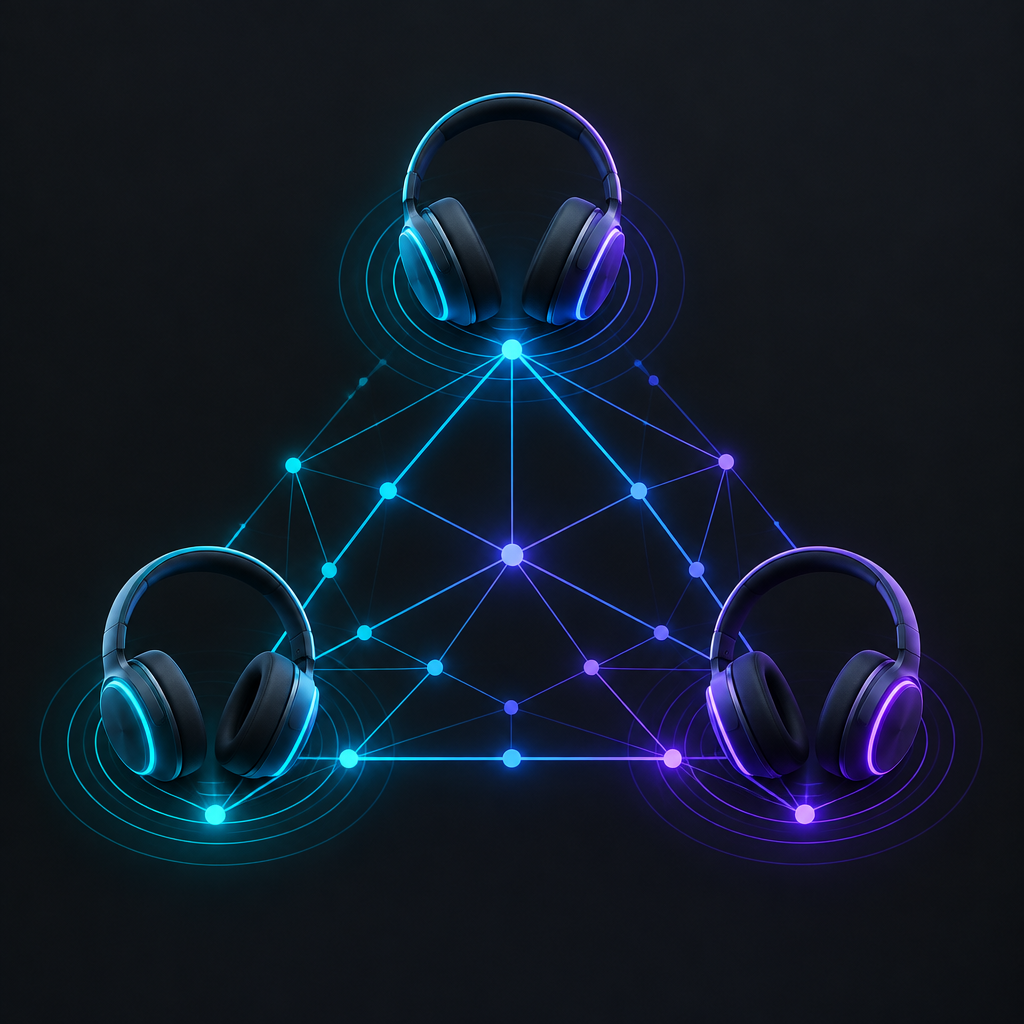
Bluetooth 5.4, finalized in 2024 and shipping now in flagship chipsets, changes this with a single architectural addition: mesh networking. Headphones can now relay through other headphones. Multiple pairs can form an ad-hoc network where every device is both a speaker and a relay point. A single phone can address dozens of headphones and coordinate playback. The range is theoretically unlimited because devices pass the signal hand-to-hand until it reaches its destination.
This isn't just a spec upgrade. It's a category redesign for wireless audio, and it unlocks use cases that couldn't exist under the old point-to-point model.

The limits of point-to-point Bluetooth
Classic Bluetooth (or "Bluetooth Classic," the narrow-bandwidth audio profile most headphones use) operates on a master-slave architecture. Your phone is the master. Your headphones are the slave. Data flows one direction: the phone decides what gets sent, and the headphones receive it. If a second pair of headphones wants the same audio, the phone has to establish a second independent connection, which it can do, but synchronization between the two connections is a software problem, not a hardware one. The tiny latency differences between two separate Bluetooth links compound, creating the lip-sync lag that makes watching video or gaming unplayable.
Range extends with antenna design and radio power, but the limit is physical. A 1-milliwatt Bluetooth Classic transmitter can reach about 240 meters in ideal conditions; open air, no interference, line of sight. Urban environments, offices, apartment buildings, and metal structures all degrade this dramatically. Walls cut the range in half. Dense RF interference cuts it further. Most people experience effective Bluetooth range of 20 to 50 meters indoors, which is fine for a single device used in a home, but useless for a stadium, a hotel, or a park.
Bluetooth Low Energy (BLE), introduced in 2010, solved power efficiency but kept the point-to-point model. BLE headphones drain batteries slower, which is why fitness trackers and smart rings use it. But BLE's narrow bandwidth makes it unsuitable for high-fidelity audio without proprietary compression; most consumer audio still uses Bluetooth Classic.
For two decades, this was the tradeoff you accepted. You got wireless, you got freedom from cables, and you lived with the range limit.
How Bluetooth 5.4 mesh rewires the architecture
Mesh networking is not new. WiFi mesh systems have existed for a decade. Zigbee, a competing wireless protocol for smart homes, has had mesh since 2003. But consumer Bluetooth never had it, and that was a choice, not a limitation. The Bluetooth SIG (the standards body) considered mesh a feature that belonged in IoT and industrial use, not consumer audio.
Bluetooth 5.4 changes that. The specification now includes a full mesh layer that sits between the radio (the PHY layer) and the application. Any Bluetooth 5.4-capable chipset can participate in a mesh network. Devices broadcast and relay frames across the 2.4GHz band, each transmission hopping to a new frequency to avoid interference. Messages are encrypted so other networks can coexist without collision. The mesh algorithm uses a self-healing topology, where if a relay node disappears, the remaining nodes automatically route around it.
For headphones, this means transforming from isolated point-to-point devices into nodes in a distributed network. A pair of headphones isn't just a receiver anymore; it's also a repeater, a router, and potentially a source.
The first practical outcome is range extension. A user at the far end of a house, beyond the 240-meter Bluetooth limit, can still receive audio if another device is closer to the source and willing to relay. In a stadium or outdoor festival, relay nodes could be distributed so that no seat is out of range. In a hotel, the WiFi-connected mesh controller could forward audio to mesh-enabled headphones throughout the building.
The second outcome is true synchronous multi-device playback. Multiple headphones can receive the exact same audio stream simultaneously because the mesh layer coordinates timing. All devices sync to the same clock. Lip-sync lag disappears. A family watching a movie together on separate headphones could hear perfectly in sync; an instructor teaching a fitness class could send an audio feed to dozens of participants' headphones, all playing at the same millisecond.
The third outcome is device flexibility. Headphones in a mesh no longer need to pair exclusively with one phone. Instead, a phone (or any source) broadcasts an audio feed to the mesh, and any headphone in range can tune in. Group listening becomes a solved problem. Pass the song to a friend's headphones by moving closer; no re-pairing, no menu navigation, just proximity-based audio sharing.
Why this matters for audio
Mesh networking is fundamentally a relay architecture. It works because many devices is better than one. A single point-to-point link fails if either end is out of range; a mesh survives because there are always alternate paths. But mesh adds complexity to the chipset, power consumption to each device (relaying burns battery), and software overhead to manage the topology.
For headphones, the tradeoff is worth it. Headphones are used in the same acoustic space as their source (your ears are within 5 meters of your head), so they rarely need to relay for their own audio. But they can relay for others, which multiplies the utility of the network. The power cost is manageable; Bluetooth 5.4 mesh protocols are power-optimized for wearables. And the software overhead is increasingly abstracted by chipset vendors like Qualcomm and Broadcom, who bundle mesh stacks as part of their Bluetooth modules.
The bigger picture is ecosystem change. Mesh makes wireless audio devices less isolated. Your headphones can coordinate with your friend's headphones, your car's audio system, a Bluetooth speaker in the next room. The entire 2.4GHz space becomes a potential network of audio nodes instead of a collection of separate point-to-point links.
This is the same inflection point that happened to WiFi a decade ago when mesh systems became standard in consumer routers. Users stopped thinking of WiFi as a single base station and started thinking of it as a space they move through, with continuous coverage. Bluetooth headphones are about to go through the same shift.
When Bluetooth 5.4 mesh headphones arrive
Bluetooth 5.4 was finalized in November 2024. The first chipsets shipped within weeks. But shipping a chipset and shipping consumer products are different timelines. A headphone manufacturer has to redesign the firmware, test the mesh implementation, validate power consumption under mesh relay load, and set up the supply chain. Expect the first Bluetooth 5.4 mesh headphones in late 2025 or early 2026.
The initial products will be premium. Mesh support requires a newer radio module, which costs more. Early adopters will pay a premium for the feature. But as the feature cascades down to mid-range and budget models (usually 2-3 years after premium), mesh will become standard for any Bluetooth headphone that wants to stay current.
The catch; mesh only works if other devices in your environment also support it. A single pair of Bluetooth 5.4 mesh headphones doesn't gain the benefit of mesh if there are no other mesh devices to relay through. This is the classic cold-start problem for any new network technology. It solves itself slowly, as more headphones, speakers, and devices get mesh support, the value of ownership increases for everyone. Once critical mass is reached, it becomes a feature people expect, and then demand.
We're at the moment before critical mass. The specification exists. The chipsets exist. The first products are in early engineering. The mesh revolution in wireless audio hasn't happened yet, but the foundation is being poured.