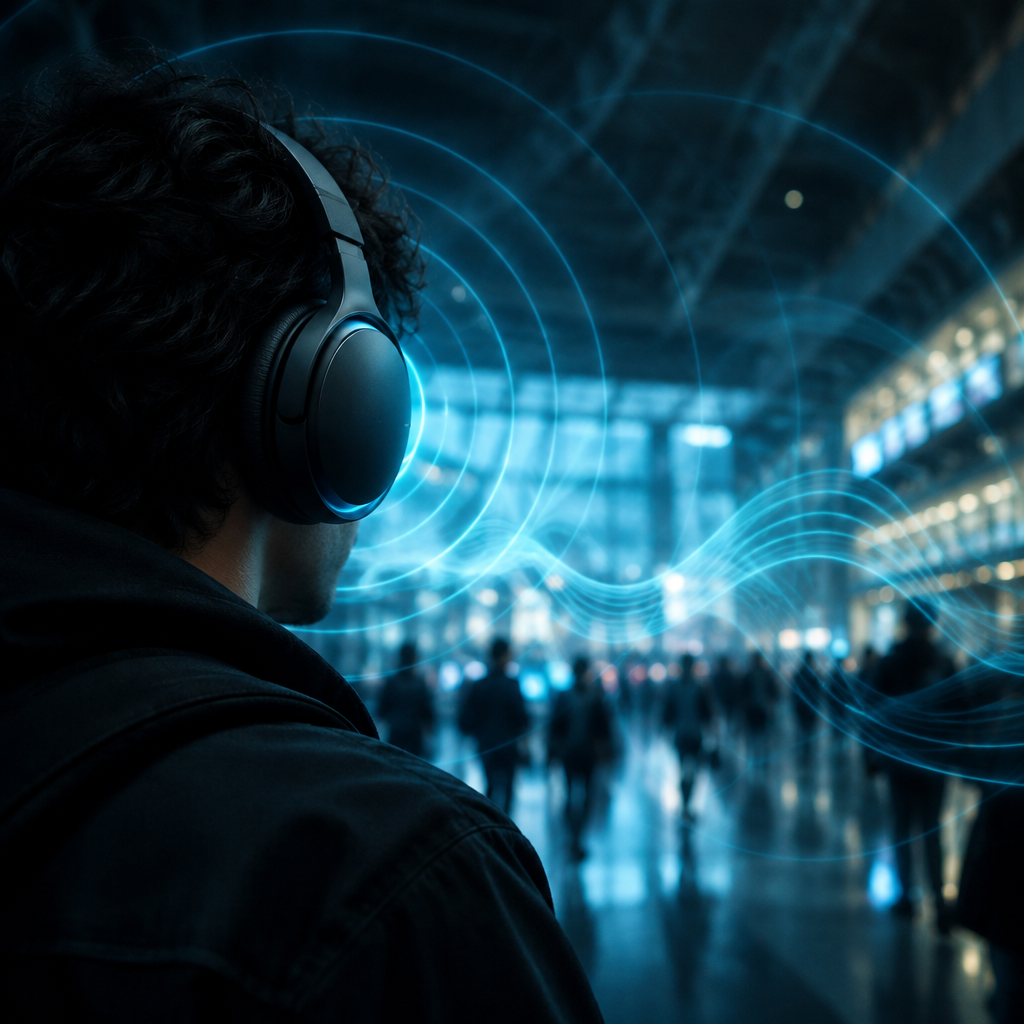
You are at an airport gate. Four televisions hang from the ceiling, all muted. A departures board flickers overhead. Someone two seats over is watching a phone with the volume cranked loud enough to share with the entire concourse.
What if you could just tune in?
Auracast broadcast audio, the Bluetooth LE Audio feature that lets a single transmitter push audio to an unlimited number of receivers, is doing exactly that. Not in some prototype lab. In real venues, on real headphones, right now in 2026. The Sydney Opera House has it. The Marriott Theatre in Illinois has it. Bristol Temple Meads railway station has it. And the number of installations is growing fast enough that the Bluetooth SIG compares the trajectory to the early spread of public Wi-Fi.
How Broadcast Audio Actually Works
Traditional Bluetooth audio is a point-to-point affair. Your phone pairs with your headphones, establishes a connection, and streams audio over a dedicated channel. Two devices, one link. If someone else wants to listen, they need their own pairing session.
Auracast throws that model out entirely. Instead of connecting, it broadcasts.
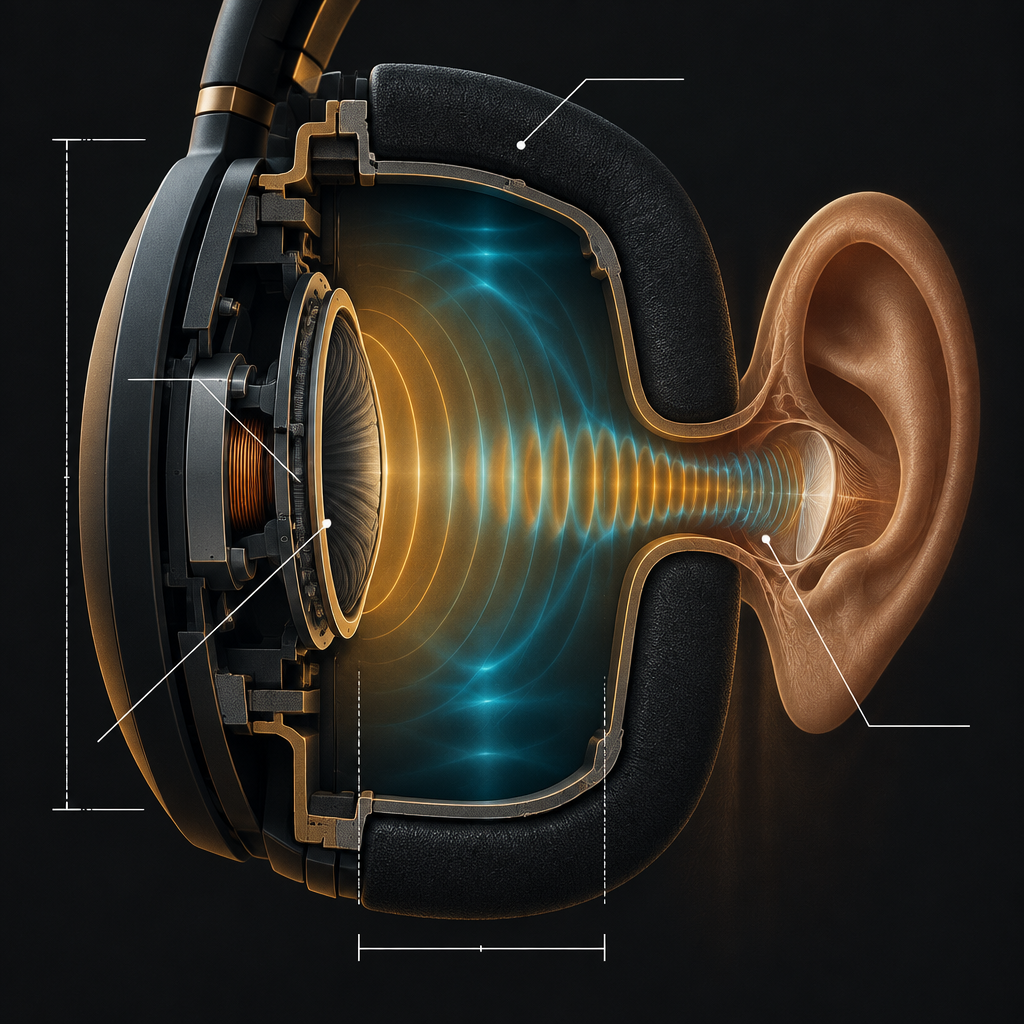
The technical architecture rests on two structures defined by the Bluetooth LE Audio specification: Broadcast Isochronous Streams, called BIS, and the containers that hold them, called Broadcast Isochronous Groups, or BIG. A single Auracast source encodes audio using the LC3 codec, wraps it in one or more BIS streams, bundles those streams into a BIG, and transmits the whole package as an open broadcast on the 2.4 GHz band. Any compatible headphone within range can receive it. No pairing handshake. No device limit. No authentication exchange between transmitter and receiver.
The isochronous part matters. Isochronous streams guarantee time-bound delivery, meaning every receiving headphone gets the audio at the same moment. If 200 people in a concert hall are listening to the same Auracast broadcast, their headphones are all playing the same note at the same millisecond. There is no drift, no echo, no cascading delay as more devices join.
This is fundamentally different from classic Bluetooth, which uses asynchronous connections optimized for data transfer, not real-time synchronization. The shift to isochronous channels is what makes broadcast audio viable for live events where timing is everything.
Contrast this with unicast LE Audio, which uses Connected Isochronous Streams, or CIS, within Connected Isochronous Groups, called CIG. CIS requires a dedicated connection between source and each receiver. BIS does not. That distinction is the entire reason Auracast can scale to unlimited listeners without the transmitter breaking a sweat. The transmitter does not track who is listening. It simply sends, and whoever wants to tune in, does.
The Discovery Problem
If no pairing is required, how do your headphones know which broadcast to listen to? A venue might have a dozen Auracast streams running simultaneously: one for the main audio, one for Spanish language interpretation, one for descriptive audio for visually impaired attendees, one for a backstage feed.
Bluetooth LE Audio solves this with the Broadcast Audio Scan Service, known as BASS. BASS allows a receiving device, typically your phone acting as a Broadcast Assistant, to scan for nearby Auracast broadcasts and present them to you as a list. You pick one, and your phone hands the connection details to your headphones. The headphones then tune in to that specific BIS within the BIG.
Think of it like tuning a radio. The broadcast is always there, filling the room. Your phone is the dial. Your headphones are the speaker. You select the station; the audio starts flowing.
In practice, Samsung has built this discovery flow directly into its Galaxy devices. A Galaxy S25 running Android 16 can detect nearby Auracast broadcasts and display them in a unified interface. Samsung has also integrated Auracast broadcast controls, letting users start their own broadcasts from their phone microphone, which is useful for guided tours or small group listening.
Why Headphones Are the Killer Device
Hearing aids were the first Auracast devices to market, and for good reason. Replacing the aging hearing loop induction technology in public venues is a massive accessibility win. Hearing loops require physical wiring embedded in walls and floors. They only work if you are sitting within the loop's magnetic field. Move to the lobby and the signal vanishes.
Auracast has no such constraint. The broadcast fills the entire venue. A person with hearing loss can sit anywhere, walk to the concession stand, stand in the lobby, and the audio stays with them. The signal is digital, so there is no analog degradation or interference from fluorescent lighting, which has plagued hearing loops for decades.
But headphones are where Auracast reaches scale. Hearing aids serve a specific population. Headphones are universal. When a venue installs an Auracast transmitter, every visitor with compatible headphones benefits, not just those with hearing loss. That universality is what transforms Auracast from an accessibility feature into a public infrastructure upgrade.
Kim Franklin, CMO at Ampetronic and Listen Technologies, frames the shift plainly. The biggest opportunity is societal, normalizing accessible audio everywhere. The transition moves assistive listening from being something for some to simply being better audio for all.
Real Deployments, Real Results
The Sydney Opera House installation is the headline example. GN, the parent company of ReSound hearing aids and Jabra headphones, worked with the venue to deploy Auracast in the Playhouse Drama Theatre and Studio. Patrons can now receive high-quality audio directly to their personal devices from any seat in the house.
The Marriott Theatre, an 800-seat venue in Illinois, deployed Auracast alongside its existing hearing loop. Andrew Bellavia, hearing health advocate and founder of AuraFuturity, reported that the Auracast transmission coverage was remarkably consistent throughout the theatre, including the lobby. The venue now offers seamless audio to patrons whether or not they wear hearing aids.
Sony demonstrated Auracast at the Music Festival for Children and Young People 2025 in Japan, the first concert in the country to use the technology. Children with hearing loss could hear high and low frequency sounds that are usually inaudible to them, and each child could adjust the volume independently on their own device.
At Bristol Temple Meads station in the UK, Southern, Thameslink, and Gatwick Express permanently installed Auracast assistive listening technology for commuters. It was the first deployment of its kind on UK rail.
Which Headphones Can Tune In Today
Here is where the picture gets complicated. Not all Bluetooth headphones support Auracast. In fact, most do not. The feature requires specific hardware and firmware support for Bluetooth LE Audio and the Auracast profile. A headphone box that says Bluetooth 5.3 does not guarantee Auracast compatibility.
As of mid-2026, the devices confirmed to support Auracast include the Samsung Galaxy Buds2 Pro, Galaxy Buds3, and Galaxy Buds3 Pro, along with Samsung Galaxy S24, S25, and S26 smartphones for broadcast discovery. Several Jabra models from the Evolve and Elite lines support it. ReSound and other GN hearing aids have it built in. Sony has added Auracast to select WH-series headphones through firmware updates.
The notable absence is Apple. As of early 2026, iPhones cannot receive or transmit Auracast broadcasts. AirPods do not support the feature. This is a significant gap in the ecosystem, and it frustrates users who expect their premium headphones to work with public infrastructure. Apple has not commented publicly on Auracast adoption plans.
If you are shopping for headphones with Auracast in mind, look for explicit mentions of LE Audio and Auracast on the product page. If you only see Bluetooth 5.3 or 5.4 listed without LE Audio or Auracast, assume it is not supported.
The LC3 Codec: Why It Matters for Broadcast
None of this works without the right codec. Auracast relies on LC3, the Low Complexity Communication Codec, which replaced the SBC codec used in classic Bluetooth audio. LC3 is not just a marginal upgrade. At equal bitrates, it delivers noticeably better audio quality than SBC. At equal quality, it uses roughly half the bitrate, which means half the power consumption and half the spectrum usage.
For broadcast audio, that efficiency is critical. A venue transmitter running multiple simultaneous Auracast streams for different languages needs each stream to be as lean as possible. LC3 makes it feasible to pack several high-quality audio channels into the same 2.4 GHz airspace without them stepping on each other. Fraunhofer IIS, the institute that developed LC3 alongside the Bluetooth SIG, reports that the codec maintains intelligibility at bitrates as low as 160 kbps for stereo, which is remarkable for a wireless broadcast scenario.
The Road Ahead
The Bluetooth SIG projects that Auracast adoption will accelerate through 2026 and 2027 as more venues install transmitters and more headphone manufacturers update their product lines. The market research is striking: the Auracast broadcast audio market is projected to grow at a compound annual rate of over 20% through 2034, driven initially by public venue installations and consumer headphone adoption.
The long-term vision is ambitious. Industry leaders describe a future where public audio access is as common as public Wi-Fi. Airports broadcast boarding announcements directly to your headphones. Museums offer multilingual tours without dedicated audio wands. Gyms silence their TVs and let each member tune in from their own device. Classrooms stream to hearing-impaired students without stigma or special equipment.
Raviv Kramer, director of product and business development at Bettear, sees the technology as fundamentally dignified. Auracast gives people with hearing loss an easy way to access clear audio in places they attend, using their own personal devices. Wherever they sit or stand, they receive high-quality audio directly. No special seating. No loaner hardware. No asking for accommodation.
The technology is real. The deployments are growing. The headphones are arriving. The only question is how quickly the venues around you will switch on.