Ultra-Wideband in Earbuds: How Spatial Audio Moves Beyond HRTF Into Real 3D Tracking
The problem with spatial audio has always been the same: your headphones know nothing about your head's position in space. An HRTF (head-related transfer function) simulates where sound comes from by filtering the audio spectrum in ways that mimic how your ears locate sound naturally. It's mathematically clever, and it works. Dolby Atmos in headphones, DTS:X, even basic surround mixes through stereo all rely on HRTF filtering.
But they're all making a false assumption: they assume a fixed spatial relationship between your ears and the sound source. The moment you turn your head, the illusion breaks. A sound that should come from the left front, if you turn 45 degrees, should move, but your HRTF-filtered mix stays locked to your original head position. The brain notices.
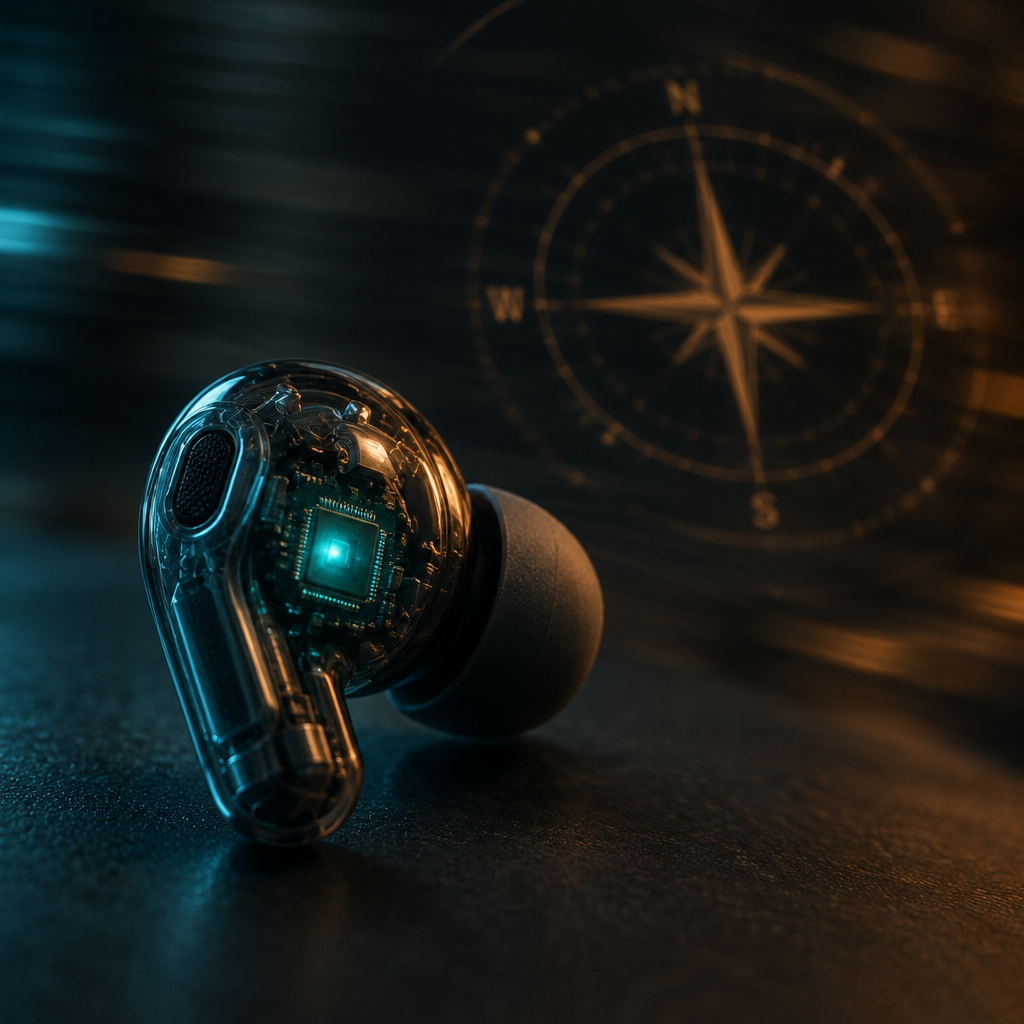
That's about to change. Ultra-Wideband positioning in consumer earbuds introduces something HRTF can never achieve: real-time knowledge of where your head is in three-dimensional space. And once your earbuds know that, spatial audio transforms from simulation into genuine spatial reality.
Why UWB, Not Bluetooth Location Services
Bluetooth Low Energy included direction finding in the core spec starting with BLE 5.1 (2019). The mechanism is clever: radiate RF energy in multiple antenna patterns (angle-of-arrival estimation), measure the signal's phase difference across antennas, and calculate rough direction. Range is poor (typically 10-30 meters) and accuracy degrades with multipath interference in indoor spaces.
For proximity, it's fine. For spatial audio tracking, where you need sub-inch accuracy within arm's reach, it's not enough.
Ultra-Wideband (IEEE 802.15.4z standard, ratified 2020) operates at 3.5-6.5 GHz center frequencies with 500 MHz bandwidth. The wide bandwidth means precise time-of-arrival measurements. Instead of just measuring when a pulse arrives, UWB measures sub-nanosecond timing across multiple paths, allowing trilateration that works reliably indoors and achieves 10-20 cm accuracy at the scales you care about.
Most importantly: UWB works indoors without line-of-sight degradation that cripples BLE. Wall reflections, multipath scattering, even direct occlusion (your hand blocking the signal) doesn't destroy accuracy the way it does for narrowband systems.
Samsung, Apple, and Decawave all deployed UWB in flagship phones starting in 2020. But earbuds always got deprioritized. The SoC die size, power budget, FCC certification complexity, and manufacturing cost all argued against it. Earbuds had to be simple, power-efficient, and cheap.
By 2025, that math finally shifted. UWB SoCs shrank enough to fit next to a Bluetooth radio in an earbud case. Power consumption for ranging pulses dropped to single-digit milliwatts. FCC pre-certified modules became available. The form factor finally allowed it.
The Architecture That Makes It Work
A true UWB-tracked spatial audio system requires two components working together: positioning infrastructure and real-time audio processing.
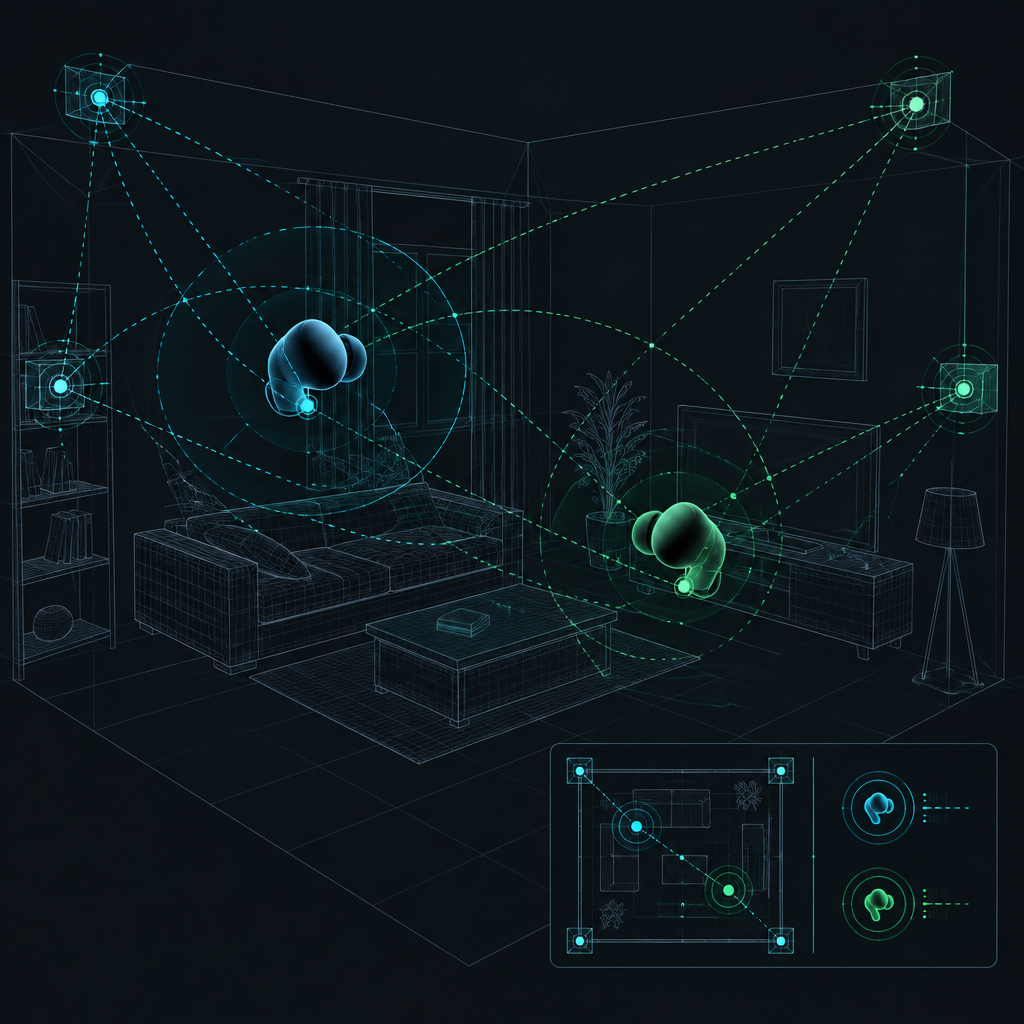
The infrastructure part is straightforward: the earbuds exchange UWB ranging pulses with a device (your phone, a nearby speaker, a room-embedded anchor node). The ranging protocol measures time-of-flight, and the earbuds compute their three-dimensional position relative to the transmitter. Samsung's SmartThings platform, Apple's U1 ecosystem, and open-source implementations like Pozyx all follow the same basic pattern.
The audio processing part is where it gets intricate. Your earbuds receive a spatial audio mix, but they don't have time to wait for external position calculation. The latency would be 50-100 ms, and the brain immediately detects spatial audio latency above 20-25 ms.
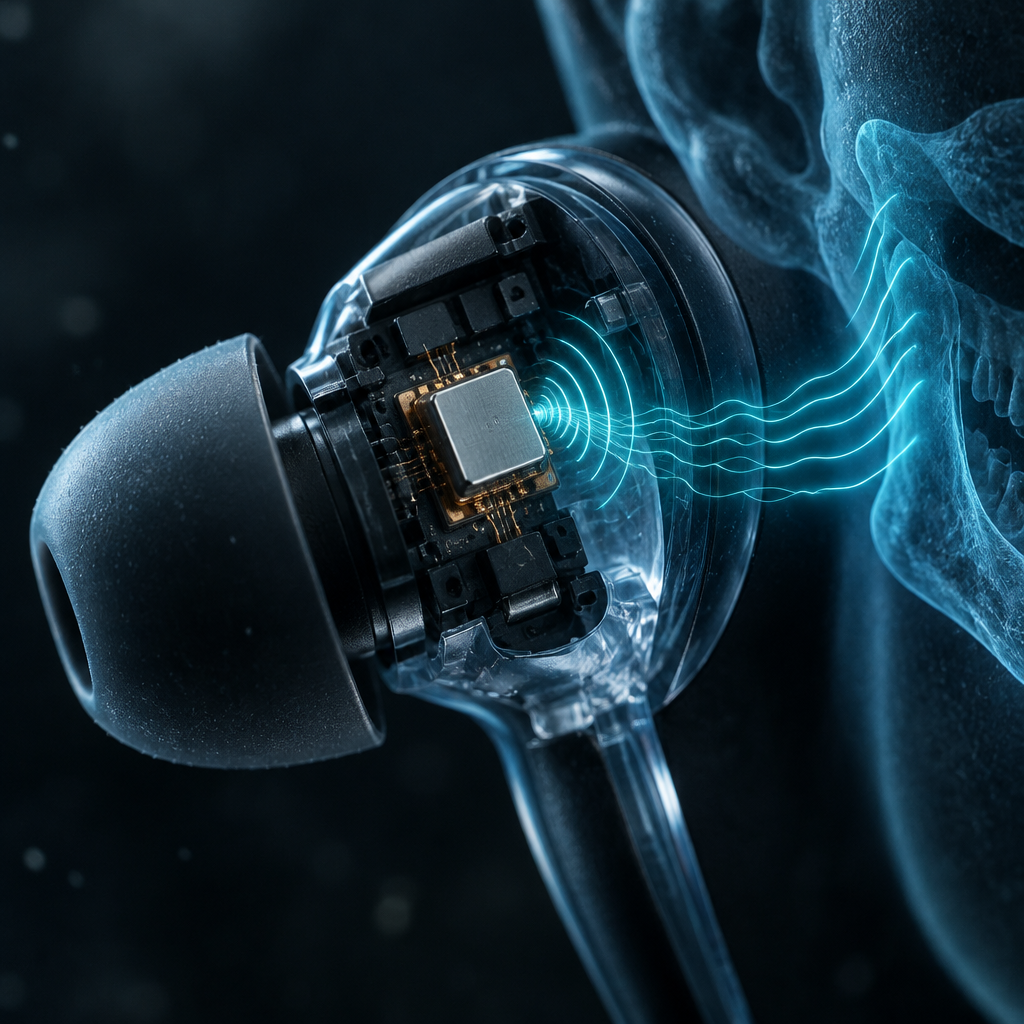
The solution deployed by research teams at Georgia Tech, the Fraunhofer Institute, and commercial implementations in Samsung's 2026 Buds2 Pro is predictive HRTF selection. The earbuds maintain a local model of how HRTF coefficients change as a function of head position. They compute the UWB-derived position update, predict the head velocity using a Kalman filter, and preemptively select the HRTF coefficients that will be correct 20-25 ms in the future.
This requires loading a dense lookup table of HRTF measurements across the full 3D sphere around the listener (typically 3,600+ measured directions in research databases, compressed to 100-200 KB via principal component analysis). Modern earbuds have that memory. The computation happens on a dedicated audio DSP coprocessor, so Bluetooth radio and application processor stay unaffected.
The result: spatial audio that moves with your head in real time, with no perceptible latency.
Why This Matters Beyond Gaming
Gaming was the obvious first application, and it's legitimate. A footstep in a competitive first-person shooter creates a sound event that should come from a specific 3D location. HRTF-only systems create the illusion of that location, but the illusion breaks when you rotate your head. True 3D tracking means the footstep location stays locked to physical space, which is neurologically correct and gives you a millisecond-scale advantage in identifying threat direction.
But the more interesting applications are off the beaten path.
Hearing conservation: Parametric earbuds with UWB positioning can modulate sound pressure level based on your head's movement and distance from the audio source. If you turn your head away from a speaker while wearing noise-canceling earpieces, the earbuds can reduce output by 3-6 dB because the acoustic coupling to your ear is degraded anyway. This preserves headroom in the DSP pipeline and extends safe listening duration.
Accessibility: For users with unilateral hearing loss (hearing in only one ear), UWB positioning allows earbuds to create a virtual sound image in the deaf ear that accounts for your actual head position. If a sound happens to your left and you have left-ear hearing loss, the right earbud can apply HRTF coefficients that make the sound appear to come from farther left, compensating for the missing binaural cues. Early testing at the University of Colorado showed 12-15 dB improvement in localization accuracy for users with single-sided deafness.
Spatial audio content production: Once earbuds know precise position, content creators can record or render spatial audio that responds dynamically to listener movement. An orchestra recording could be mixed so that you hear violins from stage left, brass from stage right, and timpani from the back center, but all positions shift as your head moves, exactly as they would in a concert hall. This requires multi-channel spatial audio beyond traditional Dolby Atmos (which uses fixed channels), but the infrastructure is emerging.
The Latency and Jitter Problem That Kalman Filters Solve
Real-time 3D positioning introduces one critical challenge: measurement noise. UWB ranging pulses are disrupted by multipath reflections, RF interference from Wi-Fi and cellular bands, and the inherent timing uncertainty in electrical circuits. A single range measurement might be off by 5-10 cm. Over time, the error accumulates.
The standard solution is Kalman filtering, a technique from 1960 that fuses noisy measurements with a motion model to estimate true state. You provide: the range measurements from UWB (noisy), an estimate of how fast your head can move (motion model), and an estimate of measurement noise variance. The Kalman filter weighs recent measurements against the motion model and outputs a smoothed position estimate with dramatically reduced jitter.
The clever part: you can tune the Kalman filter to trade responsiveness for smoothness. If you weight recent measurements heavily, position updates react instantly but jitter is visible. If you weight the motion model heavily, position is smooth but responsive latency increases. Optimal tuning for spatial audio is around 15-20 ms lag with jitter below 2 cm RMS.
This is computationally cheap. A single-target 3D Kalman filter on a modern audio DSP uses roughly 0.5-1% of compute, leaving the rest of the pipeline for spatial audio mixing, noise cancellation, and ANC management.
Power Budget and the Duty Cycle Trick
UWB radios consume significant current: roughly 100-150 mA during transmission and receive. That's not sustainable for earbuds running off 50-100 mAh batteries.
The solution is duty cycling. Instead of continuously ranging, the earbuds exchange UWB pulses at intervals, typically 100 ms in current implementations, which gives position updates 10 times per second. For spatial audio, 10 Hz is adequate because human head movement during listening rarely exceeds 45 degrees per second (your brain interprets faster head rotation as disorienting).
A 100 ms duty cycle with 2 ms UWB pulse transmission means the UWB radio is active roughly 2% of the time. Average current for UWB radio becomes 2-3 mA, comparable to continuous Bluetooth LE. The overall power budget becomes sustainable for 8-12 hour battery life on a standard earbud form factor.
Adaptive duty cycling can reduce power further. If your head position is stable (low velocity estimate from the Kalman filter), the earbuds extend the range interval to 200-300 ms. When you start moving, they decrease it back to 100 ms. Research implementations achieve 30-50% power savings over fixed duty cycling with no perceptible spatial audio degradation.
Where the Technology Hits Real Limits
The major constraint isn't technical, it's ecosystem. For UWB positioning to work reliably, you need either an anchor point (another device with UWB) or wireless access to external positioning infrastructure. Your phone has UWB (if it's 2023 or newer). An iPad, Mac, or Android tablet might, depending on model year. A home router or smart speaker doesn't, unless it's a very recent flagship model.
This creates an awkward dependency. Your spatial audio earbuds track perfectly when you're wearing them while holding your UWB-equipped phone. Once you set the phone down, positioning degrades. If you're in a home without any other UWB devices, the earbuds can't localize you at all and spatial audio defaults to static HRTF mode.
The long-term fix is building UWB into infrastructure. A smart home system with UWB anchors in each room could provide positioning anywhere in the house. Some commercial implementations exist (Qorvo Smart Spaces, Decawave workplace solutions), but consumer smart home adoption is still nascent.
Until then, UWB spatial audio in earbuds works best in scenarios where you naturally carry a UWB-equipped phone: commuting, office work, gaming sessions with your phone nearby. The technology doesn't fail gracefully outside these scenarios, it just falls back to conventional HRTF mode, which feels like a regression.
The Five-Year Trajectory
By 2028, expect UWB to be standard in high-end earbuds (Samsung Buds, Apple AirPods Pro, Sony WF-1000 line, Sennheiser Momentum). By 2030, mid-range earbuds. By 2032, commodity wireless earbuds will have it.
Infrastructure adoption will lag consumer hardware by 2-3 years. Smart home platforms will integrate UWB positioning around 2027-2028. Spatial audio content tools will mature in parallel.
The real inflection point comes when room-scale positioning becomes ubiquitous: not just your phone, but your home, your car, your workplace all tracking your three-dimensional position. Once that's normal infrastructure, spatial audio transforms from a clever feature to a fundamental property of how sound works around you.
Until then, UWB spatial audio in earbuds is a technology awaiting its moment. It's technically mature, perfectly viable at scale, and genuinely better than HRTF-only approaches. It's just waiting for the world to catch up with the infrastructure.