Two Sensors, One Voice, and a Bad Geometry Problem
An earbud microphone sits twelve to fifteen centimetres from the corner of your mouth, usually off to the side of it. That number does more damage to call quality than any codec, and the arithmetic is unforgiving: every doubling of distance costs six decibels of direct sound, so the earbud starts twelve to eighteen decibels down before anyone switches on a noise canceller. Point the capsule off axis and you lose more. Turn your head and the loss changes second by second. No better capsule fixes that. A MEMS microphone at 65 dB signal to noise is already excellent; the voice at its port is simply quieter.
So the industry stopped trying to win on the air path alone. Galaxy Buds 4 Pro, detailed by Samsung in June 2026, carries three microphones and a voice pickup unit, a bone conduction sensor bonded to the housing. Timekettle's W4 interpreter earbuds put a bone voiceprint sensor inside a translation product. Different products, one shared premise: your skull is a better microphone cable than the room is.
An Accelerometer Does Not Hear the Room
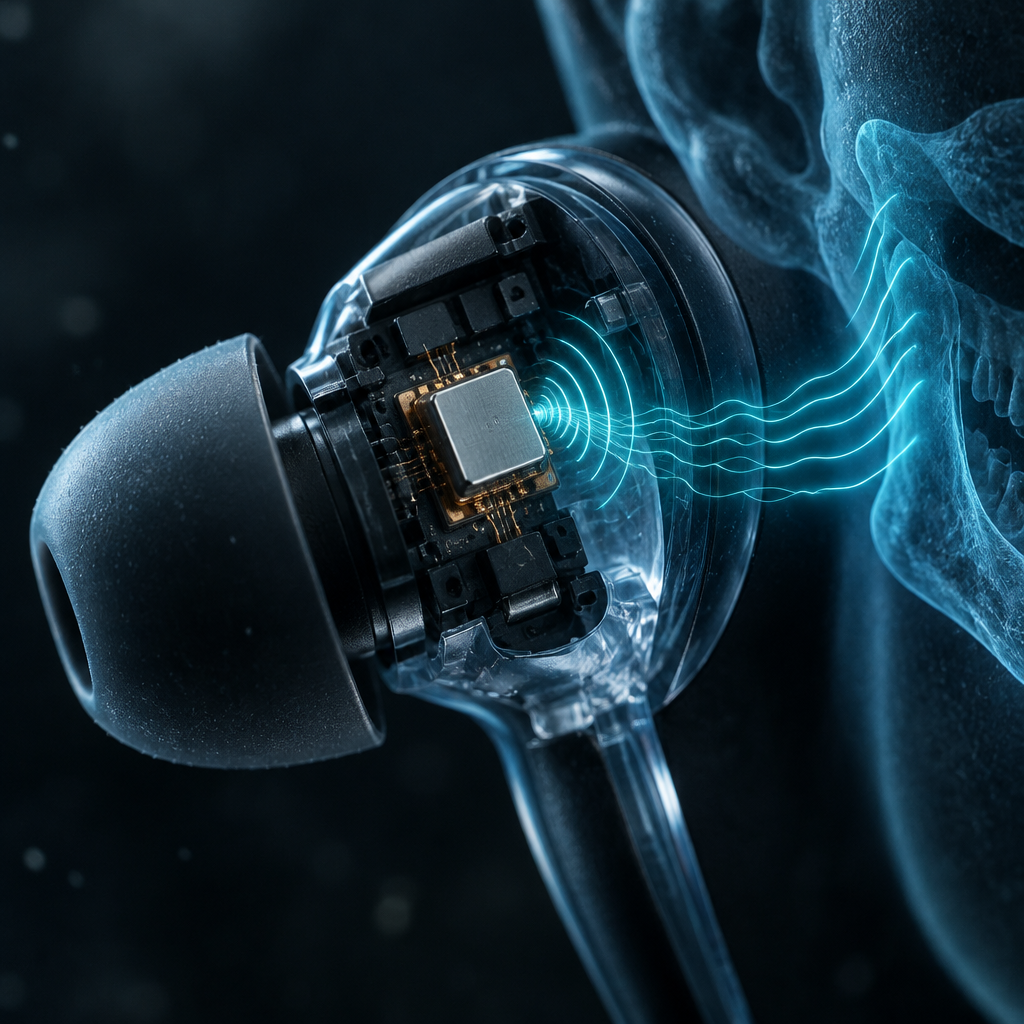
A voice pickup unit is a piezoelectric MEMS accelerometer, small enough to sit behind the driver, rigidly attached to the shell resting against your ear. When you speak, your vocal folds set the skull vibrating. The mandible, the temporal bone, and the cartilage of the ear all move by fractions of a micrometre, and the housing travels with them. The sensor measures acceleration, not pressure.
That distinction is the entire point. Airborne noise is a pressure fluctuation. Wind, a bus, a cafe, a colleague on speakerphone: all pressure. None of it displaces the housing meaningfully, because the housing is clamped to your head, and your head is heavy and indifferent to a 90 dB conversation two metres away. A voice pickup unit produces voice from a room where the microphone path has already surrendered.
Vesper's second generation part shows the scale the industry works at. The VA1210 measures 2.9 by 2.76 millimetres, gains 17 dB of sensitivity over the previous generation, adds 6 dB of signal to noise, and offers a wake on voice mode drawing ten microamps. That last figure matters more than it sounds. A sensor listening at ten microamps can stay awake all day and gate the main processor, rather than the processor waking constantly to check whether anyone spoke.
The Channel Is a Mechanical Low Pass Filter
Now the catch, which is severe. Bone conduction does not carry high frequencies well. The path from vocal folds to housing crosses soft tissue, cartilage, and a joint, and each behaves like a lossy spring. Energy above roughly one to two kilohertz arrives attenuated and smeared.
Speech does not survive that intact. Vowels live below a kilohertz and pass cleanly. The consonants that make speech legible sit between three and eight kilohertz, precisely the band the tissue path filters away. A pure vibration signal sounds like someone talking through a wall in the next room. Every word present, no edges on any of them.
Stephen Xia at Northwestern named the constraint directly: bone conduction is robust against ambient noise but attenuates vocal frequency, degrading intelligibility especially in the higher range. His team's answer, a hybrid transformer and Mamba architecture called TRAMBA, reconstructs the missing band from a single head worn accelerometer. It runs in about five megabytes of memory against roughly 500 for comparable super resolution systems, and improved word error rate in noise by up to 75 percent.
Hold those facts together and the architecture reveals itself. Nobody is shipping a bone conduction phone call. The vibration sensor is not the voice; it is the reference that tells the system where the voice is.
The Sealed Cavity Gives Something Back
One accident of acoustics works in the sensor's favour, and it explains why in ear and open ear designs behave so differently. Plug your ear canal and your own voice turns loud, boomy, hollow. That is the occlusion effect. Bone conducted sound that would normally escape through an open canal gets trapped in a small closed volume, and below about 500 hertz the pressure rises by ten to twenty decibels, with some measurements running higher. A sealed earbud is a closed cavity, and your own low frequency voice gets amplified inside it.
Two consequences follow. The internal microphone Samsung describes, the one detecting speech transmitted within the body, is not sensing your larynx. It is hearing the occlusion boosted low end of your voice inside a chamber, which is a genuine signal. And the ear canal has joined the voice path, so its geometry and the quality of the seal now shape the spectrum the fusion algorithm must invert.
The Silicone Is Doing Two Jobs and Losing One
Here is the tension almost no spec sheet mentions. The tip is acoustic seal and mechanical coupling simultaneously, and those roles want different materials.
A soft, compliant silicone tip seals well and stays comfortable for hours. It also decouples. A soft spring between housing and canal wall attenuates vibration the way any soft spring attenuates anything: preferentially, and worst at higher frequencies. Stiffen the tip and the accelerometer gets a firmer grip on your skull, the seal improves, and ninety minutes later your ear canal hurts.
The vibration path and the acoustic path run in series through one piece of rubber, and every product picks a point on that curve. Open ear clips, which rest on cartilage instead of sealing, get a far lossier mechanical path and a housing fully exposed to wind. Cartilage is floppy, and a clip is not clamped to bone. That is part of why clear calls in the open ear category are harder won than in sealed models, and why the record there is the more interesting claim.
The Sensor Can Hear the Speaker Beside It
The driver and the accelerometer share a housing. The driver moves that housing on purpose, thousands of times a second, at amplitudes far above the micrometre scale of skull vibration. Play something bass heavy and the voice pickup unit sees enormous mechanical energy unrelated to your voice. Chewing, footsteps, and jaw clenching arrive the same way: mechanical, plausible, and not speech.
Manufacturers answer with mechanical isolation and foreknowledge. Music is known, so it can be predicted and subtracted, the way echo cancellation predicts what a loudspeaker sends into a microphone. Your voice is unknown, so it has to be found.
What Sensor Fusion Actually Does With Two Signals
Ignore the marketing phrase and consider what information exists. Air microphones carry the full spectrum plus the full noise field. A vibration sensor carries the low band of your voice, clean, with no airborne contamination.
The useful move is not to blend them. It is to use the vibration signal to make a decision about the air signal. Voicing lives in harmonic structure: a fundamental and a stack of harmonics, regularly spaced, and that structure survives in the bone path after the top band dies. So the system takes pitch and voicing from the sensor, then interrogates the microphones and asks which energy sits on those harmonics and which does not. Noise between harmonics gets attenuated. Noise on them gets kept, briefly, which is why the residual artefact in a good implementation reads as slight roughness on vowels rather than as a robot voice.
That is what Samsung's sixteen times more vocal detail really claims. Not bandwidth. Resolution in the decision.
The Human Variable Nobody Can Spec
Skull thickness varies. Fat and muscle vary. Cartilage stiffness varies. The transfer function from vocal folds to housing differs for every person alive, and the model inverting it must either generalise across all of them or adapt to one.
Xia's team chose adaptation: up to fifteen minutes of the user reading aloud, paired with a clean microphone reference, to fine tune a pretrained model. That is a strange request, and an honest one. The alternative is a model tuned to an average head that fits no actual head. Expect the enrolment step, or a quiet version of it spread across the first week of ownership, in more products.
Reading the Claims With the Bandwidth in Mind
Samsung's Super Wideband figure, up to 16 kilohertz with a Galaxy phone, is a transmission claim. It says the link can carry the band, not that the capture chain produced it. The EVS codec has supported super wideband speech for years from roughly 9.6 kilobits upward, so the pipe has been sitting there while microphone geometry was the bottleneck. Capture is the problem now.
Likewise, a high G-MOS score describes how a listening panel rated what it heard. That is a quality judgement, not a word recognition test, and the two can agree without measuring the same thing.
The honest account of bone conduction voice pickup in 2026 runs like this. It turned the quietest signal in the chain into the most trustworthy one, then discovered that the trustworthy signal holds only a kilohertz of usable spectrum, then spent the compute budget rebuilding the rest from the microphones it was meant to replace. The sensor did not replace them. It taught them where to look.
What that means for you is narrow and practical. On a windy street, a sealed earbud with a vibration sensor holds a structural advantage over one without, because wind is turbulence striking a pressure sensor and the housing does not care. In a quiet room the advantage evaporates. And if a manufacturer advertises bone conduction voice pickup while saying nothing about bandwidth reconstruction, they have described the easy half.