The Number That Should Not Fit
Ninety-eight milligrams. Forty-six cubic millimetres of package. A silicon die you could lose under a fingernail, and a claim of 140 decibels of sound pressure at 20 hertz.
xMEMS attaches the usual footnote. That figure is not a listening level, and nobody at the company pretends otherwise. It is headroom, the acoustic reserve an active noise cancellation loop needs to push back against a bus engine. Still, 140 dB at 20 Hz is roughly what a well-built 10 or 12 millimetre moving coil driver manages. Getting there from a chip one twentieth the volume of that driver, using a mechanism with no magnet and no voice coil, is the part worth understanding.
Because bass has never really been a loudness problem. It is a volume problem, and the industry spent a century solving it with more excursion, bigger motors, and heavier magnets. The Cypress driver solves it by refusing to move at 20 hertz at all.
Twenty Hertz Is Seventeen Metres Long
Start with the geometry. At 20 Hz a wave in air measures about seventeen metres from crest to crest. A 10 millimetre diaphragm is a speck against that: roughly one seventeen-hundredth of a wavelength. Radiators that small do not push waves, they breathe them out, and the pressure they generate falls with the square of frequency. Halve the frequency and you lose twelve decibels unless you quadruple the excursion. That is the trap every small speaker has been stuck in since the 1920s.
Now seal the whole thing into an ear canal.
The equation changes character. In a small closed cavity, the pressure developed by a volume displacement is governed by the bulk modulus of air: pressure equals rho times c squared, multiplied by displaced volume, divided by cavity volume. For a cavity on the order of a cubic centimetre, the arithmetic is generous. Two hundred pascals, which is what 140 dB means in real units, needs only about one and a half cubic millimetres of air to be moved.
That is the loophole. The same air movement that would be inaudible a metre away in open space becomes a violent pressure swing when it happens inside a thimble. Two hundred pascals is a fifth of one percent of atmospheric pressure, the change you would feel riding an elevator up fifteen or twenty metres. Confine that to a space smaller than a grape and it is a serious acoustic event.
Trade Stroke for Rate
Here is where a voice coil and a piezoMEMS flap part company.
A dynamic driver has to physically travel. At 20 Hz, with the ANC vent bleeding off low frequency pressure, that travel can reach half a millimetre in each direction, thousands of times a minute, for hours. Everything ugly about small dynamic drivers traces back to that travel. The suspension stiffens as it stretches, so the motor's force factor changes with position. The coil leaves the gap. Adhesives creep. The surround takes a set. Distortion at low frequency in a cheap earbud is largely a story about displacement.
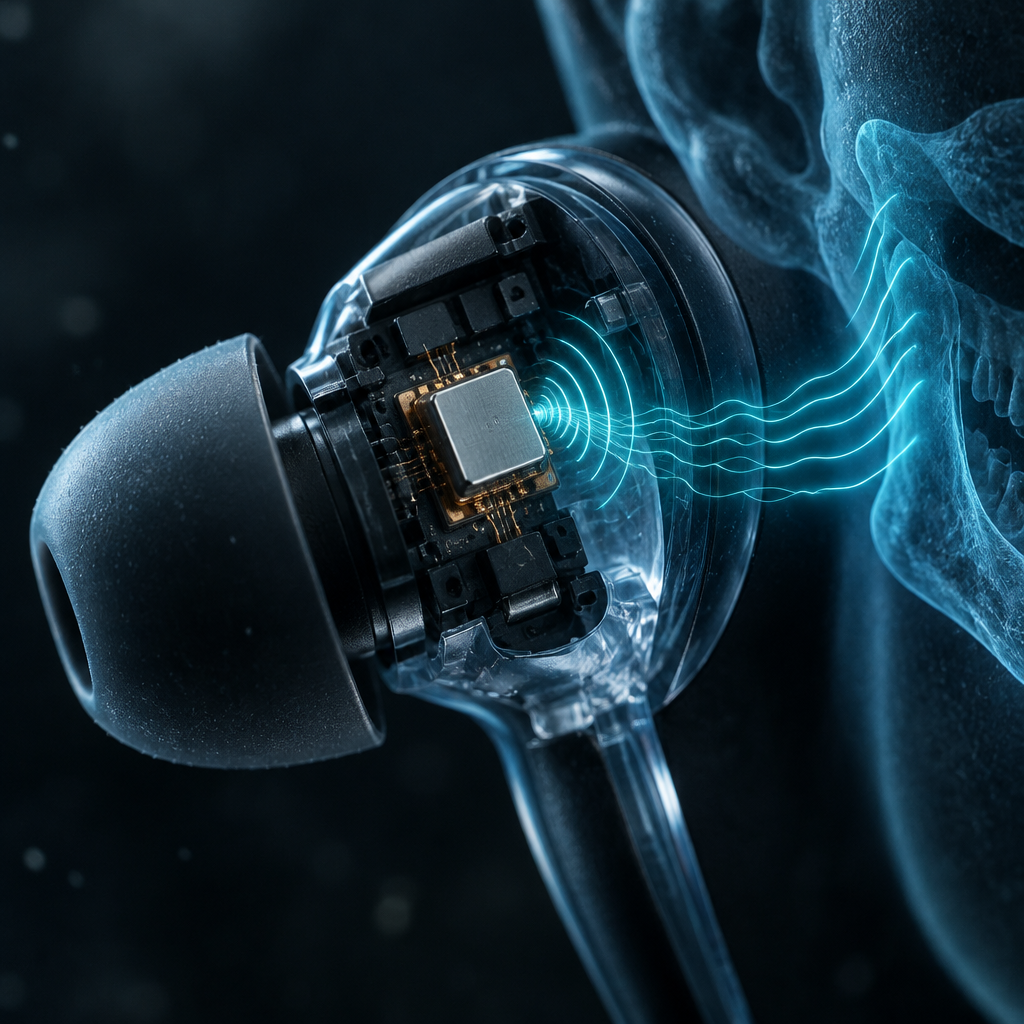
Cypress sidesteps the story. Its diaphragm oscillates at ultrasonic frequencies, tiny motions measured in nanometres, and a second structure vents the chamber in step with that oscillation. The result is a stream of pressure pulses, tens of thousands per second, whose envelope traces the audio waveform. Nothing in the audio band moves mechanically. xMEMS puts it plainly in its own product literature: no in-band mechanical movement, so no in-band displacement nonlinearity.
The trade is legible once you name it. Instead of one large slow stroke, the driver makes an enormous number of tiny fast ones. Total volume velocity ends up in the same territory, because volume velocity is simply how much air passes per second, and a huge pulse count with a small volume per pulse can add up to the same figure as a few big gulps. What changes is the difficulty of the engineering. Making a stiff silicon flap flutter is easy. Making it swing half a millimetre without distorting is not.
Audio engineers will recognise the shape of this. It is pulse width modulation, executed in air rather than in a switching amplifier. The signal lives in the duty cycle, not in the amplitude of a slow mechanical sweep.
Where the Old Ultrasound Trick Failed
Sound from ultrasound is not new. Peter Westervelt described the underlying nonlinearity in 1963. Two intense ultrasonic beams travelling together generate a difference frequency as the medium's own compression alters local sound speed, and because ultrasound has a short wavelength, the resulting audio inherits a beam tighter than any cone could produce. Museum installations use it to make a voice appear out of empty space.
It has always been terrible at bass, for a reason that matters here. Demodulation happens gradually, as the wave propagates. Close to the transducer there is only ultrasound and no audible content, the notorious near-field dead zone. Low difference frequencies accumulate slowly, so commercial parametric arrays give up below roughly 200 Hz and hand the low end to a conventional woofer.
Cypress does not wait for air to do the work.
The demodulator sits on the chip. The venting structure is microns from the diaphragm, gated synchronously with the carrier, so the envelope is extracted mechanically at the source rather than acoustically over metres of propagation. Which is why the design works at all inside a sealed ear canal a few millimetres from the eardrum, a listening position where no propagation-based parametric system could function. The dead zone that has limited this physics for sixty years simply does not exist.
There is a second payoff, quieter but commercially important. The mechanical response is fast and its delay barely varies with frequency, so the transfer function the ANC processor has to invert is nearly flat in phase. ANC filters get shorter, latency drops, and the loop can chase noise higher up the spectrum, into the range where a crying baby sits rather than the range where a diesel idles.
What the Footnote Leaves Out
Three things deserve scepticism.
The measurement standard is the first. xMEMS cites an IEC 60318-4 ear simulator, which is the right instrument for insert earphones and the one every earbud lab owns. That standard's characterised range runs from 100 Hz to 10 kHz. Twenty hertz is more than two octaves below the band where the coupler is calibrated and where its own compliance is trusted. The number is not fabricated, and the coupler does respond down there. It is simply quoted at the frequency where the instrument has the least authority to speak.
Distortion is the second. A driver advertised at 140 dB at 20 Hz is being described near the top of its output, and any transducer asked for its maximum is producing its worst linearity. The nonlinearity did not disappear when the diaphragm stopped moving in band. It relocated, into the demodulation scheme, where it appears as quantisation artefacts and envelope intermodulation rather than as suspension asymmetry. Different mechanism, same obligation to measure it.
The third is why the headroom figure exists. The ANC vent that makes modern earbuds comfortable, and keeps your own voice from booming inside your skull, is an intentional leak, and a leak costs about 20 dB of low frequency output. Earlier solid-state designs topped out near 120 dB and needed a coil woofer alongside to cover the gap. Everything about that 140 dB claim is a response to a vent, not to the limits of hearing.
Add the drive electronics. Piezoelectric actuators want high voltage, so the companion ASIC carries a boost stage with its own conversion losses. The package shrank. The power budget did not automatically follow.
The Part That Actually Shipped
Cypress reached mass production readiness in September 2025, with customer shipments ramping through 2026. The more instructive datapoint is Nothing's Headphone (1) Pro, which launched in October at $399 with a triple driver array and an xMEMS silicon tweeter covering the top octaves.
Notice where solid state landed first. Treble. Which is the easy assignment, because high frequencies need almost no displaced air, and a stiff silicon diaphragm with no breakup mode is genuinely superior up there. Bass is the hard assignment, and bass is the one Cypress is only now arriving to take.
So the honest test is not the silicon specification. It arrives in two measurements nobody puts on a box: how deep the noise cancellation actually reaches below 100 Hz on a real head with a real seal, and how the bass behaves when you ask for it loudly. Headroom is a claim about capability. Distortion under load is a claim about competence.
The One Variable You Control
Look again at the cavity equation, because the denominator is doing more work than the numerator.
Pressure scales inversely with trapped volume. A seal that leaves twice as much effective air between driver and eardrum halves the pressure, and that is six decibels of bass gone. Not six decibels of tuning, six decibels of physics, and no equaliser setting can restore what was never generated. Earbuds with a driver this small are more sensitive to fit than anything that came before, which makes tip selection a load-bearing decision rather than an accessory afterthought.
Then listen for texture instead of quantity. Play something with real low frequency content at a volume you would actually use, and pay attention to whether the bass has grain or just weight. A driver that reaches 20 Hz by chopping air can sound startlingly clean, right up until the envelope runs out of resolution. The number on the datasheet is headroom. Your ears are being asked about something else entirely.