Watch a film with head-tracked earbuds and the trick holds beautifully at first. Turn your head and the dialogue stays pinned to the laptop. Look at the ceiling and the orchestra stays down near the floor. Then the geometry relaxes. The stage you assembled in your mind loosens and slides a few degrees to follow you. By the credits the sound sits roughly where your face points, and you cannot say when it moved.
Nothing failed. That slow migration is the honest signature of an earbud with no idea which way is north.
Six Axes, One Missing Reference
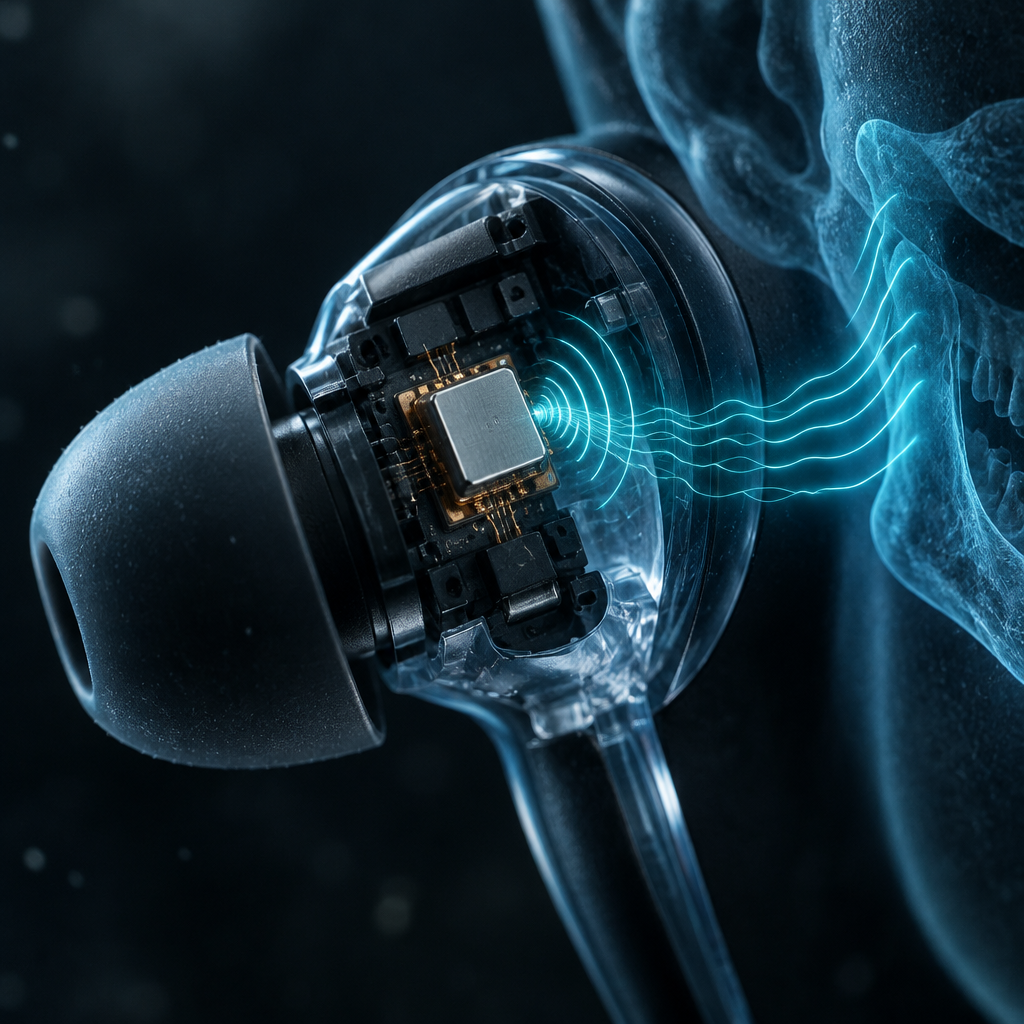
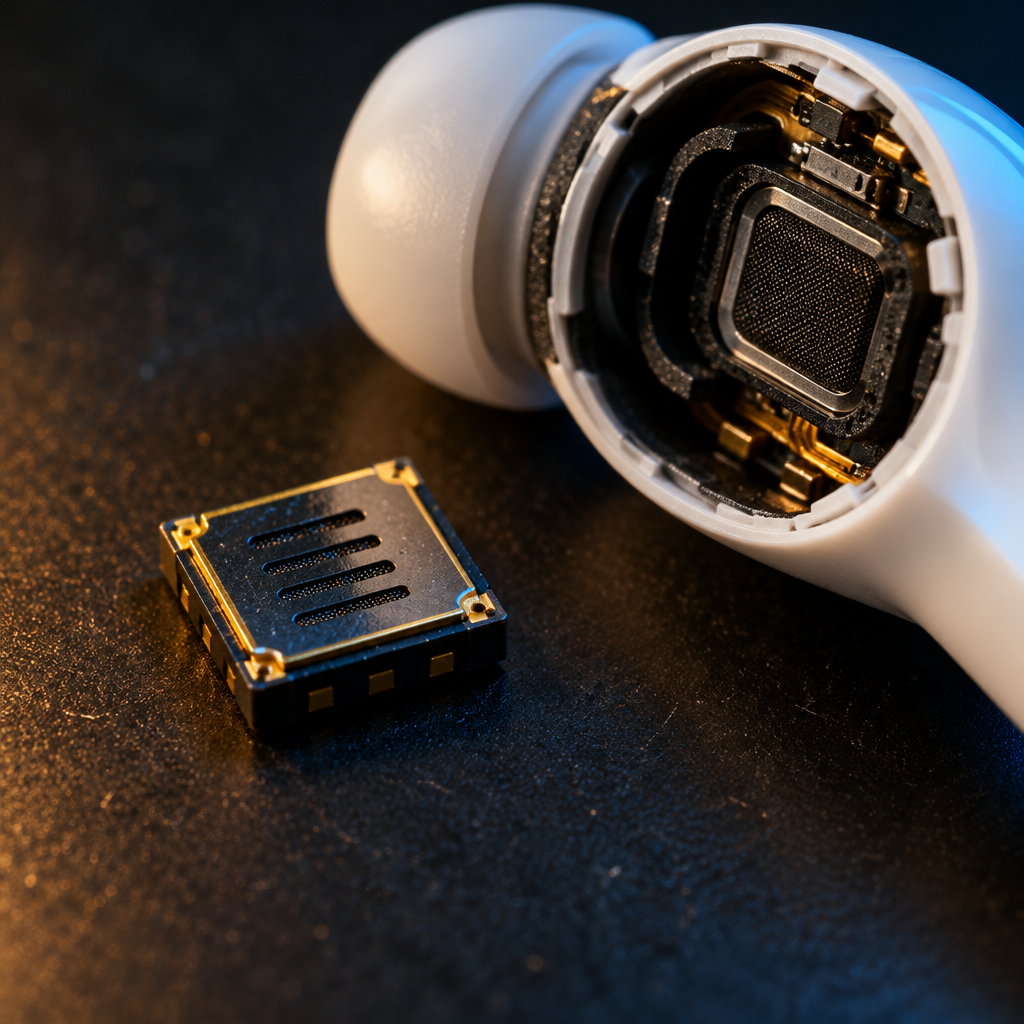
The head tracker in a modern earbud is nearly always a six-axis MEMS inertial unit: three rate gyroscopes, three accelerometers, one package a couple of millimetres on a side, sipping microamps. The gyroscope reports angular velocity in degrees per second. The accelerometer reports specific force, which at rest is simply gravity, and gravity points down wherever you stand.
That detail is worth more than it appears. Gravity is an absolute reference for pitch and roll, so the accelerometer can say, permanently and without accumulating error, whether your head is tilted forward or cocked sideways. Tilt is observable. Heading is not. Your ears sit on a vertical neck, and gravity never rotates about itself, so the axis that matters most for spatial audio is the one the accelerometer cannot see.
Yaw has to be integrated. Rate in, angle out, indefinitely.
Integration Is a Memory, and Memories Rotate
A gyroscope reporting 14.3 degrees per second for one second means you turned 14.3 degrees. It does not report truth; it reports truth plus a small offset, and that offset is not a number you measure once at the factory and subtract forever. Bias drifts with temperature, with board flex, with whatever the plastic did when you shoved the bud into your ear canal. Sum a rate signal carrying a sliver of bias and you are not adding noise. You are adding a slowly growing angle that no measurement can separate from a genuinely slow, genuinely real head turn.
The arithmetic is smaller than the folklore. A decent consumer gyroscope holds bias to a few degrees per hour, with angular random walk near a tenth of a degree per root hour. Neither number explains what you felt on the sofa.
Why Earbuds Do Not Carry Compasses
The obvious repair is a magnetometer. Nine-axis units exist, cost almost nothing, and every phone and drone uses one to observe heading absolutely. Earbuds do not, and the reason is mounted two millimetres from the sensor.
A moving coil driver is a neodymium magnet with a coil in front of it. A small one for a 10 mm earbud might be 10 mm across and 2 mm thick, with a surface field in the hundreds of millitesla. Ten millimetres out on axis the field has fallen to a handful of millitesla, still a thousand or several thousand microtesla depending on geometry. Earth's field, the thing a compass reads, is 25 to 65 microtesla. Inside that shell the driver dominates by twenty to a hundred times, and because it does not move it never registers as a disturbance. It registers as a completely wrong north.
Worse, it is not quite static. The coil carries the audio, the audio is current, and the current makes its own field rising and falling with your bass line. A magnetometer there would not measure a planet. It would measure the song.
The compass is out. Integration stays, and that forces a compromise every spatial audio team has negotiated in private.
The Leak Is a Feature Nobody Calls a Feature
Without an absolute heading reference, the only way to stop yaw walking off is to pull it back. Designers do it the way inertial navigation always has: a leaky integrator, a filter correcting the accumulated angle toward a reference at a rate proportional to the error. Pick a time constant of ten to thirty seconds and heading becomes stable enough to survive a film without spinning.
Now look at what the leak does to real motion. A head turn taking ten seconds is, to a filter with a twenty second time constant, indistinguishable from drift. The correction eats part of it. The field rotates with you instead of holding still, and the harder you lean into the illusion, the more it slips. Fast snaps lasting a quarter second pass through untouched, far above the filter's corner. Slow, deliberate, exploratory motion is what leaks.
This is where VR headsets and earbuds part company. A headset has cameras and can localize itself against the room, so heading is observed rather than remembered and the leak nearly closes. Earbuds have no external reference that fits in a 5 gram shell. The leak is not a shortcut to save money. It is the best available answer to a problem with no absolute.
The Milliseconds Have to Come From Somewhere
Brungart and colleagues mapped this across virtual audio display studies in the early 2000s. Their conclusion, echoed since, is that tracker latency below about 60 milliseconds is comfortable, seventy is marginal, and past roughly 73 milliseconds localization accuracy degrades measurably during head motion. Those numbers came from workstations, and the budget has not grown since. It has only been squeezed.
Spend the budget honestly. Sensor sampling interval, filter group delay, transport to whichever chip renders, the render block itself, orientation interpolation, output buffering. Nothing exotic, every item a few tenths of a millisecond to a few milliseconds, and they add.
Then the architecture fork. Render on the earbud and pose never leaves the device, at the cost of burning a bank of head related transfer functions into the audio DSP and shipping the scene description down the link. Render on the phone and the pose travels up, which means a Bluetooth Low Energy connection interval of 7.5 to 15 milliseconds plus jitter plus the occasional retry, and the phone owns the filter.
Here is the part that is easy to get wrong. Audio reaching an earbud over a legacy Bluetooth link typically trails real time by 150 to 200 milliseconds. Applying head orientation to that buffered audio as you render keeps the geometry coherent, which is fine. But making the stage feel instantaneous rather than stale means predicting forward across the whole buffer. Extrapolating head motion 150 milliseconds ahead at a brisk 200 degrees per second commits you to thirty degrees of guess. Prediction is reasonable over twenty or thirty milliseconds. Ten times that is astrology.
Which is why LE Audio matters here more than its marketing admits. A 20 to 30 millisecond link does not just shorten lip sync error. It shortens the window you predict across, and for head tracked rendering that is the difference between a stage that holds and one lagging behind your ears.
A Wrong Head Model, Rescued by Motion
Every one of these systems also runs on a transfer function recorded from somebody else's head, or a mannequin. Non-individualized filters are notorious for front to back confusion and smeared elevation; static playback can put a voice behind you when it belongs in front, and no equalizer curve repairs that.
Motion rescues it, partly. Rotate a few degrees and the cue trajectory changes in a way no frozen snapshot could. The auditory system resolves the ambiguity from how the spectrum shifts, not from the spectrum itself. Least advertised benefit of head tracking, and probably the largest: it does not make a mediocre filter accurate. It makes one usable.
Between poses, the system interpolates. Nearest neighbour switching gives audible zipper artefacts on smooth rotations. Crossfading adjacent filters kills the clicking and introduces a brief comb during the blend, because two filters with different arrival times are being mixed. Spherical harmonic representations sidestep both, rebuilding any direction from a compact set of coefficients at the cost of angular resolution that scales with the order you can afford. No free interpolation, only the artefact you pick.
The Body Attached to the Head
An earbud is mechanically coupled to your jaw. Chew and the gyroscope sees it, because the ear canal moves with the mandible, and the rendered world wobbles in time with your lunch. Walking arrives as a periodic signal near two hertz, which is why filtering below the bandwidth of deliberate head motion matters. And with two earbuds there are two inertial units, which should agree about rotation and mostly do, giving a free averaging term for noise. When they disagree, one is no longer rigidly attached to the skull. A loose bud announces itself as a sensor disagreement before it announces itself as a sound quality problem.
Three Checks Worth Doing
Sit still ten minutes with a fixed source and watch whether the stage migrates toward your nose. Turn your head ninety degrees over five seconds and notice whether the source holds or travels with you. Then eat something crunchy. If the field wobbles, you are hearing the leak and the jaw arguing in public.
The Honest Version of the Feature
Head tracked audio in an earbud is a reconstruction built on a memory. Rate sensors supply a heading nobody can verify, a leaky filter keeps it from wandering into the wall, and that leak costs you exactly the slow movements you make while paying attention. The driver magnet keeps the repair out of reach. What remains is a system engineered well enough that most listeners never notice the seam, and honest enough that the seam is always there.
Worth remembering the next time the cinema in your ears quietly swings around to face you.