For decades, personal audio lived in a flat plane. Left channel, right channel, some stereo separation, maybe surround sound if you were lucky. But spatial audio, powered by Bluetooth 5.4 connectivity and motion sensors built into modern earbuds, is demolishing those boundaries. What started as a novelty feature on Apple's premium devices has rippled across the entire audio ecosystem, turning earbuds into legitimate three-dimensional listening instruments. By mid-2026, spatial audio isn't a luxury anymore; it's becoming table stakes for anyone serious about their listening experience.
What Spatial Audio Actually Is, Beyond the Marketing Hype
Spatial audio isn't magic, but it can feel that way when it works correctly. At its core, it's a combination of two things: head tracking via inertial measurement units (IMUs) and advanced binaural rendering that adjusts the audio signal in real time based on where your head is positioned in three-dimensional space.
Your ears naturally detect sound direction and distance through tiny differences in timing and frequency response as sound waves hit each ear. A sound coming from your left arrives at your left ear microseconds before your right ear, and the head itself filters certain frequencies depending on the sound's origin. This collection of cues, called head-related transfer functions (HRTFs), is what your brain uses to place sound in three-dimensional space. Spatial audio earbuds replicate this using accelerometers and gyroscopes that monitor your head's position 50 to 100 times per second, then adjust the audio output so that when you turn your head, virtual sounds seem to remain anchored in space rather than following you around.
In practical terms, imagine watching a video on your phone where a character speaks from the right side of the screen. With spatial audio enabled, that character's voice seems to come from that direction in three-dimensional space. When you turn your head left, the sound doesn't rotate with you; it stays positioned where it was on screen, which is neurologically more convincing to your brain than traditional stereo. Your auditory system recognizes it as closer to real-world listening.
Bluetooth 5.4: The Connectivity Backbone
None of this is possible without robust, low-latency wireless connectivity. Bluetooth 5.4, finalized in early 2023 and now standard on flagship earbuds in 2026, provides the bandwidth and stability necessary to stream spatial audio metadata alongside the primary audio signal. The protocol's improvements over Bluetooth 5.3 might seem incremental on paper, but in implementation they matter enormously.
Bluetooth 5.4 increased maximum data rates and improved LE (Low Energy) Coded PHY performance, which translates to better range and more consistent connections even in crowded RF environments. When you're relying on head-position data being transmitted to your earbuds 50 times per second alongside a compressed audio stream, that stability is non-negotiable. Drop outs or latency spikes destroy the illusion. The protocol also includes enhanced privacy features and mesh networking improvements, allowing spatial audio to work seamlessly across multiple devices without constantly re-pairing.
Most manufacturers aren't yet pushing Bluetooth 5.4's full capabilities for spatial audio, but the infrastructure is there. Sennheiser's MOMENTUM True Wireless 4 and several other 2026 flagships support it. As the year progresses, expect more mid-range models to catch up.
The Sensor Stack That Makes It Possible
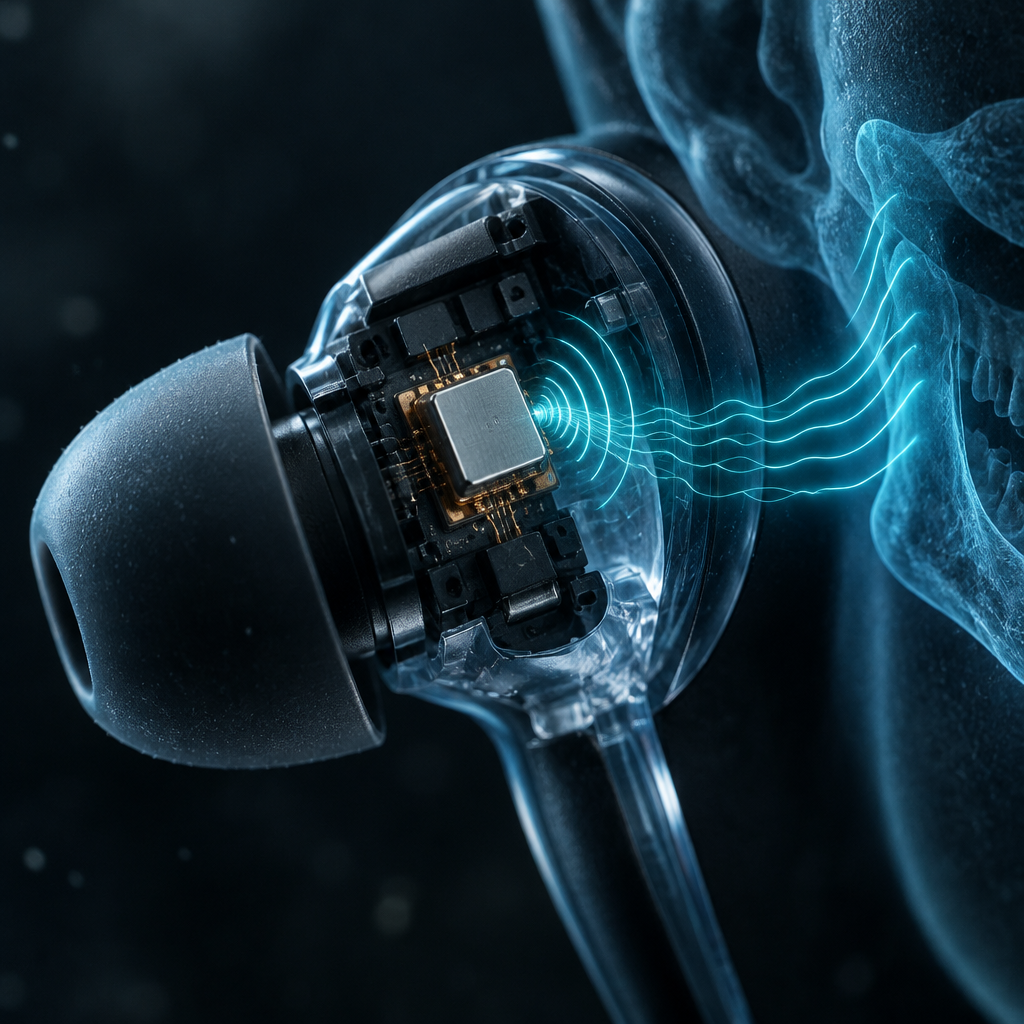
An earbud with spatial audio capabilities contains a surprisingly complex sensor architecture. Beyond the obvious audio drivers and microphones, you've got accelerometers measuring linear acceleration across three axes, gyroscopes detecting rotation, and often a magnetometer providing compass-style orientation data. Some premium models now include barometric sensors that detect altitude changes, because sound propagation changes measurably as air pressure shifts.
These sensors feed into onboard processors running motion-tracking algorithms that calculate your head's position relative to your device in three-dimensional space. The math is real-time sensor fusion, the same type of computation that powers smartphone gyroscopic stabilization and AR applications. Most 2026 earbuds performing this work use dedicated ARM Cortex processors consuming only 5 to 15 milliwatts during active head tracking, which is why it doesn't annihilate battery life.
The challenge isn't the sensors themselves; it's calibration and algorithm tuning. Every head is shaped differently. Every ear canal geometry is unique. This is why some spatial audio implementations feel convincing while others feel like your ears are being played with. The best implementations use machine learning models trained on thousands of HRTF measurements to approximate your personal head-related transfer functions. Cheaper implementations use generic HRTFs that work okay for most people but feel off to anyone with unusual ear geometry.
Content Ecosystem: Where Spatial Audio Actually Lives
Here's the constraint that keeps spatial audio from being universal in 2026: you need content designed for it. Your Spotify playlist doesn't automatically become spatial. Neither does your YouTube subscription. Apple Music has the largest spatial audio catalog, with tens of thousands of tracks mixed in Dolby Atmos, which translates to spatial audio earbuds. Amazon Music offers spatial audio on select releases. Tidal, Qobuz, and YouTube Music are playing catch-up. But most streaming services still treat spatial audio as a premium feature behind an extra subscription tier or available only on certain artist releases.
Video content fares better. Apple TV+, Netflix, Disney+, and major streaming platforms now produce significant portions of their original content with spatial audio tracks. Gaming is where spatial audio truly shines, though; most modern games with Dolby Atmos support work brilliantly with spatial audio earbuds. The three-dimensional soundscape of a competitive first-person shooter becomes almost unfairly immersive when you can actually place gunshots, footsteps, and environmental sound in three-dimensional space relative to your head position.
The ecosystem is expanding, but it's not seamless. You still find yourself toggling spatial audio on and off depending on what you're listening to, and that friction prevents it from becoming as ubiquitous as stereo.
Perceptual Reality: Does It Actually Feel Different?
This is where subjective experience diverges from technical specifications. To ears trained on conventional stereo, spatial audio can feel immediately striking. The first time you enable head tracking on a spatial audio earbud while watching a film with Dolby Atmos, the expanded soundscape is noticeable. Dialogue positioning feels more precise. Ambient sound feels less like it's painted onto the recording and more like it exists in the space around you.
But here's the honest assessment: the improvement over very good traditional stereo is real but not revolutionary for music listening. For video and gaming, it's more impactful. For watching films with spatial audio masters mixing, the difference can be profound. Some spatial audio purists claim it fundamentally changes how you perceive audio, and they're right in specific contexts. For casual listening to a compressed Spotify track, the difference is subtle. Your brain fills in a lot of gaps.
Perception also depends on the earbud hardware itself. Spatial audio processing is only as good as the drivers delivering the audio signal. A pair of cheap earbuds with flawless head-tracking algorithms will still sound cheap. You need solid driver tuning, decent frequency response, and at minimum adequate noise isolation to make spatial audio shine. This is why spatial audio has become a differentiator among premium earbuds; it's a feature that works best when paired with other high-end specifications.
The Battery Trade-Off
Running motion sensors and real-time head-tracking algorithms continuously burns power. Even with efficient processor design, spatial audio capability adds measurable drain. Most 2026 earbuds with spatial audio can toggle the feature on and off; leaving it on 24/7 typically costs you 5 to 10 percent of total battery life compared to stereo-only operation. That's manageable if your earbuds already get 6 to 8 hours of playback. It's more problematic for true wireless earbuds targeting 4 to 5 hour battery claims.
Manufacturers have gotten smarter about power management. Samsung's Galaxy Buds2 Pro and similar models intelligently pause head tracking when you're stationary, resuming only when motion resumes. Some devices implement power scaling, reducing sensor sampling rates during less demanding tasks. By 2026, this has become standard practice rather than exception. The battery penalty is real, but it's not the dealbreaker it was in 2023.
The Comfort Question
Earbuds with accelerometers and gyroscopes are marginally heavier than identical earbuds without them. We're talking differences of 0.2 to 0.4 grams per earbud, which sounds trivial until you're wearing them for six hours straight. The weight distribution also shifts slightly; the sensors need to be positioned strategically to work properly, sometimes throwing off the balance slightly compared to traditional designs.
Most people never notice this. For people with smaller ear canals or those particularly sensitive to earbud fit, it can be annoying enough to prefer spatial audio-less earbuds. The fit of the earbud matters more than the feature set; a perfectly fitting stereo earbud beats an uncomfortably fitting spatial audio earbud every single time.
Where Spatial Audio Is Actually Winning in 2026
Professional audio production is seeing real adoption. Audio engineers and mixing studios now have spatial audio monitoring tools built into professional DAWs. Podcast producers are experimenting with spatial audio mixes. Some video production companies are treating spatial audio as a standard deliverable alongside stereo and 5.1 surround.
Gaming, as mentioned, is the real stronghold. Esports teams are using spatial audio earbuds for competitive advantage because the audio positioning cues provide genuine information advantage. Movie enthusiasts with access to Dolby Atmos content genuinely love it. Apple ecosystem users with spatial audio-capable devices, spatial audio content, and willingness to pay premium prices are very happy.
But the mainstream consumer? Most people still don't know what spatial audio is, and casual listeners who do know often see it as a gimmick rather than a must-have feature. That's the real story of 2026: spatial audio is excellent, it's becoming standard on premium earbuds, and it's genuinely useful in specific contexts. But it hasn't crossed the threshold into being as essential as noise cancellation.
What's Coming Next
The trajectory is clear. As Bluetooth 5.4 becomes universal, as content libraries expand, and as sensor costs continue dropping, spatial audio will migrate downmarket. We'll see it on mid-range earbuds by 2027. The sensor technology will improve; IMUs with lower power consumption and better accuracy are already in development. Software algorithms will become more sophisticated at inferring personalized HRTFs without requiring explicit calibration.
The real innovation frontier now is hybrid audio, where spatial audio works in concert with other features like adaptive noise cancellation and awareness modes. Imagine active noise cancellation that understands spatial positioning, intelligently suppressing noise from specific directions while preserving speech from others. That's where the next generation is heading.
For now, spatial audio in earbuds is a solidly excellent feature that you should absolutely try if you have the opportunity, particularly in gaming or film contexts. Just don't expect it to revolutionize your casual music listening. It enhances what's there; it doesn't transform fundamentals. And for the subset of users who care deeply about how audio is presented, that enhancement is genuinely worth the extra cost and the battery trade-off.