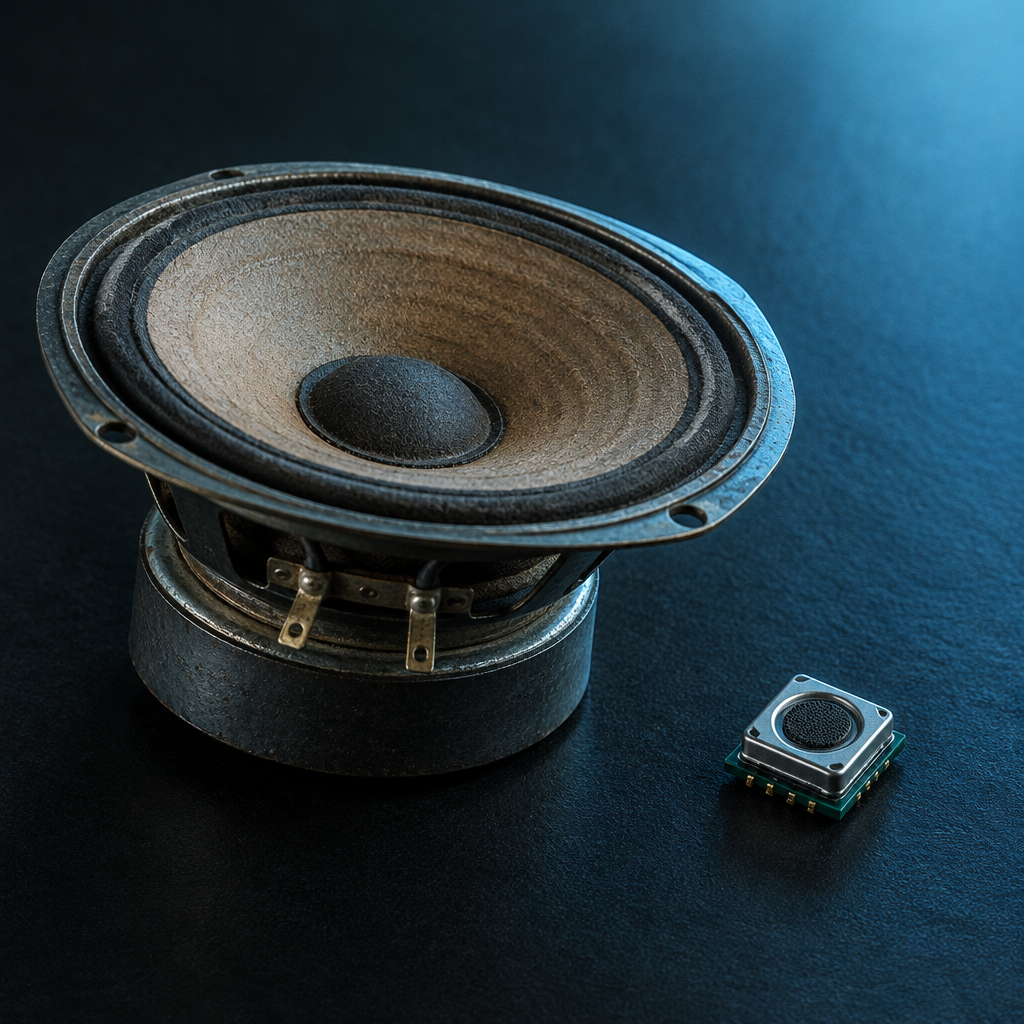
The first electromagnetic speaker was built in 1925. A paper cone, a coil of copper wire, and a permanent magnet. One hundred years later, the earbud in your pocket contains the exact same three components, just shrunken down to fit inside a pea-sized shell. The dynamic driver hasn't changed in a century. Not fundamentally.
That century ends now. Possibly.
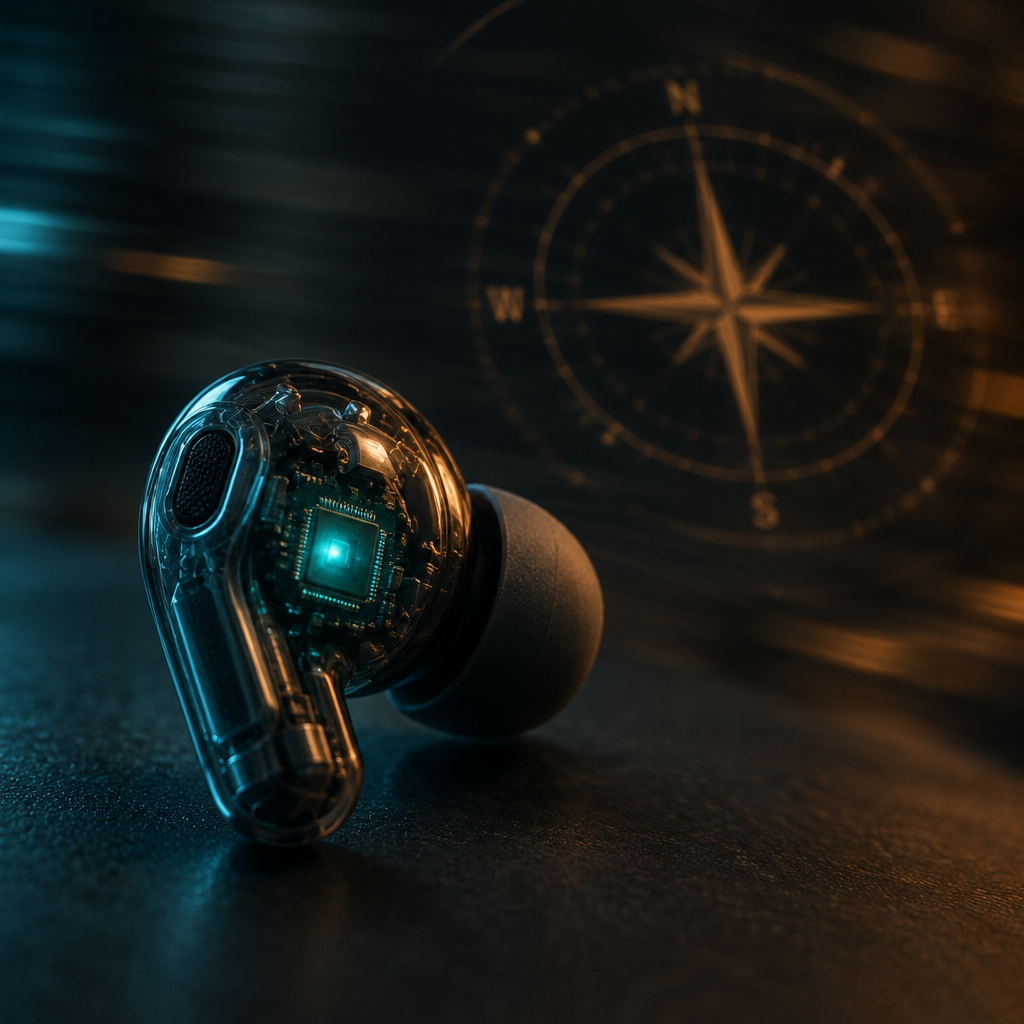
In 2023, a company most people have never heard of shipped the first solid-state microspeaker inside a consumer audio product. xMEMS Labs, founded in 2017 in Santa Clara, California, had spent six years figuring out how to etch a speaker onto a silicon wafer the same way Intel etches transistors onto a processor. The result is something called a MEMS driver, micro-electromechanical systems, and it doesn't use magnets, voice coils, or paper cones. It uses piezoelectric actuators fabricated in a semiconductor foundry. The speaker, in other words, is a chip.
This isn't a minor materials upgrade. It's a category change, and it's happening inside wireless earbuds right now while the headphone world is still arguing about planar magnetics versus dynamics like it's 2018.

How a century-old design stayed on top
A dynamic driver works on a principle you learned in middle school. Run current through a wire, create a magnetic field, push and pull against a permanent magnet. Attach the wire to a diaphragm, and you get sound. It's elegant, it's cheap, and it's everywhere.
The problem isn't the principle. It's the manufacturing. Every dynamic driver is assembled partly by hand. The voice coil is wound, the diaphragm is attached, the magnet is positioned, the housing is sealed. Tolerances stack up. Two "identical" earbuds from the same production line can measure noticeably different. At scale, consistency becomes a statistical game: ship enough units, the averages will be fine, but any individual pair might be slightly off.
Balanced armature drivers improved on precision but not on the fundamental problem. Developed originally for hearing aids, BAs use a tiny reed balanced between two magnets: no voice coil moving through a field, just a reed vibrating a diaphragm through a drive pin. They're smaller than dynamics and they use less power. But they're still assembled mechanically. Still subject to the same tolerance drift. And they have their own acoustic tradeoffs: most BAs struggle below 100Hz without a dedicated woofer, which is why multi-driver IEMs exist.
For decades, this was an acceptable compromise. Audio engineers designed around the hardware. Enthusiasts debated driver counts and crossover slopes. Nobody questioned the basic assumption that a speaker, even a tiny one, had to be mechanically assembled.
Then MEMS arrived.
The speaker that's a computer chip
MEMS speakers work on a completely different physical principle. Instead of electromagnetic force, they use the piezoelectric effect: certain materials physically deform when you apply voltage to them. Apply alternating voltage, and the material bends back and forth, pushing air. That's your sound.
xMEMS builds this on silicon wafers using standard semiconductor fabrication techniques. They deposit layers of piezoelectric material, lead zirconate titanate, or PZT, onto a silicon substrate, then etch away the silicon underneath to create a free-moving cantilever or membrane. The entire structure is microscopic: multiple "speaker cells" are arrayed across the chip surface, each one moving in perfect synchronization because they were all manufactured on the same die with the same process.
The manufacturing implications are hard to overstate. Semiconductor fabrication achieves tolerances measured in nanometers. A MEMS speaker chip doesn't have "unit variation" in the traditional sense: every speaker from the same wafer is functionally identical. Channel matching between left and right earbuds approaches theoretical perfection not because someone matched drivers by hand but because the fab ensured they were born identical.
Then there's speed. A dynamic driver's moving mass, voice coil, former, diaphragm, has inertia. It takes time to accelerate and decelerate, which introduces phase shift, particularly in the treble. A MEMS driver's moving elements are microstructures measured in microns. Their mass is negligible. They start and stop with effectively zero overshoot, producing near-perfect square wave reproduction and phase response that's essentially flat through the audible band.
xMEMS published measurements showing their drivers achieve phase shift below 1 degree across the entire frequency range. For context, a well-engineered dynamic driver might manage 15 to 30 degrees. This isn't a marginal improvement. It's a different order of operation.
The bass problem and how they solved it
For the first few years, MEMS had one glaring weakness: bass. A tiny silicon cantilever can move fast but it can't move much air. Physics is unforgiving about displacement, and piezo actuators work best at high frequencies. If you tried to make a MEMS speaker produce 40Hz at useful volume, you got nothing.
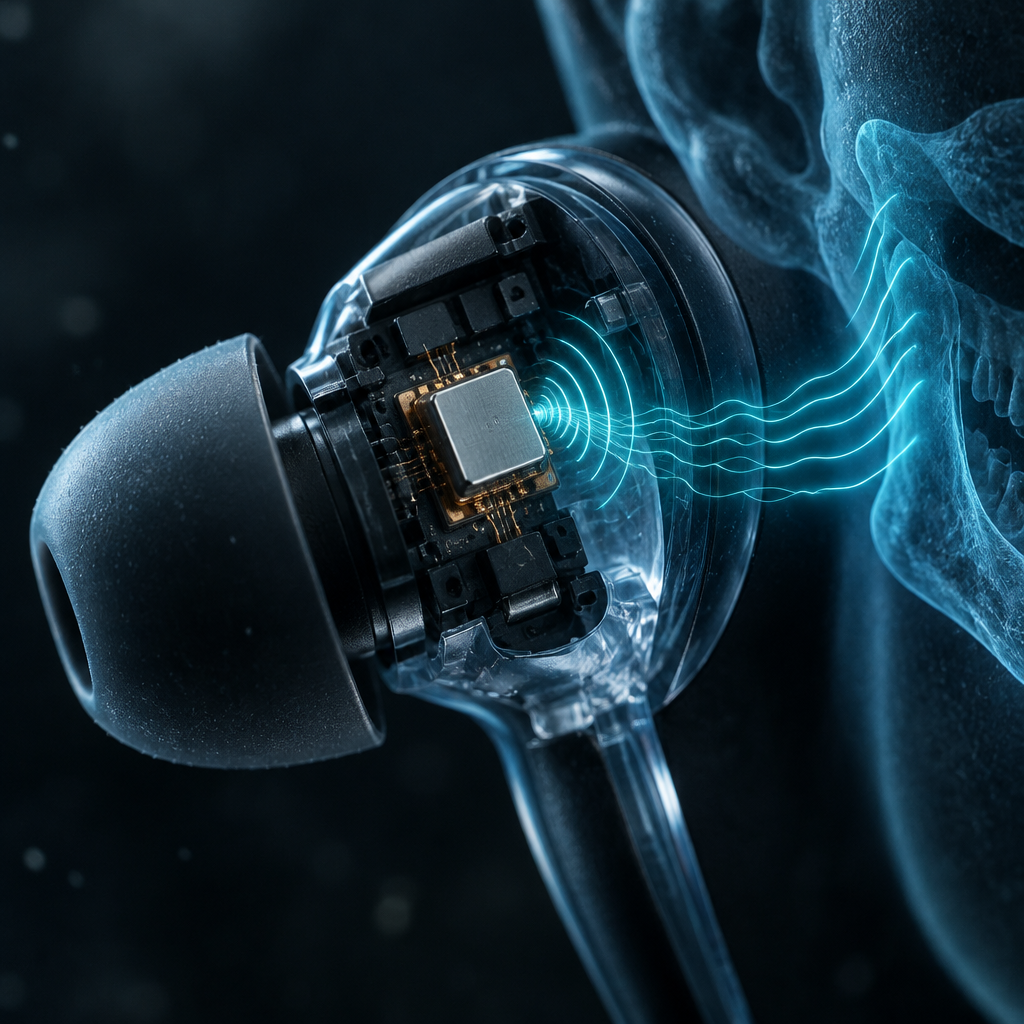
The workaround arrived in 2024 with xMEMS Cypress, their second-generation platform. Cypress uses ultrasonic modulation: the audio signal is shifted into the ultrasonic range above 20kHz, amplified, and fed into the MEMS driver. The driver doesn't reproduce the audio directly: it generates an ultrasonic carrier wave that's amplitude-modulated with the audio content. When this ultrasonic wave hits your eardrum, the nonlinear acoustic properties of the ear itself demodulate the signal back into audible sound.
Yes, your eardrum becomes part of the signal chain.
This sounds like audiophile heresy. It also works. The demodulation principle has been studied since the 1960s in parametric array loudspeakers, but it required large transducer arrays and impractical power levels. MEMS makes it viable for earbuds because the driver can operate efficiently at ultrasonic frequencies, and the extremely short distance from driver to eardrum, literally millimeters in a well-fitted ear tip, keeps the demodulation path short enough to maintain fidelity.
The practical result: a solid-state earbud driver that produces flat bass down to 20Hz with total harmonic distortion under 0.5% at 94dB SPL. That's competitive with any dynamic driver on the market and exceeds most.
Products you can actually buy
The Creative Aurvana Ace 2, launched in late 2024, was the first mass-market TWS earbud to ship with xMEMS drivers. Creative paired a MEMS tweeter with a conventional 10mm dynamic woofer in a hybrid configuration: MEMS handles everything above roughly 5kHz, the dynamic driver handles bass and mids. At $149, it undercut most premium TWS earbuds while offering something genuinely novel.
Reviews were instructive. The treble detail and imaging drew consistent praise. Instruments separated in ways that dynamic-only competitors couldn't match at the same price. The bass was fine, carried by the dynamic woofer rather than the MEMS driver. People called them "detailed," "precise," "unusually clean."
But the Aurvana Ace 2 was a hybrid, not a pure MEMS design. The first all-MEMS TWS earbud, no dynamic driver, no balanced armature, just solid-state, arrived in 2025 through Noble Audio's Falcon Max. Noble, a company known for multi-thousand-dollar wired IEMs, bet their reputation on single-driver MEMS. The Falcon Max uses a full-range MEMS driver with the ultrasonic modulation trick, producing the entire frequency spectrum from a single chip.
The audiophile response was, predictably, split. People who value tonal accuracy and imaging precision loved it. People who value bass impact and "musicality" found it thin. This is the exact same argument that plays out whenever a new transducer technology appears, from electrostatics in the 1950s to planar magnetics in the 2010s. Accuracy sounds different from euphony, and listeners accustomed to dynamic driver warm-hall resonance often perceive accurate reproduction as lacking body.
CES 2026 brought the next wave. xMEMS showcased Cypress in mass production readiness, claiming yields sufficient for the major TWS brands: Sony, Samsung, Apple, the companies that ship tens of millions of units. They also demonstrated µCooling, a related MEMS technology that uses the same solid-state piezo platform to create active cooling for AI wearables. The company's roadmap suggests full-range MEMS drivers will be standard in flagship TWS earbuds by 2028.
What this means for earbud design
A dynamic driver is a three-dimensional mechanical object. It requires depth, a rear volume, an acoustic port for pressure equalization. These constraints dictate earbud shape. You can't make a truly flat earbud with a dynamic driver because the driver itself is a cylinder.
A MEMS driver is a flat chip, 1mm thick, roughly the size of a grain of rice. It doesn't need a rear cavity. It doesn't need an acoustic port because it's waterproof at the silicon level without any mesh covering. IP58 certification becomes trivial. It doesn't generate heat the way a voice coil does after hours of playback.
These properties unlock designs that are physically impossible with electromagnetic drivers. Imagine earbuds thin enough to sleep on. Earbuds with the entire freed-up internal volume dedicated to a larger battery. Earbuds that integrate biometric sensors, microphones, and processing chips in a package that's smaller than a current AirPods stem. The driver stops being the dominant design constraint and becomes just another component on the board.
There's also the durability angle. Dynamic drivers fail mechanically: voice coil burnout, diaphragm fatigue, magnet corrosion. MEMS drivers are solid-state silicon. There is nothing to fatigue, nothing to corrode, nothing to burn out. A MEMS earbud could theoretically last decades if the battery and Bluetooth chip hold up. Whether consumer electronics companies want products that last decades is a separate question, but the materials don't limit it.
The limitations that remain
MEMS isn't perfect, and it's worth being honest about what it doesn't solve.
First, the ultrasonic modulation technique is clever but inherently lossy. Converting audio to an ultrasonic carrier and demodulating it acoustically adds noise. The signal chain is more complex than a wire and a magnet, and that complexity shows up in measurements. At moderate volumes, the performance is excellent. At very high SPL, the demodulation becomes nonlinear, and distortion rises faster than it does on a dynamic driver.
Second, MEMS is currently earphone-only. The physics that make it work at millimeter distances don't scale to over-ear headphones. You need a dynamic driver or a planar magnetic to move enough air for a headphone-sized volume. The company that figures out how to make a solid-state full-size headphone driver will get a Nobel Prize and a market cap in the billions, but nobody has solved it yet.
Third, cost. Semiconductor fabrication has massive upfront costs amortized over millions of units. At small scale, MEMS drivers are more expensive than dynamic equivalents. The math flips at volume, once a fab line is running, marginal cost approaches zero, but the transition period is awkward for smaller manufacturers who can't commit to millions of chips.
And fourth, the subjective question that no spec sheet can answer: do they sound good? The measurements say yes. The phase response alone should convince anyone who values accuracy. But audio isn't just engineering, it's culture. People have spent a century learning what "good bass" sounds like from dynamic drivers. Changing the transducer changes the reference point, and that kind of perceptual shift takes longer than any product cycle.
A century in the making
Chester Rice and Edward Kellogg built the first moving-coil loudspeaker at General Electric in 1925. They were trying to improve telephone receivers. What they made instead became the foundational transducer of the twentieth century, reproduced in billions of units across every audio format from radio to streaming.
A century is a long time for a technology to remain dominant. The dynamic driver survived magnetic tape, the compact disc, the MP3, and Bluetooth because it had no credible alternative at its price and size. MEMS gives it one. Not by being slightly better; by being made differently, from different materials, on different principles, in different factories.
The question isn't whether solid-state drivers will replace electromagnetic ones in earbuds. The timeline is the only thing left to settle.