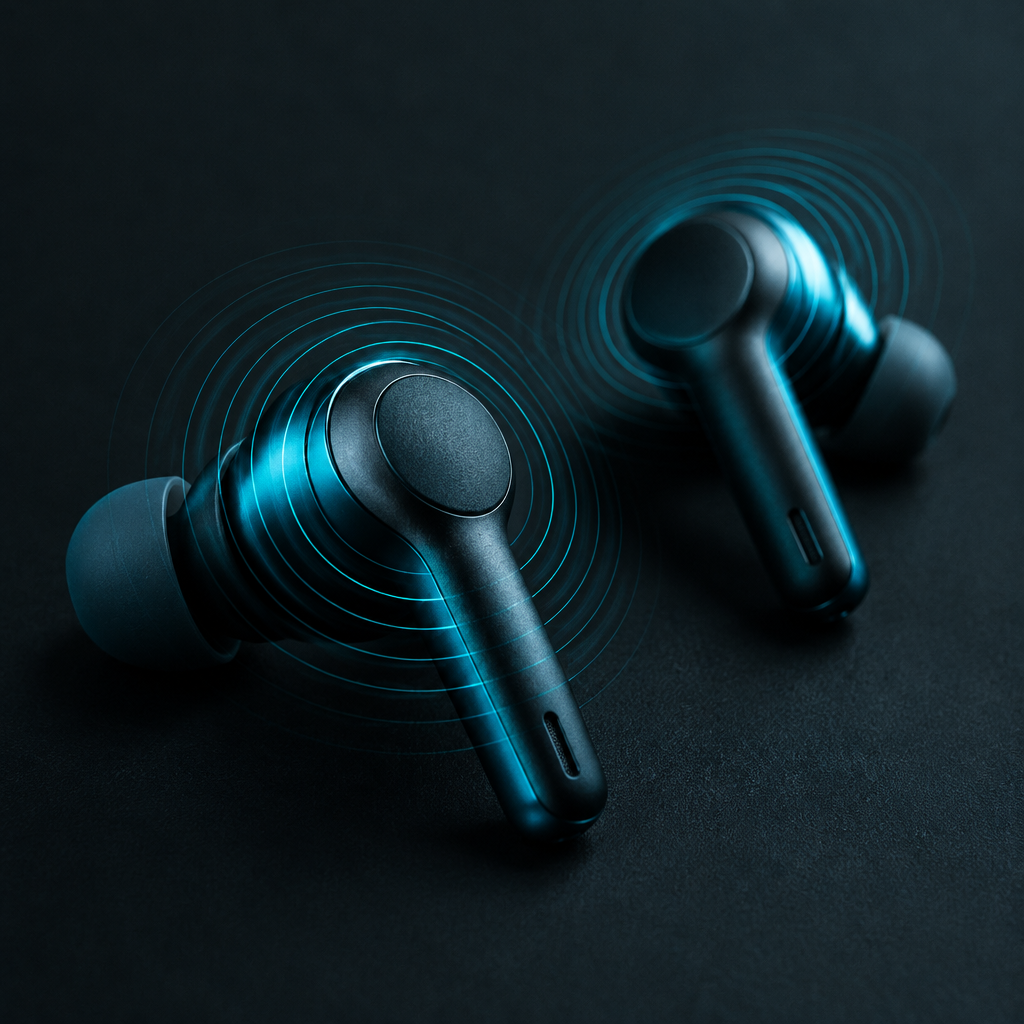
For the past three years, your earbuds have had a secret language. They've been talking to you through micro-vibrations, but most people never realized the difference between a haptic notification and the audio they were hearing. Apple started quietly, with subtle stem-touch haptics in the AirPods Pro, just enough vibration to confirm a button press. Sony answered with the WF-C7, adding directional steering cues through precision vibration patterns. Samsung's Galaxy Buds Pro 2 went further, using haptic to guide users through spatial audio positioning during gaming sessions. Each vibration was supposed to feel intentional, purposeful, distinct from the audio itself. Most users still missed it entirely.
The Engineering Constraints of Micro-Actuators
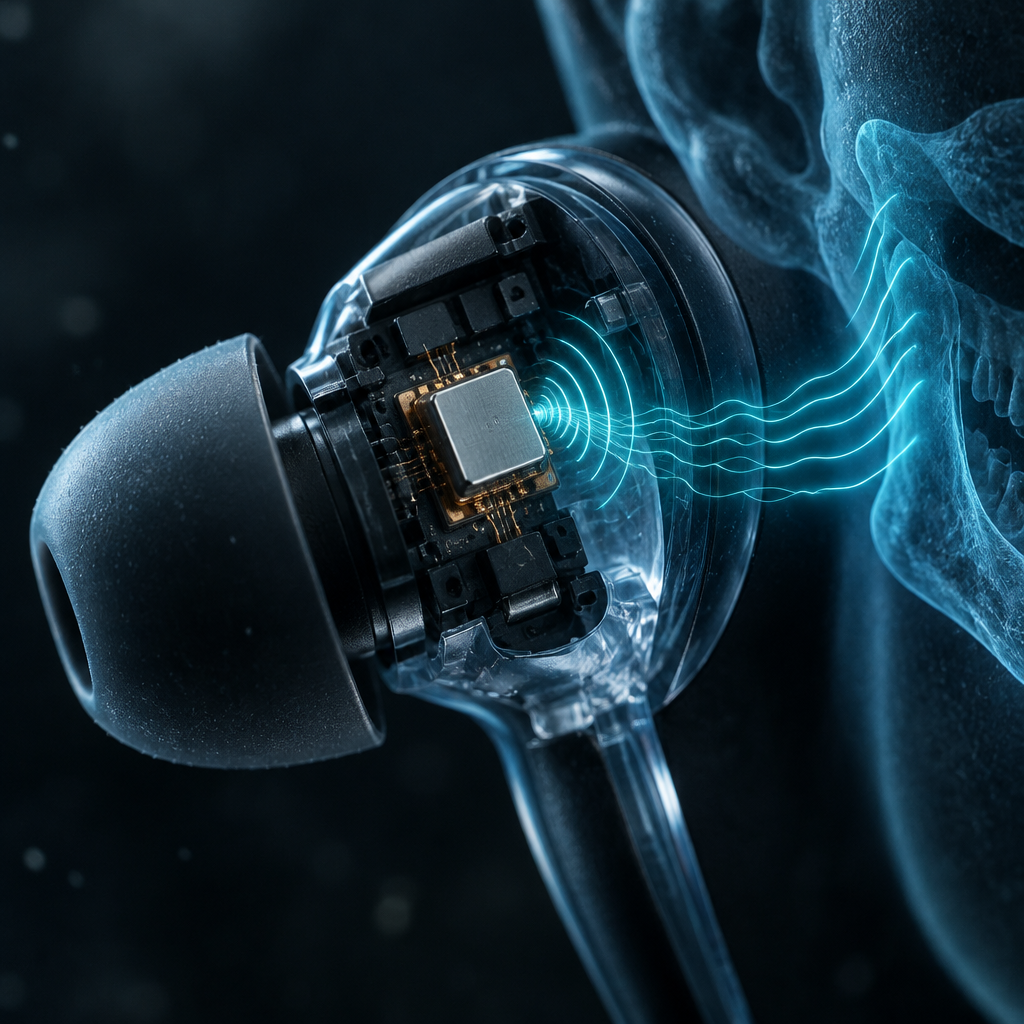
The misconception persists because haptic feedback in earbuds doesn't feel like haptic feedback in phones. Your phone's Taptic Engine can shake your hand with force. An earbud can't. The actuators embedded inside a 6-gram form factor operate under severe constraints. They use piezoelectric or linear resonant actuators, miniaturized to fit inside aluminum and plastic housings already crammed with drivers, coils, batteries, and antenna traces. There's barely room to breathe, let alone room for powerful motors. Yet the engineering has advanced to a point where these tiny vibrations convey meaningful information, and the applications have exploded far beyond what anyone predicted.
Competitive Gaming Drives Spatial Awareness Cues
Gaming has become the crucible for earbud haptics. In Valorant and Counter-Strike 2, footstep audio is everything. Professional players can pinpoint enemy position by the sound's decay and stereo image alone. But what if you could also feel where the enemy was? That's what Sony explored with its gaming-focused WF-L900H prototype, which delivers haptic pulses that correspond to directional audio cues. A footstep from the left comes with a left-side vibration. An explosion to the right generates a right-side vibration pulse. The haptics don't add information you couldn't get from audio; they augment spatial awareness in a way that's particularly potent when you're in a high-stress competitive scenario. Your brain processes both channels simultaneously, creating a richer, more immersive sense of positioning than audio alone provides.
The Battery Life Penalty and Local Pattern Caching
The problem is obvious: battery life. A piezoelectric haptic actuator consumes more power than the audio driver itself, watt-for-watt. Driving precise vibration patterns requires sending control signals over the Bluetooth link, decoding them locally, and then actuating the driver on demand. Each vibration event costs milliwatts, and across an hour of competitive gaming with constant directional cues, that overhead becomes significant. Sony's gaming earbuds claim 8 hours of battery with haptics enabled, but disable the haptics and you're looking at 10-12 hours. The tradeoff is stark: immersion versus duration.
Apple's approach with AirPods 7, rumored for late July 2026 launch, reportedly solves this with aggressive power profiling. Instead of sending continuous haptic control signals over Bluetooth, the earbuds cache pre-compiled haptic patterns locally and trigger them based on device-level events. When you dismiss a notification with a stem-tap, the pattern fires from the earbud's internal memory, not from a real-time signal from the iPhone. This dramatically reduces Bluetooth overhead and puts the power cost where it belongs: in the actuator itself, not in constant wireless communication. Battery life stays competitive while haptic responsiveness actually improves.
Notification Vocabularies: The Apple and Google Split
This is where things get weird.
If the earbuds have local pattern memory, why not just build more patterns in? Apple has literally thousands of notification types it could encode vibration patterns for. Incoming calls, messages, calendar reminders, fitness achievements, health alerts, critical battery warnings, spatial audio mode changes, conversation detection toggles. Each could have its own signature vibration, distinguishable without looking at the phone. You could identify what just happened by touch alone. But Apple hasn't done this. Their haptics remain minimal and conservative, mostly limited to touch feedback for physical controls. The reason appears to be UX philosophy: Apple doesn't want to overwhelm users with hidden patterns, and they worry about haptic language fragmentation across different devices and apps.
Google took the opposite bet with the Pixel Buds Pro 2, shipping with a richer haptic vocabulary from day one. Notifications have distinct patterns. Call incoming? A rapid double-pulse. Message? A slower triple pulse. Reminder? A single, longer activation. The patterns are simple enough to learn intuitively after a few weeks. Some reviewers found it delightful; others found it gimmicky. But the data is interesting: users who actively enabled haptic notifications reported higher engagement with their devices. They weren't reaching for their phones as often, trusting the haptic channel to filter and prioritize information before committing to a look. That's a meaningful shift in how people interact with wearables.
Accessibility and the Rise of Haptic Speech
Accessibility opened an entirely different frontier. For Deaf and hard-of-hearing users, haptic feedback can communicate information that audio cannot convey. A vibration pattern can encode spoken dialogue, differentiate between speakers, or convey urgency in a way that visualizations alone cannot capture when someone is moving or can't look at a screen. Researchers at MIT and the University of Michigan have experimented with "haptic speech," where vibration patterns map to phonemes or words in real time. The prototype systems are still crude, but the potential is enormous. Imagine an earbud that could render speech into haptic patterns, allowing someone to have a Bluetooth call purely through vibration, even in an environment where visual subtitles or visual alerts aren't feasible.
Bandwidth Bottlenecks and Next-Generation Actuators
The technical barrier to doing this at scale is Bluetooth's bandwidth. Current Bluetooth LE (low energy) supports a maximum throughput of around 2 megabits per second, and after subtracting overhead, audio codecs, and basic control signals, you're lucky to have enough bandwidth for a few kilobits per second of additional haptic data. That's barely enough for simple event-triggered pulses. Real-time, nuanced haptic communication, the kind you'd need for speech rendering or precise gaming cues, requires higher bandwidth. Bluetooth LE Audio, the updated standard rolling out in 2026-2027, promises to double this theoretical capacity. But promises and delivery are different things.
Samsung's Galaxy Buds Pro 3, launching in Q3 2026, reportedly incorporates a newer linear resonant actuator with improved frequency response. Instead of just on-off vibration pulses, these actuators can modulate their vibration frequency in real time, creating more complex tactile sensations. Imagine the difference between a phone vibration (on-off blips) and a speaker capable of reproducing bass frequencies. The Galaxy Buds Pro 3's haptic system can theoretically produce "shaped" vibrations that feel smoother, less jarring, and more nuanced. Early demos suggested users could distinguish between different haptic patterns more reliably, improving the potential for haptic language development. The challenge now shifts to software: can developers actually use this capability in meaningful ways, or will it remain a technical accomplishment looking for a killer app?
A Hidden Feature Waiting for Industry Standardization
The cost of this technology is still hidden. Consumers don't see the price premium for haptic earbuds because manufacturers bundle it into existing flagships without highlighting it. A pair of AirPods Pro costs $249, and you get haptics along with spatial audio, active noise cancellation, and wireless charging, with no itemized breakdown. If you tried to sell haptic feedback as a standalone feature, people would balk at an extra $30 or $50. But packaged as one component of a premium experience, it sells. This creates a strange market dynamic: the feature exists, it works, but most people don't know they own it because nobody is marketing it as a primary value proposition.
Here's what nobody talks about: haptics in earbuds are still largely experimental in terms of real-world usage. We have the technology, but we don't have consensus on how it should work or what it's actually for. Gaming? Sure, but the addressable market is smaller than Apple wants. Notifications? Helpful, but you can get the same information from your watch or phone. Accessibility? Promising, but still in research phases. Directional audio steering? Cool in labs, uncertain in the wild. Fitness feedback? Possible, but most runners prefer audio cues. Until manufacturers agree on some standard haptic language, or until a killer use case emerges that makes haptics as fundamental as audio itself, they'll remain a feature that some people love and most people never fully activate.
The next two years will be decisive. Apple's rumored AirPods 7 will likely set the industry standard. If they make haptics the center of a new interaction paradigm, including silent notifications, directional gaming cues, real-time health alerts, and gesture recognition, the entire category follows suit within months. Professional athletes, gamers, and accessibility-focused users would drive adoption upward. If Apple keeps them decorative, a nice-to-have rather than essential, then haptic earbuds remain a niche feature, impressive in demos but underutilized in real life, relegated to a deep settings menu most people never explore.
The future is vibrating, but nobody's quite sure what it's saying yet.