Your earpieces do not merely listen to you. Increasingly, they listen for you.
That distinction matters. Playback has been the headline feature of wireless audio for a decade, with codec badges, driver materials, spatial modes, and noise-cancellation claims fighting for space on the box. But the next serious contest is happening on the other side of the transducer. It is the microphone system, the tiny collection of sensors and algorithms that decides whether your voice survives a subway platform, a windy sidewalk, a busy kitchen, or the general acoustic disaster of a modern office.
Voice quality has become a product-defining feature because earpieces are no longer just music accessories. They are phone terminals, translation tools, AI interfaces, work microphones, accessibility devices, and sometimes recording studios that happen to fit inside a charging case. Every one of those jobs depends on the same difficult problem: isolate a nearby speaker from an enormous amount of sound arriving at almost the same time.
One microphone hears a mess
A single microphone cannot know which sound is important. It measures pressure changes at one point in space. Your voice, a passing truck, a refrigerator compressor, and the wind hitting the microphone port all become one waveform. The software can clean that signal, but it starts with an information problem. There is no second viewpoint to reveal where each sound came from.
Modern earpieces solve this with microphone arrays. Two, three, or more microphones are placed at different positions around the housing. Because sound reaches each capsule at slightly different times and amplitudes, the system can estimate direction. A voice coming from the front creates one pattern. Wind creates another. A loudspeaker across the room creates a third.
The geometry is tiny, which makes the engineering nasty. The microphones may be separated by only a few millimeters. At the frequencies important for speech, that spacing produces useful timing differences, but the array must also account for the shape of the ear, the rotation of the listener's head, the fit of the earpiece, and reflections from nearby walls. It is not enough to point a microphone toward the mouth. The entire device becomes a miniature acoustic camera.
Beamforming is the first filter
Beamforming combines the microphone signals so that sound from a chosen direction reinforces itself while sound from other directions partially cancels. In an idealized version, the processor delays one microphone feed by a calculated amount, adds the signals together, and creates a virtual listening beam aimed at the talker's mouth.
Real earpieces use more complicated adaptive beamformers. The target direction changes as you turn your head. A phone call may begin with the talker facing forward and end with the talker looking over a shoulder. The system has to track those changes without cutting off syllables or mistaking a passing siren for the person it is trying to preserve.
There is a useful tradeoff hidden inside the array. A narrow beam rejects more surrounding noise, but it is easier to lose the speaker when the head moves. A wider beam captures more of the voice, but it also admits more room sound. Premium designs continuously adjust that compromise, using voice activity detection and estimates of the acoustic environment to decide how aggressive the directional filter should be.
Why wind remains the villain
Wind is not simply another loud noise. It is turbulent air moving directly across a microphone port, creating low-frequency pressure fluctuations that can overwhelm the capsule before the signal reaches the digital processor. A neural network may be excellent at recognizing speech hidden under traffic, but it cannot recover clean detail that has been physically buried by turbulence and clipping.
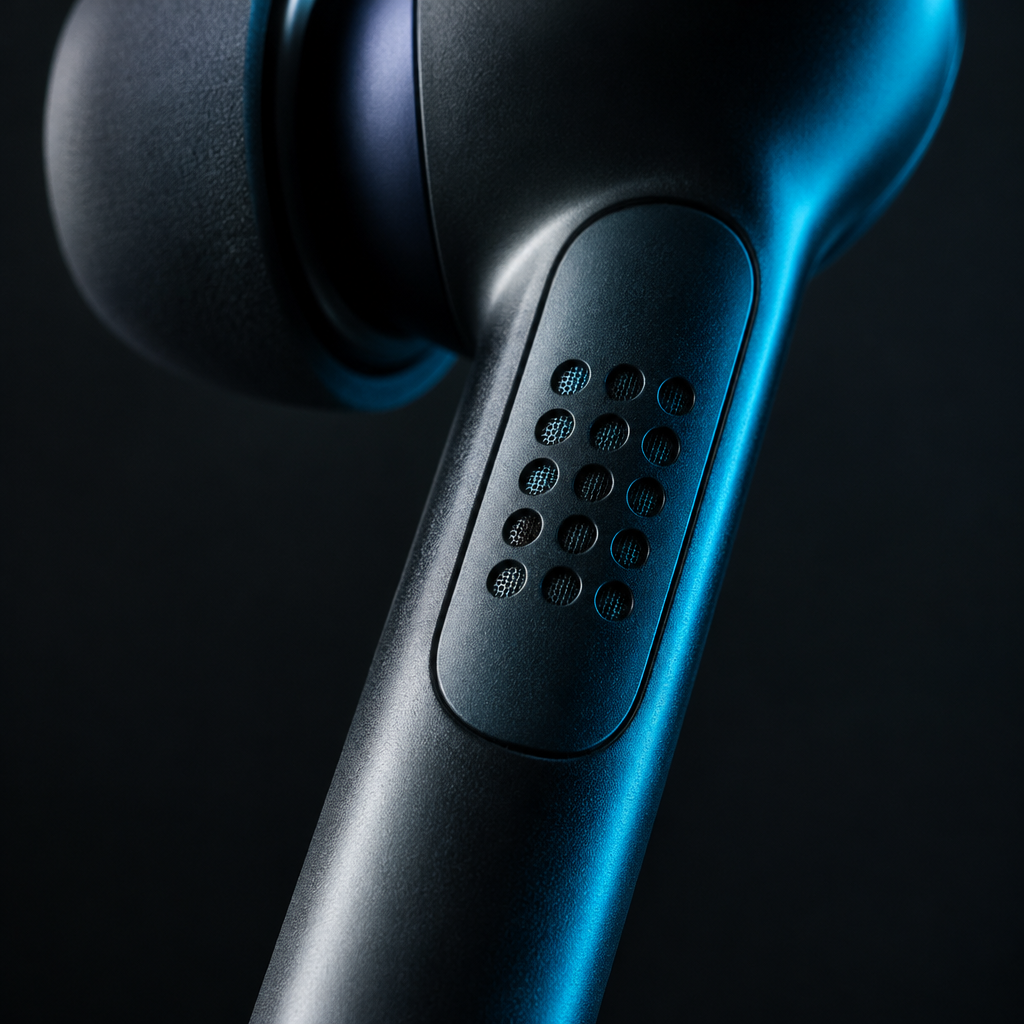
Designers attack wind in layers. Meshes and acoustic vents reduce the force reaching the microphone. Port placement moves the opening away from the most exposed edges. Some devices use a pressure sensor or a microphone dedicated to detecting wind, allowing the software to switch processing modes before the call becomes unintelligible. The best systems do not try to erase wind after the fact. They prevent as much of it as possible from entering the signal chain.
This is why a microphone specification sheet tells only part of the story. Capsule sensitivity, self-noise, and frequency response matter, but the physical route from the outside air to the diaphragm can matter just as much. A beautifully tuned microphone in a badly protected port will lose to a cheaper capsule inside a smarter enclosure.
Neural voice isolation changes the rules
Classical signal processing is built around assumptions. Speech occupies a familiar frequency range. Wind is mostly low frequency. Steady noise can be estimated and subtracted. Those assumptions work until the environment becomes irregular. A clattering dish, a nearby laugh, and a train announcement do not behave like a single predictable noise source.
Neural voice isolation treats the problem more like recognition. A trained model examines short slices of the multichannel audio and estimates which time-frequency components resemble the target voice. It can preserve a consonant at one frequency while suppressing a competing sound at the same moment. The model is not just turning down background noise. It is making a probability judgment about what should count as speech.
The challenge is latency. A model that waits too long to understand a phrase creates a delayed, unnatural call. One that operates on tiny windows has less context and makes more mistakes. Developers therefore use streaming architectures that process audio in overlapping frames, maintain a small amount of memory about what happened just before, and make corrections without producing obvious gaps.
There is also a computational cost. Neural processing consumes battery, and the smallest earpiece has very little thermal headroom. Manufacturers can run a compact model on a low-power digital signal processor, send selected features to a phone, or use a dedicated neural accelerator in the earpiece. Each choice changes privacy, battery life, responsiveness, and performance when the phone is not nearby.
The ear itself becomes a sensor
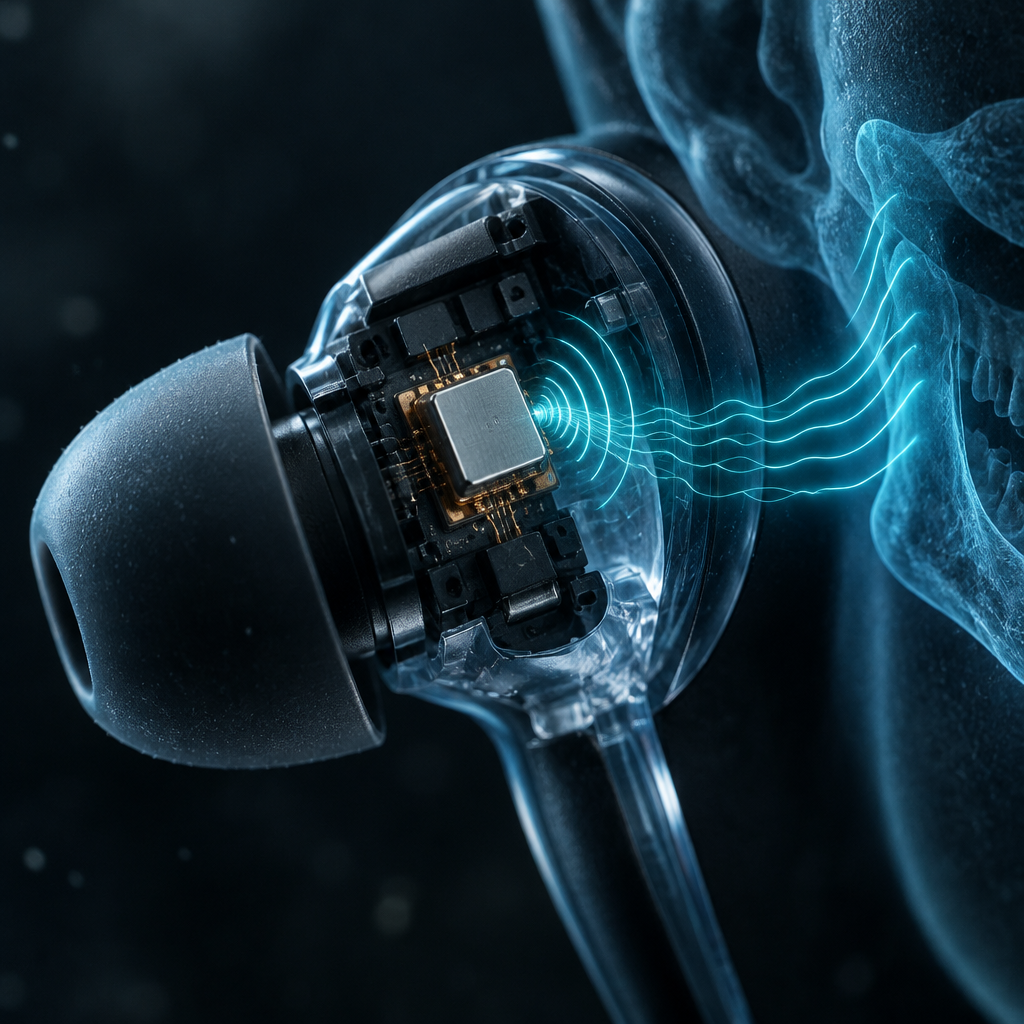
Microphone arrays are not limited to airborne sound. Some earpieces now experiment with microphones that capture vibrations conducted through the skull, cartilage, or the device's contact with the ear. These signals can contain useful information about the wearer's speech while excluding much of the surrounding air noise.
Bone-conduction voice pickup is not magic. The signal is quieter and shaped differently from ordinary speech, and it varies with fit, jaw movement, and anatomy. A model has to learn how a particular user's internal voice signal relates to their acoustic voice. In return, the system may keep a call intelligible when a conventional microphone is being battered by wind or machinery.
Combining airborne microphones with contact or bone-conduction sensing creates a multimodal voice system. The airborne array supplies clarity and natural tone. The conducted signal supplies a cleaner timing and articulation reference. When the two agree, confidence rises. When the air microphones are overwhelmed by noise, the internal signal can help the model decide which speech fragments to retain.
Good call quality is not the same as natural sound
There is a temptation to judge voice isolation by one metric, usually how little background noise the person on the other end hears. That is incomplete. Aggressive processing can produce a call that is quiet but strangely metallic. Fricatives such as s and f may disappear. Plosives can sound clipped. The speaker's voice may swell and shrink as the algorithm changes its confidence.
Naturalness requires preserving the small irregularities that make speech understandable. A good system reduces competing sound without flattening the talker's rhythm, breath, and consonants. It must also avoid the uncanny effect of hearing a perfectly clean voice surrounded by unnatural digital silence. In real life, some room tone is useful because it tells the listener that the connection is alive.
Manufacturers are beginning to tune these systems for context rather than maximum suppression. A work call may favor intelligibility. A voice memo may preserve more room detail. Live translation may prioritize stable syllable boundaries over musical warmth. The same earpiece can make different choices because voice is not one use case.
Privacy becomes part of the microphone design
An earpiece that can isolate one voice from a crowd is powerful, and power creates uncomfortable questions. Does the processing happen locally? Are raw microphone samples sent to a phone or cloud service? Can a voice assistant activate the array without a clear indication? How long are recordings retained?
On-device processing is attractive because it reduces network exposure and makes the feature work during travel or poor connectivity. It also forces manufacturers to publish clearer explanations of what the hardware is doing. A microphone that is always available for wake-word detection is not necessarily recording conversations, but users should not have to guess where the boundary sits.
The most trustworthy products will make the processing path visible. They will show when recording is active, offer local-only modes, and separate call enhancement from cloud transcription. Technical sophistication is not a substitute for consent.
What to expect next
The microphone race is moving toward systems that personalize themselves. An earpiece can learn the wearer's voice, typical fit, head movement, and preferred balance between isolation and naturalness. Calibration may happen during setup, during a short voice sample, or continuously in the background as the model observes which speech fragments survive a call.
Expect more devices to advertise voice focus, not just active noise cancellation. Expect open-ear earpieces to borrow techniques from hearing devices because they cannot rely on a sealed ear canal. Expect earbuds to work as distributed microphones for phones, laptops, translation systems, and augmented-reality displays.
The cleverest designs will not be the ones with the most microphones. They will be the ones that use the available signals with the least audible interference and the smallest battery penalty. In a product small enough to disappear in your ear, that is a formidable engineering target.
Music playback still sells earpieces. But voice isolation is what makes them feel intelligent. When a device can find your voice in the noise without making you repeat yourself, the technology stops being a tiny speaker with Bluetooth and starts becoming a personal acoustic interface.