Wireless earpieces used to have a simple job: receive a compressed audio stream, turn it into sound, and survive until the charging case was nearby. That description is becoming quaint. The most interesting change in modern earbuds is not another dramatic codec claim or a slightly larger driver. It is the arrival of a small, adaptive hearing system that listens to the room, listens to its wearer, and changes its behavior several times every second.
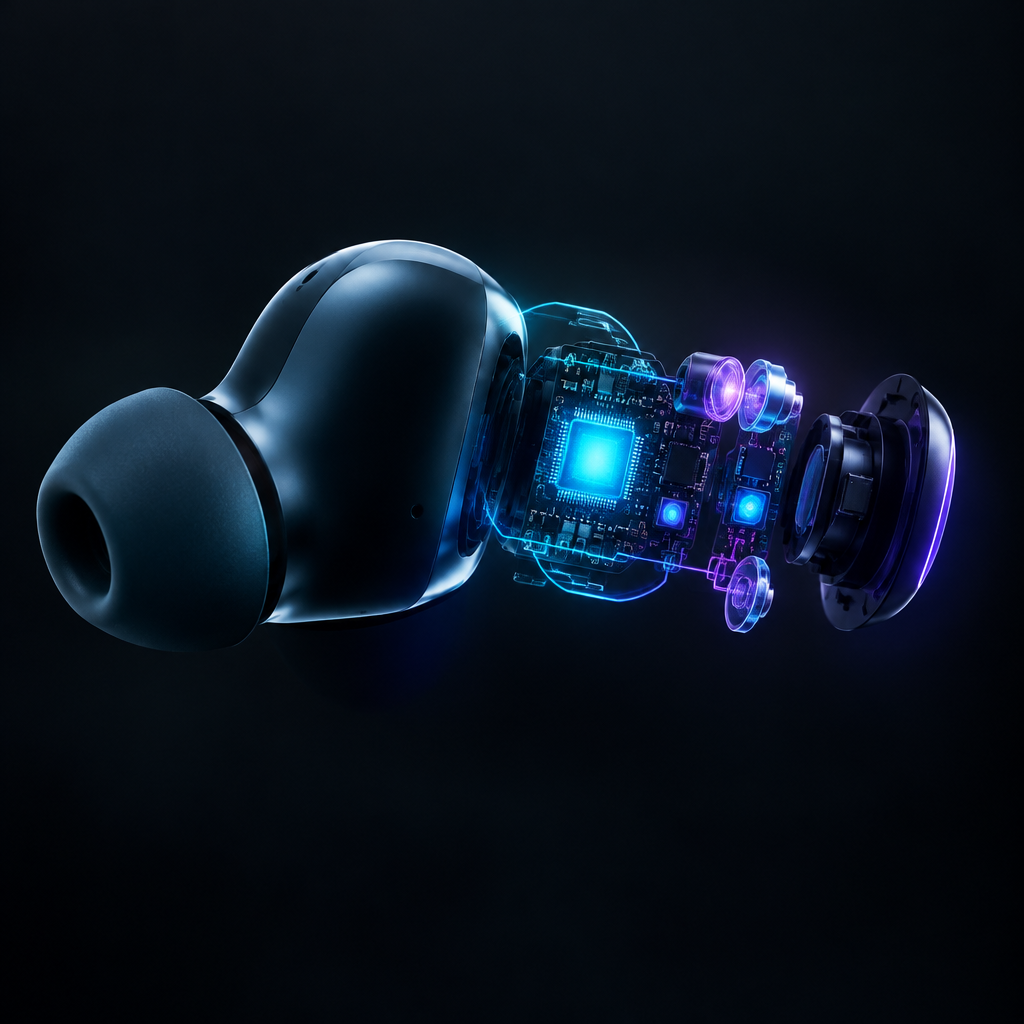
That sounds like artificial intelligence, and sometimes it is. But the useful engineering is more specific than the marketing language suggests. A pair of earpieces has microphones pointed outward, microphones pointed inward, a speaker, a motion sensor, a radio, a battery, and a processor operating under a brutally tight power budget. The product becomes better when those parts cooperate.
The result is a different kind of Bluetooth accessory. It can preserve a voice in a busy cafe, reduce the rumble of a bus without making music pump unnaturally, pass a bicycle bell through an otherwise sealed ear canal, or adjust a fitting that is technically good but acoustically wrong for one listener. In other words, the earpiece is edging toward a personal hearing computer.
Why the microphones matter more than the codec
Bluetooth determines how audio travels from a phone to an earpiece. It does not determine whether the wearer can understand a friend standing across a noisy table. That second problem is solved mostly after the signal arrives, inside the earpiece's digital signal processor.
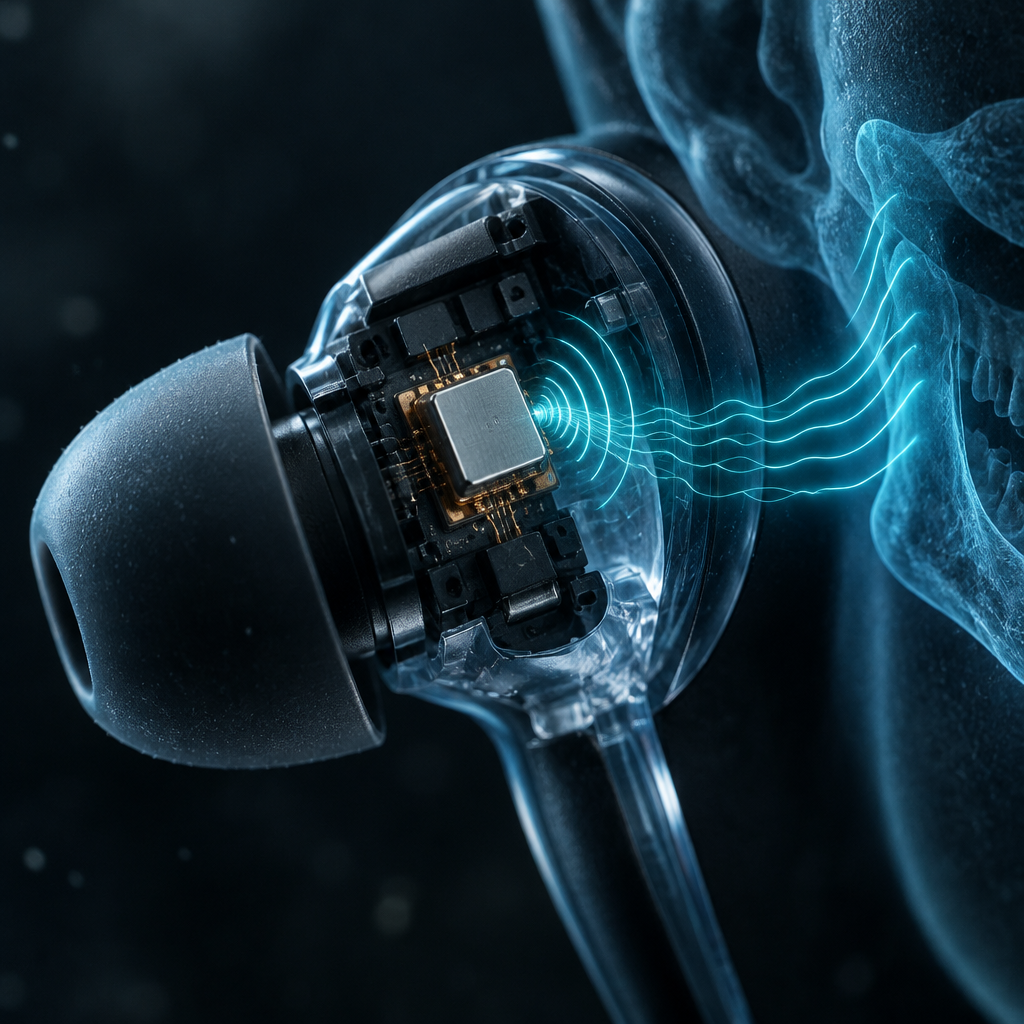
Most sophisticated models use several microphones on each side. The external microphones capture the sound field before it reaches the ear. The internal microphone samples what is actually happening inside the acoustic chamber. By comparing those signals, the processor can estimate leakage, speaker output, wind interference, and the difference between the intended cancellation signal and the sound that really reached the eardrum.
This feedback loop is why fit is not a cosmetic detail. A loose seal changes the acoustic path. Glasses, hair, ear shape, and even the way an earpiece twists after a few minutes can alter the result. A fixed noise-cancellation profile has to assume that every ear is the same. An adaptive system can at least measure part of the error and correct for it.
That correction is not magic. A microphone cannot recover information that has been physically masked, and an algorithm cannot make a tiny battery provide unlimited processing power. Still, the difference between feed-forward cancellation, which reacts to outside sound, and hybrid cancellation, which also checks the sound inside the ear, is substantial. The second approach has a better chance of remaining stable when the seal changes.
Speech enhancement is a separation problem
Voice isolation is often presented as a single button called AI noise reduction. Under the hood, the job is closer to separating overlapping photographs. A conversation, an espresso grinder, dishes, traffic, and wind all occupy the same broad frequency range. The earpiece has to estimate which patterns belong to speech, then preserve enough of the speaker's natural tone to avoid producing a robotic murmur.
Microphone spacing helps. So does beamforming, in which the processor delays and combines microphone signals to favor sound arriving from one direction. A neural model can add another layer by recognizing speech-like patterns that a conventional filter would struggle to distinguish from background noise. The best systems combine both approaches rather than expecting a neural network to solve physics on its own.
There is an important limitation here. A model trained mostly on clean speech can perform beautifully in a controlled demo and poorly in a crowded street. Accents, distance, reverberation, masks, wind, and multiple speakers all change the problem. A convincing earpiece therefore needs not just a large model, but a low-latency pipeline that fails gracefully when its confidence drops.
That is one reason local processing is becoming more valuable. Sending raw microphone audio to a cloud server may provide more computational headroom, but it adds network delay, consumes energy, and creates a privacy problem. For a live conversation, a few dozen milliseconds can matter. Running the first stage on the earpiece keeps the sensitive audio close to the ear and the response immediate.
The inside microphone changes the meaning of transparency
Hear-through mode sounds simple until you wear it in a real place. The goal is not merely to turn up the outside world. It is to make a sealed ear feel open while avoiding a loudspeaker-like color on voices, footsteps, and sudden sounds.
The internal microphone gives the processor a reference for the sound pressure that actually exists near the ear. That allows the system to compensate for the earpiece's own frequency response and for small changes in fit. It can also create a safer transition between music and environmental sound. If a siren or a nearby announcement appears, the system can lower playback while increasing the relevant outside signal.
This is where hearing assistance and consumer audio begin to overlap. A conventional transparency mode tries to sound natural. A more advanced hearing mode tries to make selected sounds easier to understand. Those are not identical goals. Boosting the consonants in speech can improve intelligibility, but excessive processing can make the world feel sharp, synthetic, or tiring.
The right target is not maximum amplification. It is controlled audibility. That requires calibration, sensible limits, and a user interface that explains what the earpiece is changing. A slider labeled “more clarity” is friendly, but a short listening test that measures the result in each ear can be more useful than a dozen generic presets.
Personalization starts with the ear, not the app
Every ear is a small acoustic filter. The shape of the outer ear affects how sound arrives, the ear canal changes resonances, and the seal determines how bass and outside noise behave. Two people can wear the same earpieces and hear noticeably different tonal balances, even when the fit test reports success.
Personalized audio systems are beginning to use a mixture of hearing checks, microphone measurements, and user feedback. Some estimate how the earpiece is behaving by comparing the electrical signal sent to the driver with the internal microphone's acoustic reading. Others ask the listener to identify tones or adjust a voice until it becomes comfortable. The technical advantage is not simply a more impressive frequency graph. It is the ability to use less correction because the system has a better starting point.
There is a practical lesson for buyers: a product's personalization feature is only as good as its repeatability. If the earbuds sit differently every morning, a carefully measured profile may not remain accurate. A comfortable, stable fit can be more valuable than an exotic driver material. The ear is part of the transducer, whether a product page admits it or not.
Battery life is the tax on intelligence
Adaptive processing costs power. Microphones must remain active, the radio must coordinate with the phone, and the processor has to run filters or machine-learning models without overheating a device pressed against skin. Every new capability competes with playback time.
Engineers manage that tax with a hierarchy of tasks. Simple filtering can run continuously at very low power. More demanding models can wake only when the acoustic scene changes or when speech is detected. A phone may handle the most expensive personalization step during setup, while the earpiece performs the latency-sensitive work locally. Hardware accelerators can execute common neural operations more efficiently than a general-purpose processor.
This architecture explains why a feature can exist on a specification sheet but behave differently in daily use. A manufacturer may technically support adaptive sound while limiting it to certain modes, lowering its resolution, or disabling it when the battery falls below a threshold. Good design is not the presence of every algorithm. It is deciding which algorithm deserves power at this exact moment.
Bluetooth still matters, just in a quieter way
The intelligence inside an earpiece does not make the wireless link irrelevant. Bluetooth has to deliver a steady stream while the buds coordinate timing, report sensor data, and sometimes maintain a connection to more than one device. Newer low-energy audio architectures can reduce the radio's burden and support more flexible stream management, but compatibility remains a system-level issue.
Phone support, operating-system support, firmware, codec negotiation, and the earpiece chipset all have to agree. A label such as Bluetooth 5.3 or Bluetooth 6.0 is not a guarantee of a particular listening experience. Version numbers describe a toolbox, not the exact tools a product has chosen to use.
For most listeners, connection stability and predictable latency matter more than a theoretical maximum bitrate. A beautiful lossless stream that stutters while walking past a crowded train station is not a better experience. The next generation of earpieces will likely win by hiding complexity, selecting an efficient mode automatically, and spending its limited energy on the sound the wearer can actually perceive.
The privacy question is now part of audio quality
An earpiece that constantly analyzes voices and surroundings is a more intimate computer than a speaker on a desk. Local processing helps, but it does not answer every question. Users still need clear controls for recording, transcription, cloud features, model updates, and diagnostic data.
There is also a social dimension. Voice isolation can make a private conversation clearer to the wearer, but a recording or transcription feature can affect everyone nearby. The most trustworthy products will make their boundaries visible instead of hiding them behind a vague promise that the experience is “AI-powered.”
The larger shift is already underway. Earpieces are no longer passive endpoints at the edge of a phone. They are sensor platforms with microphones, feedback loops, and enough local computation to shape what a person hears. The winners will not necessarily be the models with the loudest bass or the longest list of Bluetooth acronyms. They will be the ones that adapt without sounding artificial, personalize without becoming fragile, and use intelligence without treating the wearer's surroundings as free data.
That is the real story of the modern earpiece. It is becoming less like a tiny stereo and more like a private acoustic instrument, tuned in real time to one person moving through a noisy world.