The Hum Test
Here is the cheapest audio demonstration on earth. Hum one steady note with your ears open. Now seal your ear canals with your fingertips mid hum and listen to what happens. The note gets louder, and it gets darker, as if someone carried your voice into a stairwell while you were not watching. Nothing changed at the source. Your vocal folds did exactly the same work before and after the fingers arrived. What changed is the exit. Do this once and you have met the occlusion effect, the acoustic gremlin that lives inside every sealed earphone ever made. It is why your own voice sounds like a podcast hosted from inside a barrel on long calls, why biting into an apple with earbuds in feels like heavy machinery, and why a quiet run can turn each footstrike into a kettle drum. Audiologists have measured it for decades. Earbud buyers discover it alone, at midnight, through support forums.
Two Roads to Your Cochlea
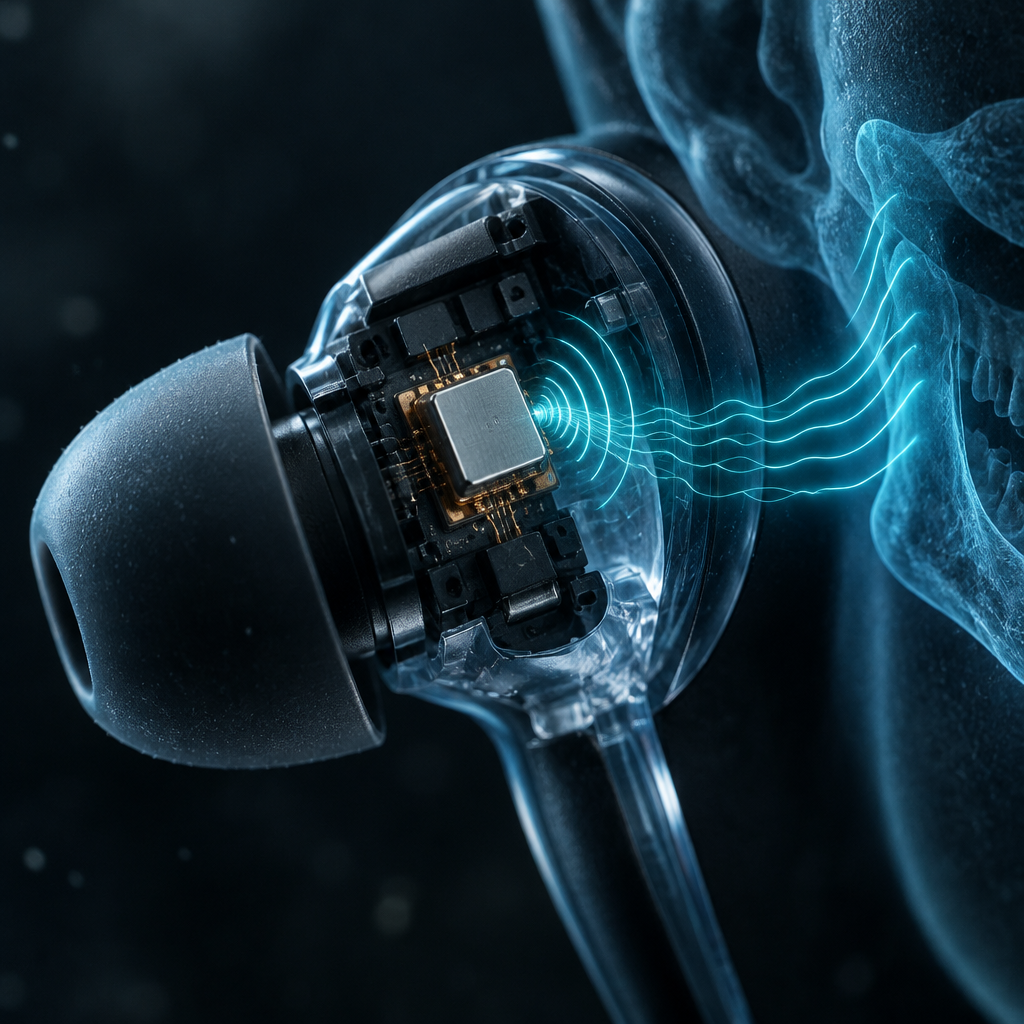
Your inner ear receives your own voice along two separate roads, and the occlusion effect is what happens when one of them gets a detour closed. The first road is air conduction. Sound leaves your mouth, travels across the room and down your ear canal, strikes the eardrum, and gets ferried across the middle ear by three tiny bones. That is the road everyone knows. The second road never leaves your skull. Your vocal folds rattle, your whole head vibrates like a sounding board, and that mechanical shudder travels through bone directly to the cochlea, bypassing air entirely. Bone carries low frequencies beautifully, which is why the deepest part of your own voice arrives largely through your head rather than your ears. Now the crucial detail: when your ear canal is open, a large share of that bone conducted energy leaks out through the canal opening and escapes into the air, like heat leaving a window cracked an inch. Seal the window and the heat stays. Seal the canal and, instead of adding sound, you remove a leak that was quietly draining it.
The Physics of a Plugged Pipe
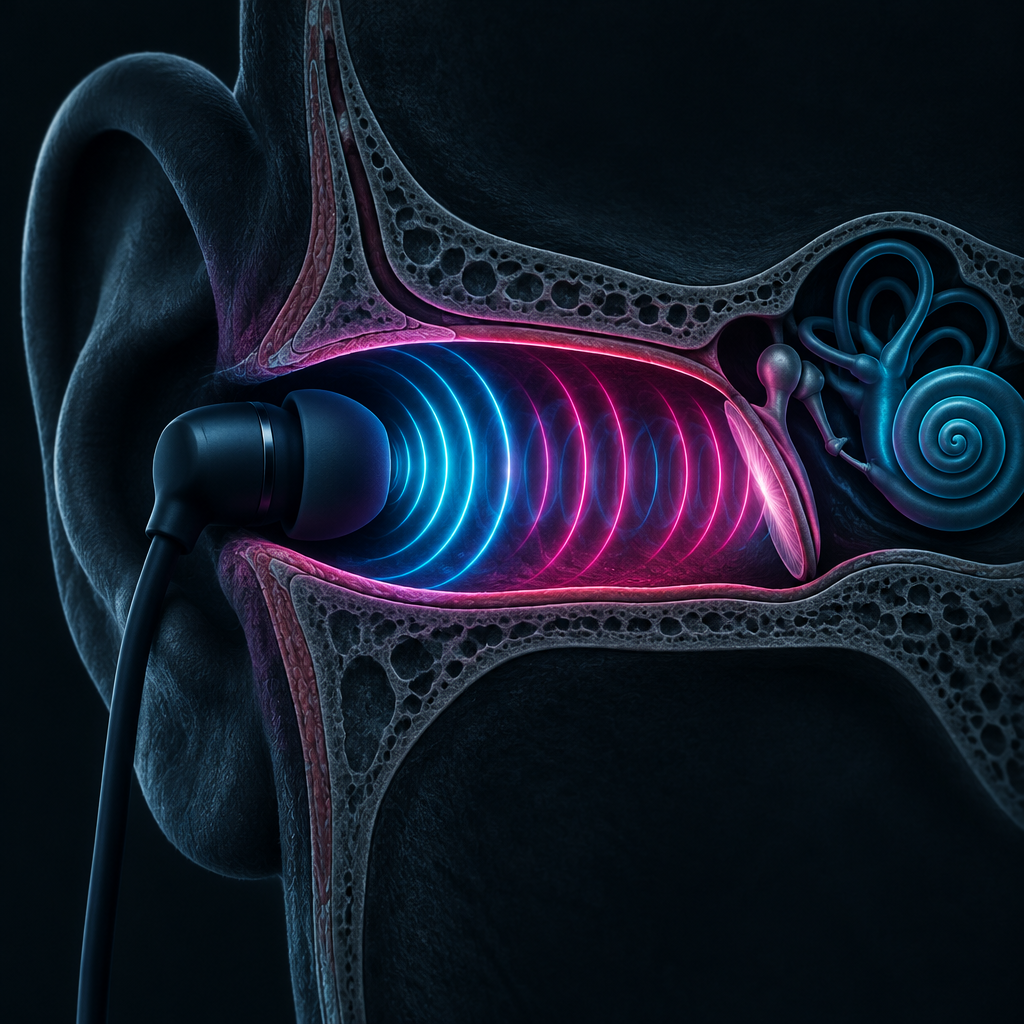
Why does a little rubber plug boost so much bass? Wavelengths. Your ear canal is about 2.5 centimeters long. A 250 hertz tone, right in the sweet spot of the effect, has a wavelength of roughly 1.37 meters, more than fifty times longer. From that wave's point of view, your canal is not a corridor; it is a pressure vessel. When the canal is open, its entrance presents a low acoustic impedance, polite physics language for an open exit door, and low frequency energy radiates away without ceremony. Snap a seal onto that entrance and the impedance at the boundary flips from escape hatch to hard wall. Pressure that used to leave now piles up against the plug and presses back in, uniformly, all the way to your eardrum. The outer third of the canal compounds the problem, because that section runs through soft cartilage that moves when you move your jaw, and a moving wall does work on whatever air is trapped in front of it. A sealed canal is a small piston chamber with your eardrum for a back wall. Your own body just became the loudspeaker cone, and no part of it asked for the promotion.
The Decibel Arithmetic Nobody Prints
Hearing clinics do not guess at this; they measure it with a probe microphone placed a few millimeters from the eardrum. The test is called the real ear occlusion effect, and the numbers are startling for anyone who assumes a $6 silicone tip is a trivial piece of rubber. Sealing the canal commonly adds 15 to 25 decibels of gain to self generated sound in the 250 to 500 hertz region, and individual anatomies can push higher. Twenty decibels is not a rounding error. It is the difference between a quiet library whisper and someone speaking directly at you, applied to the bottom octaves of your own voice before your brain ever gets a vote. Chewing and footsteps run through the same amplifier with worse manners, since each jaw motion squeezes the canal walls mechanically, and a heel strike arrives through your skeleton with no air to soften it. The saving grace is masking. Play music at a normal level and the effect hides underneath the signal, which is why you do not notice it during songs but hear it the instant the track pauses or you take a call. In total silence the amplifier turns even further inward, and some people can pick out their own heartbeat, a sound that was always there, muffled at the exits, waiting for someone to close the doors.
The Soft Wall Changes Everything
The depth of the seal decides how bad this gets, and earbuds settle into the worst available geometry. The canal divides into two very different neighborhoods. The outer third runs through cartilage, soft, mobile, and eager to vibrate in sympathy with your jaw and your voice. The inner third runs through bone, rigid, inert, and almost silent. A seal pressed deep into the bony section couples to a wall that refuses to move, which is why hearing aid manufacturers learned generations ago that deep, hard shell fittings can cut the occlusion effect dramatically. Shallow seals sitting over the cartilage do the opposite: they cap off the pump while the pump keeps pumping. Earbuds, for reasons of comfort, tip retention, and the fact that deeper insertion into a sore spot near the temporomandibular joint feels awful, deliberately perch in the soft zone. Every 'why do I sound so weird to myself' complaint traces back to that choice.
Why Earbuds Cannot Simply Add a Vent
The obvious fix is a hole. Drill a small vent through the plug, let the trapped lows escape, and the occlusion effect collapses toward nothing. Hearing aids offer exactly this, with selectable vent diameters from about 1 millimeter upward, because a vent becomes an acoustic short circuit for low frequencies, draining the boom while leaving most speech intelligibility intact. So why do flagship earbuds stay sealed? Because every vent is a two way street. The same opening that lets your own voice out lets the world in, eroding isolation, and worse, sabotaging active noise cancellation, whose control loop assumes a predictable acoustic cavity. A leak detunes the ANC response and hands the feedback microphones a moving target. Designers walk a knife edge, and it shows in the compromises on the market. Some premium earbuds ship with elaborate internal vent systems that equalize driver pressure and relieve the stuffed sensation while keeping ANC alive, tiny plumbing that occupies more engineering effort than most drivers receive. There is no free lunch in acoustic plumbing, only trades.
Call Mode and the Synthetic Band-Aid
What cannot be vented gets faked. Old landline telephones fed a deliberate copy of your own voice back into the earpiece, a trick called sidetone, invented so the line would not feel dead and callers would not instinctively shout into the silence. Cellular networks mostly abandoned it, a decision nobody noticed, because cell phones never plugged your ears. Wireless earbuds changed that overnight, and suddenly half the world's calls happened from inside a pressure chamber, so call firmware quietly relearned the old lesson. Modern buds sample your voice from their stems and mix a calibrated whisper of it back into your own playback, raising synthetic sidetone from dead tradition to necessary medicine. Some models go further, detecting the moment you start talking and blending transparency back in, a temporary unsealing performed in software. There is a deep irony here: that same sealed chamber that ruins your self hearing is an exceptional listening post for your skull. A few designs put a microphone inside the sealed cavity to harvest bone conducted voice while wearing down the ambient wind noise outside. The bud that makes you sound strange to yourself is also, engineering being perverse, the quietest place to eavesdrop on you.
What You Can Actually Do
You cannot redesign the canal, but you hold more levers than the spec sheet admits. Chase depth before you blame the hardware: a foam tip rolled thin and inserted a few millimeters deeper can move the seal toward the bony neighborhood and shrink the boom, which is why tip material and size change the effect more than the price of the product. Work through the fit test in your earbuds' app if one exists, and pay attention to tips one size up from comfortable. On calls, lean on transparency or voice modes before deciding you hate your own voice; much of what you dislike is a closed window, not a true reflection. Runners have the strongest case for a bigger change: open ear clips and bone conduction bands leave the canal untouched entirely, which deletes the footstrike drum solo at the source. Last, a consolation that keeps the embarrassment manageable. The barrel in your head is private property. The person on the other end of the call hears your air conducted voice, clean, unoccluded, and unchanged, with no idea that you are currently trapped inside an oil drum arguing with yourself about how loud you are.