The 300-Millisecond Problem
Human conversation tolerates about 200 milliseconds of silence before it starts to feel awkward. Past 500 milliseconds, the other person assumes you did not hear them. Real-time translation earbuds have to capture speech, recognize it, translate it, synthesize audio, and deliver it back to the user within that window. The entire pipeline. Every stage. No exceptions.
Apple's AirPods Pro 3, released in September 2025, claims to do it in 300 to 500 milliseconds. The H2 chip inside each earbud runs a compressed Transformer language model, performing 15 billion neural operations per second on-device, without sending a single audio packet to a server. Google's Gemini 3.5 Live Translate, released in June 2026, takes a different route. It streams audio to Google's cloud, runs a full-scale multilingual model on server-grade tensor hardware, and pipes the translated speech back over a cellular or WiFi connection. Two architectures. Same promise. Different tradeoffs.
The fight over which approach wins is the most interesting hardware story of 2026, and almost nobody outside the audio engineering community is paying attention to it.
Why Cloud Translation Was Never Going to Work in Your Ear
The math is unkind. A spoken sentence leaves your mouth, travels through air to a microphone, gets digitized, compressed, sent over Bluetooth to a phone, uploaded over cellular to a cloud server, processed through a speech recognition model, fed through a neural machine translation engine, passed to a text-to-speech synthesizer, compressed again, sent back over cellular, relayed over Bluetooth, and played through a tiny driver into your ear canal. Every hop adds latency. Every compression stage degrades fidelity. Every network glitch drops a syllable.
In real-world testing, cloud-dependent translation earbuds like the Xiaomi Buds 4 Pro, which route 95 percent of processing through third-party APIs, exhibit latencies of 800 milliseconds to over a second. Enough time for a conversation partner to assume you did not understand and repeat themselves in a louder voice, which makes the microphone's job harder.
There is also the privacy question. Cloud translation means uploading your raw speech to a server you do not control. For a tourist ordering food, this is a minor concern. For a business executive discussing quarterly earnings in a Tokyo hotel room, it is a data governance nightmare. Apple built its entire marketing position around this distinction: 100 percent edge processing, zero audio leaving the device.
The Transformer That Shrank to 50 Megabytes
The technical achievement inside Apple's edge translation is not the model itself. Transformer architectures have been around since 2017. The breakthrough is compression. A full-scale multilingual Transformer might require several gigabytes of storage. Apple's version fits in 50 to 120 megabytes per language pair.
The compression relies on three techniques working in concert. Quantization reduces the precision of neural network weights from 32-bit floating point to 8-bit integers, cutting memory usage by 75 percent with minimal accuracy loss. Weight pruning identifies and removes neural connections that contribute least to output quality, thinning the network's density. Knowledge distillation trains a small student model to mimic the behavior of a much larger teacher model, transferring the teacher's capability into a fraction of the parameters.
The result runs on the H2 chip's Neural Engine, a dedicated silicon block designed for matrix multiplication at low power. Apple trained the student models on over 10 million hours of multilingual conversational data, using federated learning techniques that protect individual user data during the training phase. The compressed models achieve 96 percent translation accuracy in restaurant ordering scenarios and 85 percent in business meetings. Not perfect. But functional. And instant.
Timekettle's Babel OS and the Semantic Segmentation Bet
While Apple optimizes the model, Timekettle optimizes the pipeline. Its Babel OS, announced at CES 2025 and now in its third generation, attacks the latency problem from a different angle. Instead of waiting for a speaker to finish a sentence before translating, Babel OS uses what it calls AI Semantic Segmentation to chop incoming speech into fragments and predict where sentences are heading.
The system does not wait for a period. It identifies clause boundaries, partial phrases, and predictive completions, then begins translation before the speaker has finished talking. This cuts perceived latency to near zero in optimal conditions. The tradeoff is risk: if the prediction is wrong, the translation needs to backtrack and correct, which can produce a jarring audible stutter. Timekettle mitigates this with a custom lexicon system that lets users define domain-specific vocabulary, improving prediction accuracy for specialized contexts like medical consultations or legal negotiations.
Babel OS also introduced voice cloning. Instead of a neutral synthetic voice, the system replicates the tone, cadence, and speech patterns of the original speaker. The translated output sounds like you, not like a robot. The psychological effect on conversation flow is significant. Listeners attribute more trust and authority to a familiar voice pattern than to a flat synthesized tone, even when they know the voice is artificially generated.
Bone Conduction: When Your Skull Becomes the Microphone
The weakest link in any translation earbud is not the AI. It is the microphone. A noisy street, a crowded train, an air-conditioned conference hall. Background sound contaminates the input signal before any neural network ever sees it. Speech recognition accuracy degrades nonlinearly with noise. A model that hits 96 percent in a quiet restaurant might drop to 78 percent at a busy intersection.
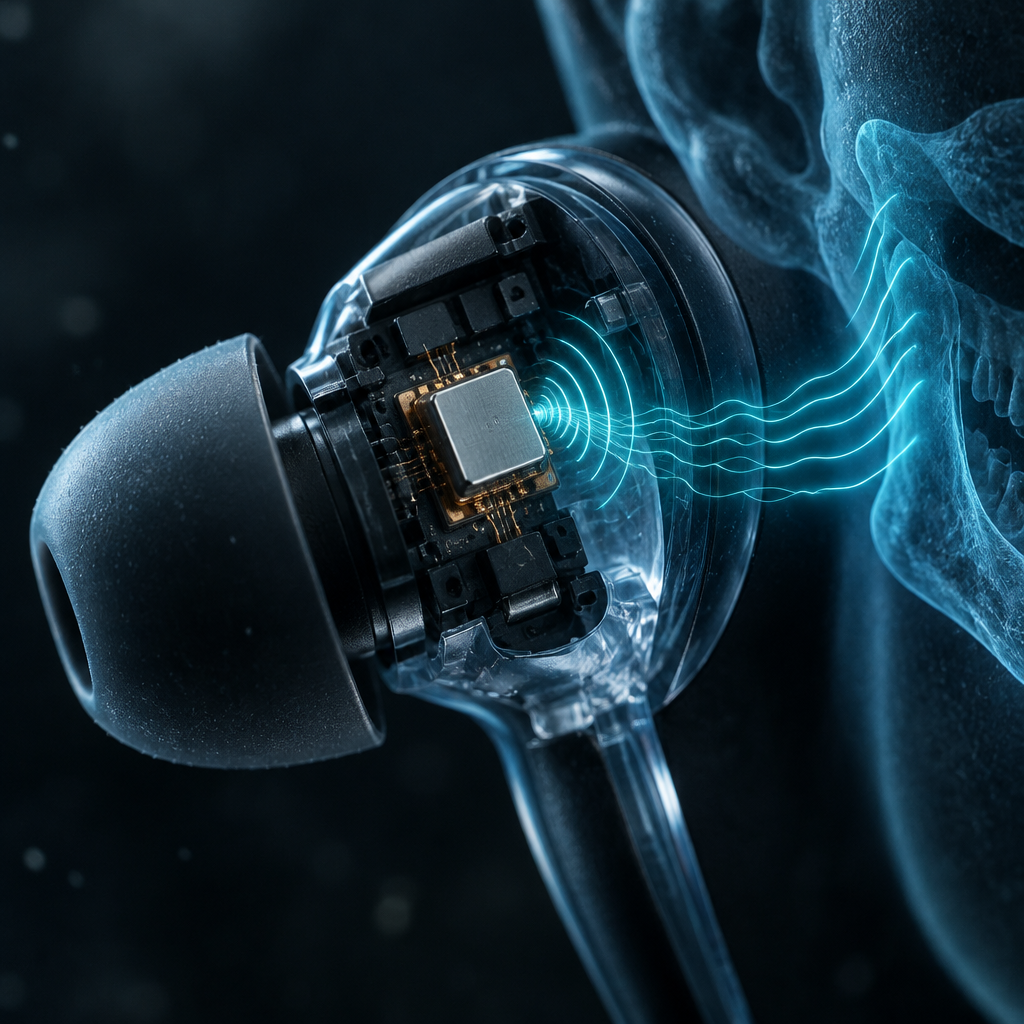
Bone conduction pickup offers a hardware solution to a software problem. Instead of relying solely on air-conduction microphones, some translation earbuds, including the Timekettle W4, capture vibrations transmitted through the skull and jawbone during speech. These vibrations bypass the ambient sound environment entirely. The signal arriving at the bone conduction sensor is cleaner, more isolated, and less affected by wind, traffic, or crowd noise.
The tradeoff is audio quality. Bone conduction captures lower-frequency speech components with fidelity but loses high-frequency detail. The consonants that distinguish sit from ship live in the 4 to 8 kHz range, where bone conduction pickup is weakest. The most effective translation earbuds use a hybrid approach: bone conduction for noise isolation, air-conduction microphones for high-frequency detail, and DSP fusion to merge the two signals. Timekettle calls this bone voiceprint technology. It is not a new concept in audio engineering, but applying it to real-time translation is a 2026 innovation that meaningfully improves recognition accuracy in noisy environments.
Google's Cloud Gamble with Gemini Live Translate
Google made the opposite bet. Gemini 3.5 Live Translate, released in June 2026, is a streaming speech-to-speech system that processes continuous audio through a full-scale multilingual model running on Google's cloud infrastructure. It supports over 70 languages, preserves the speaker's emotional tone and cadence in the translated output, and works with almost any headphones that have a microphone. No dedicated AI chip required. No model compression. No 50-megabyte constraint.
The advantage is raw quality. A cloud model with gigabytes of parameters can handle idioms, cultural context, code-switching between languages, and complex sentence structures that a compressed edge model fumbles. Google's model card for Gemini 3.5 Audio describes a system trained on the same infrastructure that powers Gemini 3 Pro, with access to far more training data and computational headroom than any earbud chip can match.
The disadvantage is everything else. Latency depends on network quality. Privacy depends on trust in Google's data handling. Offline use is impossible. The hybrid approach adopted by Samsung, where simple phrases run on-device through Exynos AI cores while complex sentences fall back to cloud processing, tries to split the difference. In practice, the transition between local and cloud processing introduces its own latency spike, producing an inconsistent experience that users find more frustrating than either pure approach.
What Breaks When You Shrink a Language Model
Edge translation has hard limits that marketing does not mention. A 50-megabyte model cannot encode the full semantic complexity of 70 languages. Apple's AirPods Pro 3 support a subset of language pairs, with each pair requiring its own compressed model stored on the device. Switching languages means swapping models, and storage on an earbud is not infinite.
Domain-specific vocabulary is another casualty. The edge models handle everyday conversation well. They stumble on medical terminology, legal language, and specialized industrial jargon. Apple is developing modular vocabulary packs using few-shot learning, which would let users download domain-specific language modules on demand. Until those ship, a doctor explaining a diagnosis through translation earbuds should expect accuracy to drop significantly.
Then there is the power budget. Running a Transformer model on an earbud chip draws substantially more current than playing music. The neural engine generates heat inside a device that sits against your skin, with no active cooling and limited surface area for dissipation. Translation earbuds that promise 8 hours of music playback often deliver 3 to 4 hours of continuous translation before the battery dies. The Qualcomm S7 and S5 Gen 3 platforms, which power many of the third-party translation earbuds hitting the market in 2026, advertise up to 50 times more on-device AI processing power than their predecessors. That power comes at a thermal cost that earbud designers are still learning to manage.
The Question Nobody Is Asking
The real story is not edge versus cloud. It is what happens when translation becomes a commodity feature baked into every earbud, not a specialty product category. Timekettle charges $449 for the W4 Pro. Apple includes translation in a $249 AirPods Pro 3. Google's Gemini Live Translate works with earbuds that cost $30 on Amazon. The price curve is collapsing. The capability is spreading.
When every earbud translates every language in real time, the differentiation shifts from can it translate to how well does it translate in this specific situation. The companies that win will be the ones that solve the hardest cases: noisy environments, low-resource languages, code-switching between dialects, domain-specific vocabulary, and the social dynamics of real conversation. Not the ones with the biggest model or the fastest chip. The ones that understand that translation is not a technical problem. It is a human communication problem that happens to require extraordinary technology to solve.