Put a pair of Bose QuietComfort Ultra Earbuds in and something curious happens before the first note plays. A thin warble, a chirp sweeping upward, sounds in each ear for a few seconds. Nothing has synced. Nothing is broken. The earbuds are taking measurements of the inside of your head, and they do it again every single time you seat them.
Other brands run the same routine, some quieter than others. AirPods Pro keep a microphone pointed inward at your canal for as long as you wear them, silently correcting the sound hundreds of times a session. Sony, Samsung, Jabra, and Sennheiser all play some version of the trick. It sounds like a gimmick spun up by a marketing department. It is closer to a clinic procedure, decades old, that used to require a dim room, a thin rubber tube, and a professional invoice. The tube is gone. The invoice is gone. The measurement moved into the foam.
The Measurement Audiologists Keep Skipping
Hearing aids are not sold on guesswork, at least in theory. They are fitted to a prescription, a set of amplification targets calculated from an audiogram. The gold standard for checking whether the hardware actually hits those targets is called real-ear measurement. An audiologist threads a slim silicone probe tube down the ear canal alongside the hearing aid, parks its tip within about five millimeters of the eardrum, plays a test signal, and records what truly arrives at the membrane. Not what the box promises. What arrives.
The gap between those two numbers is routinely shocking. Coupler curves measured on lab hardware sit several decibels off what real, fleshy, individual ears receive, and the direction of the error is not consistent. Here is the embarrassing part of the story: surveys of the profession keep finding that only a minority of hearing aid fittings are ever verified this way. The single most individual acoustic cavity a human owns, and most devices shipped for it are tuned against an average ear they will never meet. Consumer earbuds inherit exactly that problem, with one twist. Somebody finally decided to measure.
How an Earbud Does It Without the Tube
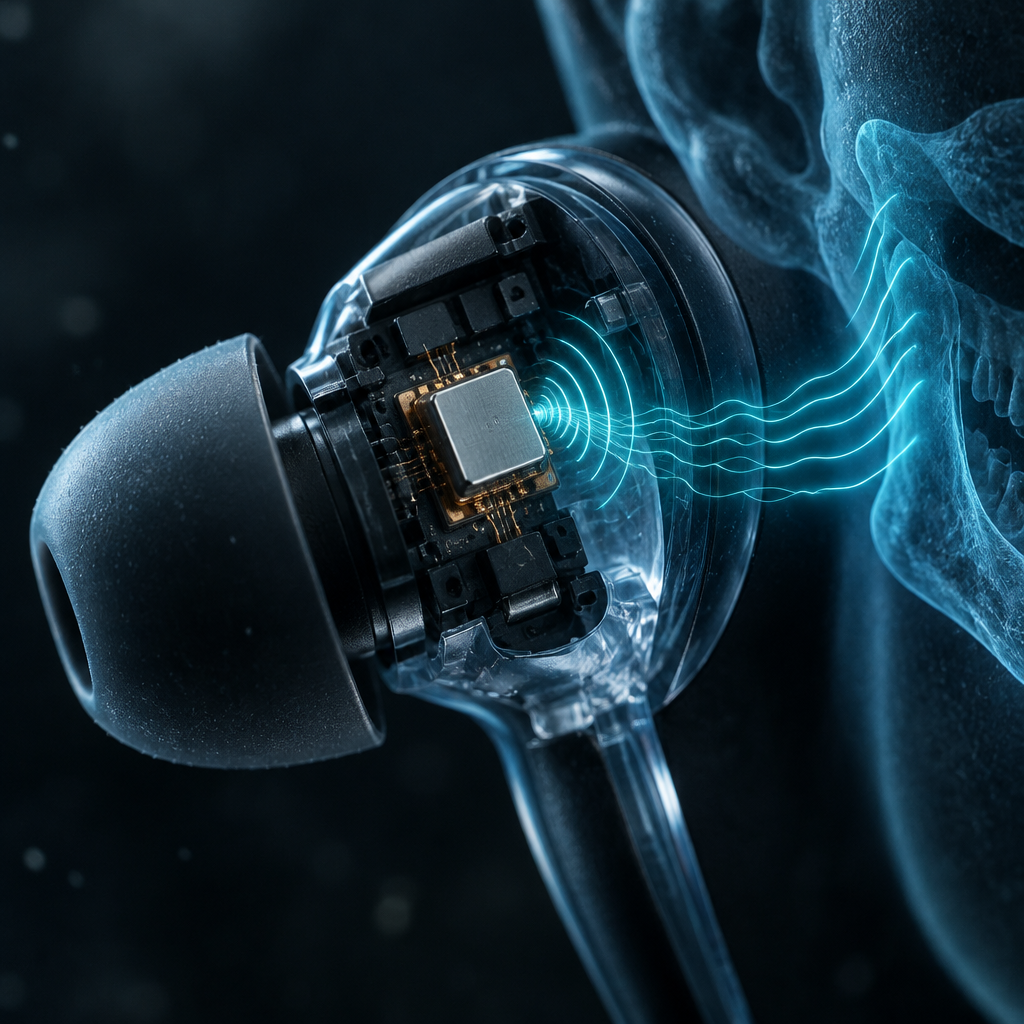
No product you would voluntarily wear can put a microphone at your eardrum. The inward-facing mic in a modern earbud sits roughly two centimeters shy of it, near the driver. So the earbud does algebra instead of anatomy. Three quantities are known from the factory: the driver, engineered and measured as a source; the microphone, characterized as a receiver; and the acoustic path between them through a reference artificial ear, the standardized IEC 60318-4 ear simulator that every audio lab on earth uses to get comparable numbers. Play a chirp. Record what bounces back. Subtract the reference. The residue that survives the subtraction is you: your canal's length, its flare, the pressure of the tip's seal, the willingness of your canal walls to give.
Bose calls its version CustomTune, and it commits to the bit. Every insertion triggers the chirp sequence, each ear measured separately, and both the sound signature and the strength of the noise cancellation are fitted to the result. A sloppy seal gets a more aggressive feedback loop to claw back the quiet. A tight one gets headroom instead. Apple's approach splits the job in two. The Ear Tip Fit Test plays a short burst after you size your tips and grades the seal, green means go. After that, Adaptive EQ samples the canal continuously through the inward microphone and nudges low and midrange response as things shift, because things always shift.
The readings are sharper than they look. A shallow insertion and a leaking seal can both cost bass, but the chirp tells them apart: depth moves the canal resonance and the treble shelf with it, while a leak mostly guts the bottom octaves and leaves the resonance standing. That distinction drives real behavior. Pull one earbud slightly outward mid-song and a modern pair will judge how its geometry changed, not merely that it changed, and respond with a correction weighted toward the right band rather than a blind bass boost. Crude systems respond to a bad fit the way a smoke detector responds to toast, loudly and without insight. The good ones read the signature.
Your Ear Canal Is a Filter Pretending to Be a Hole
Why any of this matters takes one paragraph of physics. The canal is not a hallway. It is a resonator. An open-ended tube around two and a half centimeters long supports a quarter-wave standing wave, and for the human canal that resonance lands near three kilohertz, within shouting distance of 10 dB of gain at the eardrum in that band. Your ear is literally an equalizer curve with a broad hump bolted into it, a hump that every recording you have ever heard was already shaped to complement, at least on average.
Average is where the trouble lives. Canals differ in length and diameter between strangers, sure, but they also differ between your left ear and your right. Then the walls enter the picture. Real ear canals are flesh, not acrylic, and soft tissue yields to pressure, absorbing a few decibels of low frequency that a rigid lab coupler would faithfully report. Leaks finish the job. A gap between tip and skin the width of a hair vents acoustic pressure, and below the corner frequency set by the leak, bass collapses at a slope steeper than 12 dB per octave. Translation: the same earbud, driven by the same file, can deliver powerful bass in one ear of your head and almost none in the other, purely from anatomical luck. Any tuning frozen at the factory is tuning for a mannequin. Measurement is the only way out.
Your Ear Changes Between Songs, So the Measurement Follows It
The canal you measured this morning is not the canal you will have at lunch. Drop your jaw and the canal's cross section changes; that is why yawning sometimes unseats an earbud. Chew, run, sweat, and the tip walks. A head cold changes the stiffness of the eardrum itself, which changes what the ear reports back. This is the argument for continuous or per-insertion measurement rather than one initialization ritual: the static ear it assumes does not exist. Systems that reseal during a workout, detect the moment the acoustic seal degrades, and retune around jaw movement are not being fussy. They are chasing a target that physically will not sit still.
When the measurement works, consequences ripple past music. Apple shipped a clinical-grade hearing test on AirPods Pro, an automated pure-tone exam that only functions because the system trusts its own picture of your canal and its seal. A rough fit invalidates the exam; the app knows and says so. That is the entire trajectory in one feature: the earbud stopped being a speaker that happens to sit in an ear and became an instrument that happens to play music.
The Honest Limits of the Self-Scan
Now the fine print, because the chirp is cleverer than it is omniscient. Standing wave interference is the big one. Two centimeters from the eardrum is acoustically nowhere: reflections between mic and membrane corrupt the measurement at high frequencies, which is precisely why clinical probe tubes go within five millimeters of the membrane, past the worst of the interference. An earbud cannot. Above roughly five kilohertz, its self-scan degrades from measurement into statistical inference, an educated guess about your ear drawn from databases of human canal variation rather than a reading of your head specifically.
The environment fights too. A chirp played into a loud gym comes back smeared with clatter, and the system must decide what is signal and what is weekend noise. Middle-ear conditions, eardrum impedance, the odd anatomy of a surgically repaired ear: all rewrite the answers without announcing themselves. The self-scan is an estimate, a good one, and honest engineering keeps it branded as personalization rather than diagnosis.
The Inside of Your Head Is Now Data
One more consequence deserves daylight. A stored per-ear acoustic profile, stable across weeks and dependent on your anatomy, is a biometric signature by another name. Some implementations keep the correction running entirely on the earbud's silicon, recalculated and forgotten. Others sync a profile, your canal's fingerprint, to a cloud account so a replacement unit can inherit you. Neither choice is wrong. Worth knowing which one your brand made, though, before you hand a company a recording of the inside of your skull.
The Buyer's Translation
On a spec sheet, look for these behaviors by name: a fit or seal test, something like Apple's Ear Tip Fit Test; adaptive or personalized EQ that runs on the device; per-ear storage, so your left ear does not carry your right ear's tuning. Rerun the fit test after swapping tip sizes or materials, because memory foam expands and its seal improves for the first minute of wear; a measurement taken the instant you insert will underestimate what you get after it settles. Use the largest tip that seals comfortably; most people undersize. And keep the expectation calibrated: this technology makes your earbuds sound like you, consistently. It does not check your hearing, and it is not a substitute for the audiology clinic whose signature move, buried in three seconds of chirping, it quietly stole.