Your Earbuds Are About to Become a Public Radio: Inside Auracast's Audio Broadcast Revolution
You are sitting in an airport terminal. A muted television mounted above the gate is playing CNN with closed captions, audio intentionally killed to preserve the ambient calm. Sixty years ago, this scenario would have been science fiction. Today it is the default setting for every departure lounge, gym, and waiting room in the country. You can watch the anchor's mouth move, but you cannot hear a single word.
Now imagine tapping your phone once, selecting a broadcast stream from a small menu, and hearing that exact television feed through the earbuds already in your ears. No front desk. No loaner headphones sanitised between uses. No neckloop receiver with a fraying cable. Just the hardware you brought with you, configured in seconds, pulling audio directly from a Bluetooth transmitter you never had to pair with.
That is Auracast. The Bluetooth Special Interest Group calls it the most significant advancement in wireless audio since the original specification, and unlike a lot of industry marketing, the description happens to be accurate.
The end of one-to-one
Classic Bluetooth audio operates on a connection model designed for point-to-point communication. Your phone connects to your earbuds. That connection occupies a dedicated channel, authenticated through a pairing handshake, consuming power and spectrum for exactly one listener. If a second person wants to hear the same source, the whole protocol starts over from scratch.
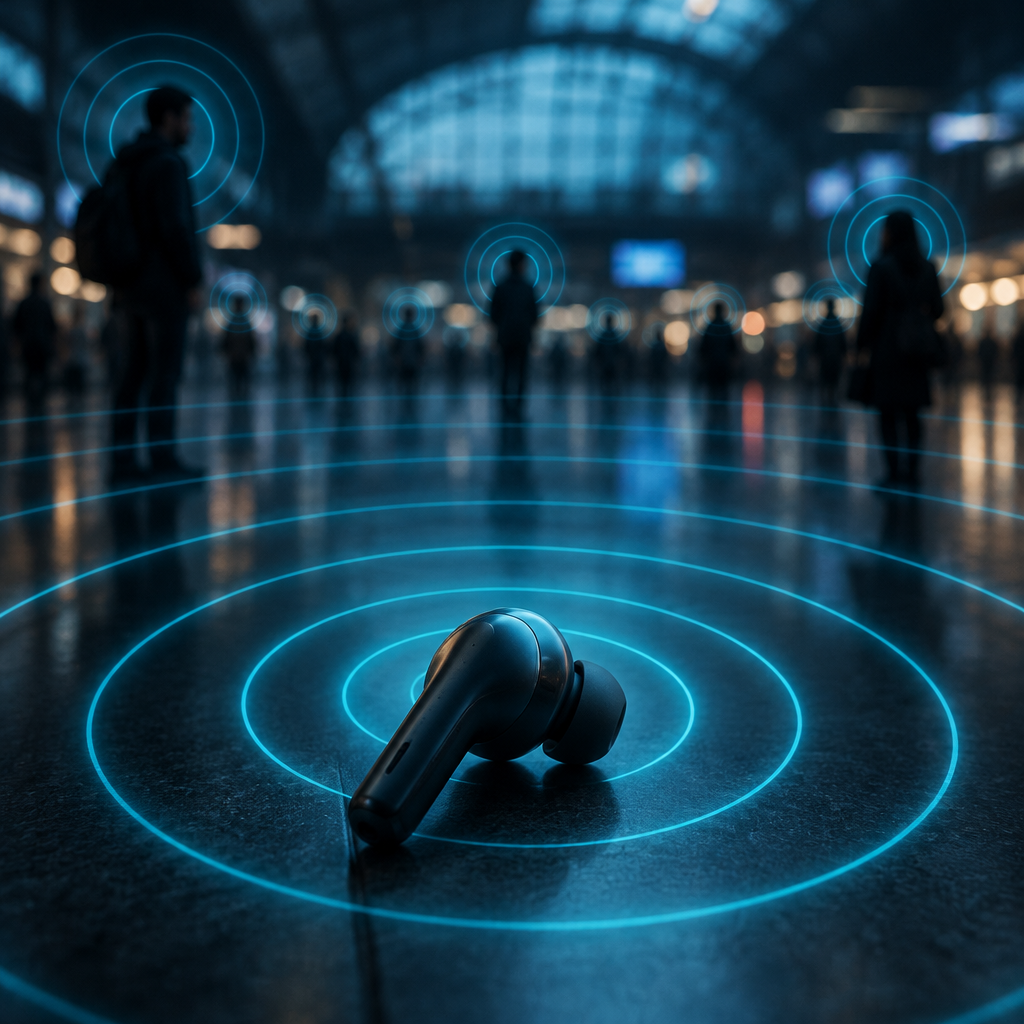
Auracast inverts this architecture entirely. Instead of establishing a private link between two devices, a transmitter broadcasts one or more audio streams into the surrounding space using Bluetooth Low Energy isochronous channels. Any compatible receiver within range, roughly 100 meters depending on the physical environment, can join that broadcast. There is no cap on the number of listeners. The Hard Rock Cafe in Dubai installed an Auracast transmitter so that every guest with compatible earbuds or hearing aids could tune into live music performances at their own preferred volume. The system does not degrade when the room fills up; it does not even care how many people are listening.
The parallel most people reach for is radio, but that analogy is incomplete. Radio broadcasts blindly across a wide area with no awareness of whether anyone is listening. Auracast uses Bluetooth LE's advertising and scanning mechanism to provide discovery, meaning your phone can detect what broadcasts are available in your vicinity and present them as selectable options through the Auracast Assistant app. You see what streams exist around you before you commit to one. You switch between them the way you would change channels on a television, not the way you would tune between FM stations and hope for reception.
The codec that made it possible
None of this would function without LC3, the mandatory codec for Bluetooth LE Audio. Its name stands for Low Complexity Communication Codec, and the engineering ambition was deceptively narrow: deliver audio quality at least as good as the legacy SBC codec, but at half the bitrate. What Bluetooth SIG's own listening tests demonstrated was more impressive than the design goal. Test subjects consistently preferred LC3 at 160 kilobits per second over SBC at 345 kilobits per second. Better perceived quality at less than half the data rate.
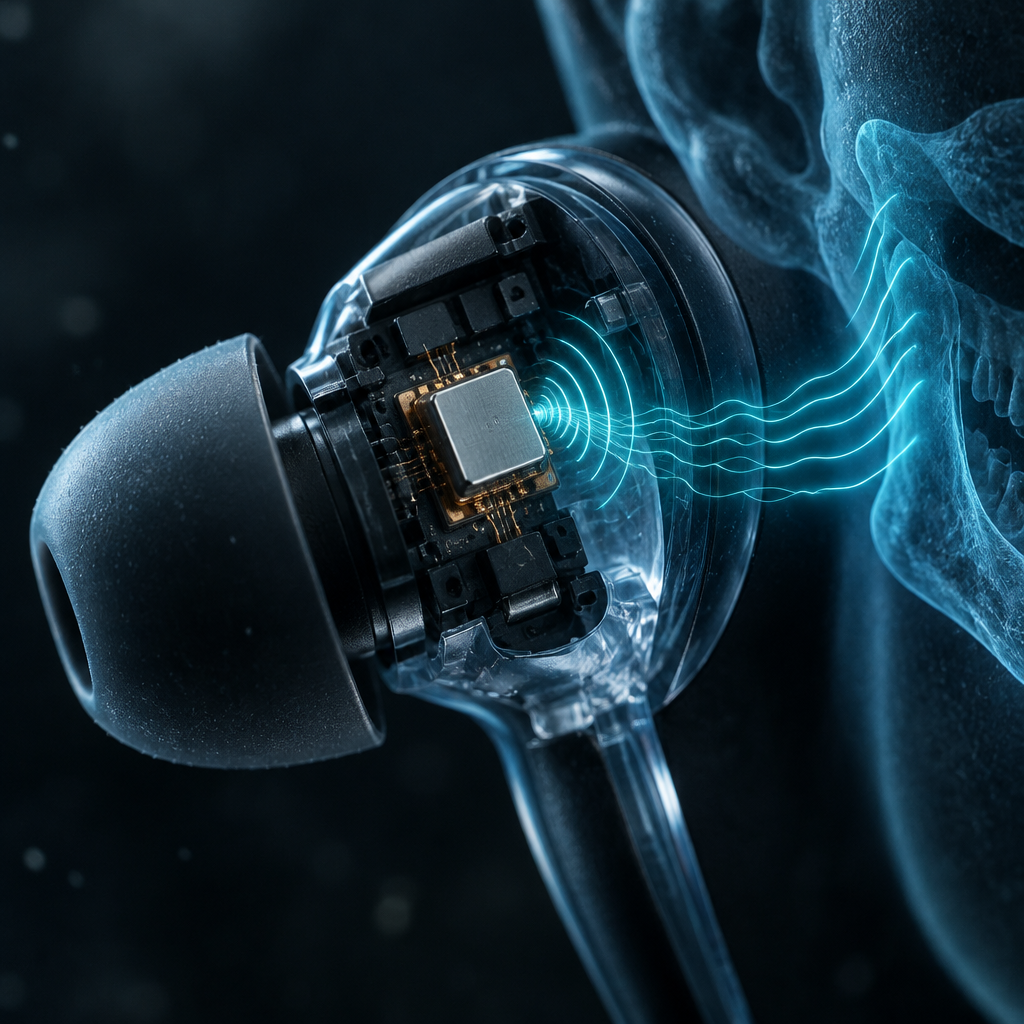
The practical consequence for earbuds is dramatic. Lower bitrate means less data to encode, transmit, and decode, which means the DSP in your earbud spends less time and less energy doing its job. The latency story is similarly improved. LC3 achieves roughly 20 to 30 milliseconds of end-to-end latency, compared to SBC's 70 to 90 millisecond range. For someone watching a muted television at a gym and streaming its audio through earbuds, the anchor's lips and the words arriving in their ears stay in sync.
Each listener can also adjust their own volume independently. This detail is easy to overlook in a technical explainer, but it is the feature that separates Auracast from every assistive listening system that preceded it. Induction loop systems, the copper wire installations embedded in the floors and walls of theaters for half a century, deliver a fixed-level audio signal to telecoil-equipped hearing aids. You get what the system sends. Auracast broadcasts the stream; the earbud decides how loud it should be. A person with mild hearing loss and a person with normal hearing can sit side by side, both tuned into the same broadcast, each experiencing it at a volume suited to their own ears.
Where it is already running
If you assume this technology remains confined to CES demo tables, the deployment list will surprise you. As of early 2026, Auracast infrastructure has been installed across 17 countries, including the United States, Japan, Germany, France, Australia, and South Korea. Real venues are using it right now, not experimenting with it.
The Sydney Opera House has Auracast installed. So does the Rosary Basilica in France, where worship services are broadcast directly to visitors' hearing aids and earbuds without any intermediary device. The Marriott Theatre in Chicago uses it for musical theatre performances. Blackfriars Theatre in New York, the Åsane Arena in Norway, the Karlsruhe Institute of Technology in Germany; these are performance spaces and public buildings that needed a better way to deliver audio to the people inside them.
Listen Technologies, one of the primary hardware manufacturers behind the Auri Auracast system, began shipping transmitters in January 2025. Their Auri TX2N transmitter sits in an equipment rack and accepts a clean audio feed from any existing PA or AV system; no special source equipment is required. For guests who arrive without Auracast-compatible earbuds, the Auri RX1 receiver offers a pocket-sized fallback that works with standard wired earbuds or neckloops. The strategy is deliberately complementary. You install Auracast alongside what you already have, not in place of it.
The earbuds you already own might work
Auracast is not a proprietary Apple feature or a Samsung exclusive. It is part of the Bluetooth LE Audio specification, which means any manufacturer can implement it. Samsung's Galaxy Buds2 Pro, Buds 3, and Buds 3 Pro support it. Sony's recent wireless earbuds support it. Philips released the TAT3000BK, an Auracast-compatible earbud marketed specifically for public broadcast listening.
Apple's AirPods Pro 3, released in September 2026, ship with heart rate and body temperature sensors but do not yet list Auracast among their features. That gap will not last. Bluetooth SIG projects that by 2029, 3.1 billion devices will ship with LE Audio capability. The installed base of compatible earbuds is growing at exactly the moment that public venue deployments are accelerating. These two curves are designed to reinforce each other: more compatible devices creates demand for venues to broadcast; more venues broadcasting creates demand for devices that can receive.
What changes when audio is a public utility
The quiet revolution here is not the technology itself but the role it assigns to earbuds. For two decades, wireless earbuds have been personal devices. You pair them to your phone, you listen to your content, you exist in your own audio envelope. Auracast asks earbuds to do something different: receive audio from the environment around you, the way your ears already do, but with control over what you hear and how loudly you hear it.
A gym with a wall of muted televisions, each tuned to a different channel, can broadcast every audio feed simultaneously through separate Auracast streams. You pick the one corresponding to the screen in front of you. An airport can broadcast gate announcements directly to the earbuds of every passenger in the terminal, in the language of their choice. A theme park can broadcast ride narration and ambient soundscapes to visitors walking through different zones, switching streams as they move.
None of these use cases require new earbud hardware for anyone who already owns a compatible pair. They require venues to install a transmitter and post a sign. The friction lives almost entirely on the infrastructure side, which is why commercial deployments are leading consumer awareness. You discover Auracast exists when you see a sticker at a museum entrance telling you to use it. That is a strange way to encounter a new technology in 2026. It is also a sign that this one might actually stick.
The open questions
A broadcast is, by definition, not encrypted point-to-point communication. Anyone in range with a compatible receiver can join an unprotected Auracast stream, which raises uncomfortable questions about who should be able to listen to what. A hospital broadcasting patient instructions through Auracast in a waiting room is convenient. A hospital broadcasting anything sensitive through that same channel would be a problem. The specification does support encryption for private broadcasts, but the decisions about when to use it fall on individual venue operators.
None of these are reasons to resist the transition. They are the normal engineering and policy challenges that accompany any technology moving from specification to deployment at scale. What is unusual about Auracast is how quickly the hardware side is resolving itself. The earbuds are already arriving. The venues are already installing. The only variable left is how long it takes before you expect it everywhere you go, not because a manufacturer told you to but because you tried it once and did not want to go back.
Auracast is live in 17 countries, running in venues from the Sydney Opera House to the Hard Rock Cafe Dubai, and compatible with earbuds you can buy today. Bluetooth SIG projects 1.5 million venue deployments by 2029. Your next pair of earbuds will almost certainly support it. Whether the places you frequent will be broadcasting by then is the only real question, and the answer depends less on technology than on whether enough people ask for it.