The Math Refuses to Cooperate
Bluetooth lives at 2.4 GHz. That frequency has a wavelength of about 12.3 centimeters, and every efficient antenna wants to be some clean fraction of that: a half wave, or a quarter wave. A quarter wave is 31 millimeters. Pick up an earbud. The whole enclosure, the plastic pebble you paid two hundred dollars for, measures around 20 millimeters across, and a third of that interior is battery.
So the fundamental problem is solved before the chip is even chosen: the antenna cannot be the right size. It will never be the right size. Every true wireless earbud ever shipped contains an antenna that is electrically too short, jammed against a metal battery, mounted in plastic, and then pressed against a human being. That the music plays at all is an act of sustained engineering fraud.
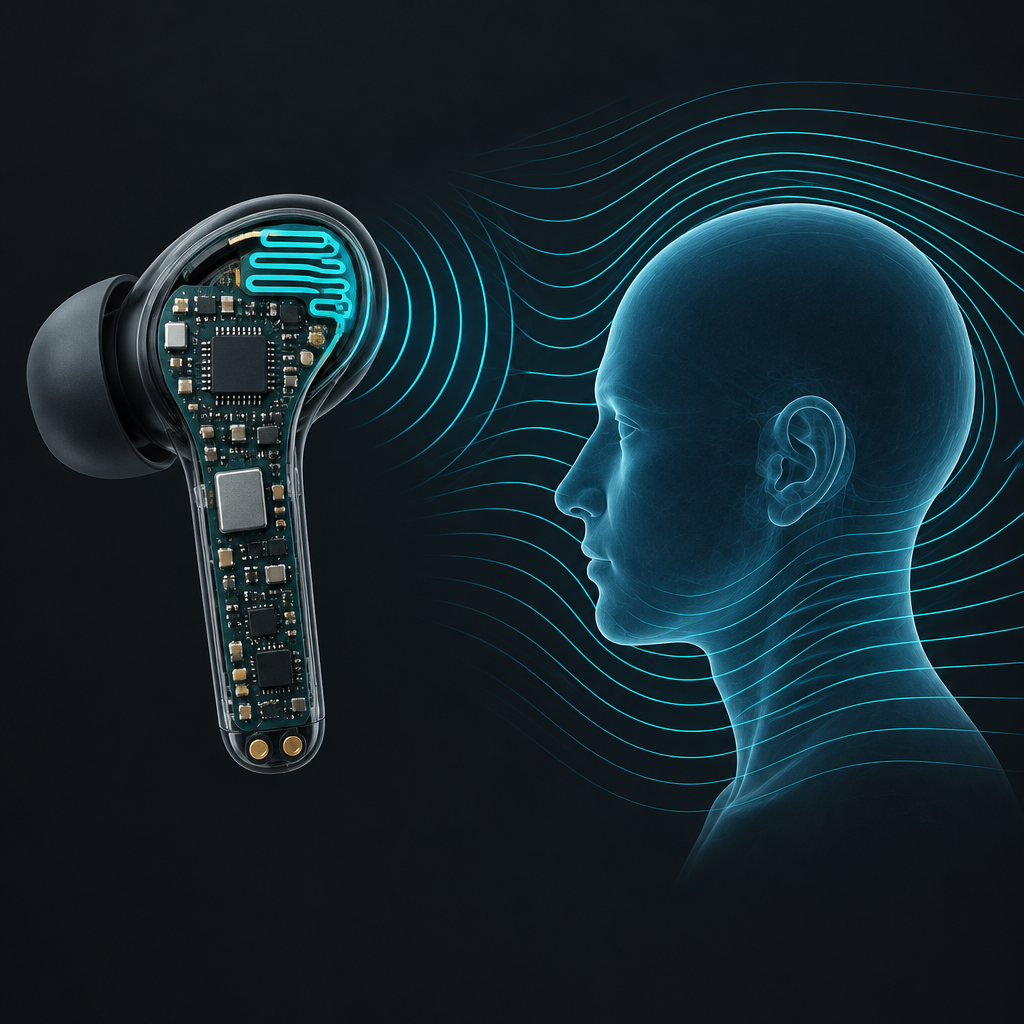
The fraud works because short antennas stop being hopeless once you feed them cleverly. Designers reach for inverted-F antennas, planar inverted-F variants, loops, and meandered monopoles: shapes that fold a quarter-wave resonator into a few square millimeters by trading efficiency for footprint. An inverted-F is essentially a monopole that has been bent flat and shorted to ground at a strategic point, which shrinks the radiator and lets it match the radio's impedance without a separate matching network the size of a grain of sand. It also behaves like an antenna half its length, which is another way of saying it radiates poorly and then gets helped.
Your Head Is a Bag of Saltwater
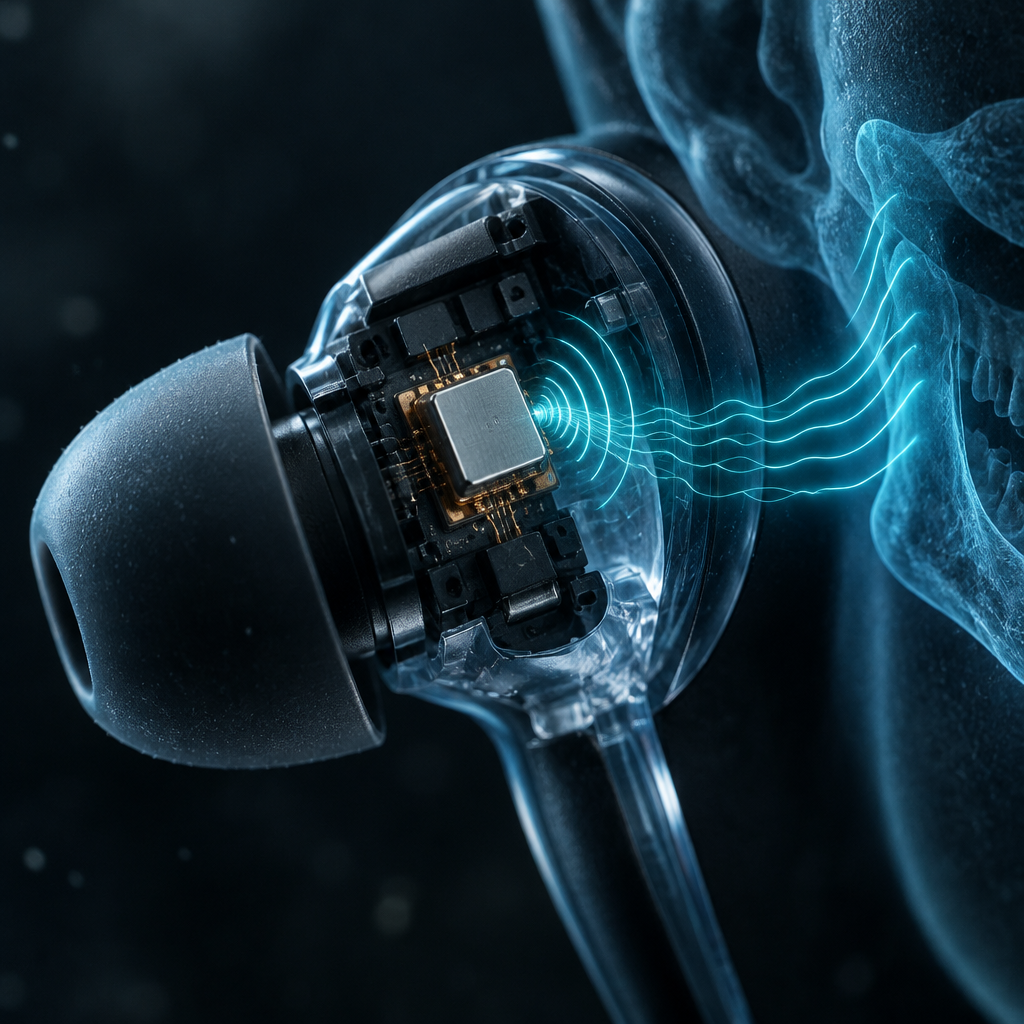
Now glue that compromised radiator to the side of a human skull. Radio engineers describe the human body, without a hint of irony, as a lossy dielectric. Water has a dielectric constant near 80 at these frequencies. The plastic housing sits around 3. Air is 1. From the antenna's point of view, being worn is a catastrophic change of medium: the near field suddenly couples into a giant conductive sponge that swallows energy and detunes the resonance.
Detuning is the cruel part. The antenna was cut to resonate at 2.44 GHz in free space. Strap it to a head and the effective dielectric load drags that resonance down, sometimes by hundreds of megahertz, right off the band where the radio transmits. Efficiency at the desired frequency collapses. Engineers quantified this decades ago: body proximity routinely costs a small wearable antenna 5 to 10 dB of realized gain, and first-generation designs without compensation lost more.
The countermeasure sounds like cheating because it is. The antenna is deliberately tuned high in free space, off its target band, so that the water in your head loads it back down onto 2.4 GHz once you actually wear it. Bench measurements of a naked earbud show a mistuned radiator; the same earbud on an artificial head phantom snaps into resonance. The finished product is calibrated to work only in the one environment it was designed for, which happens to be a person.
Painting Copper With Light
How do you even build a curvy antenna inside a bud with no room for one? Two methods dominate. The older one is a flexible printed circuit: a sliver of polyimide film with an etched copper trace, laminated along the inside wall of the housing like wallpaper, following whatever contour the industrial designer demanded. Every true wireless bud you own almost certainly carries at least one FPC antenna as thin as tape.
The newer method is stranger and more elegant. It is called laser direct structuring, and it turns the plastic part itself into the antenna. A special plastic, loaded with a metallic compound, is injection molded. A laser then traces the antenna pattern onto the surface, activating those additive molecules along the beam path. The part goes through electroless plating, and copper grows only where the laser wrote. The result is a three-dimensional copper antenna that follows the exact inner geometry of the bud, hugging curves a flat circuit never could, adding zero assembly thickness because the housing wall is the circuit board.
Apple popularized the technique in earbuds, and the rest of the industry followed. There is a variant trade everywhere: ceramic chip antennas are tiny and off-the-shelf but demand a clear patch of circuit board ground and degrade when crowded; FPC is cheap and bendable; LDS offers the best shape freedom at the highest tooling cost. Whatever the choice, millimeters matter. Move the antenna 2 millimeters closer to the battery, or swap the plastic for one with a different dielectric constant, and the resonance walks. RF teams routinely discover that a cosmetic change to a housing wall created a support ticket three months later.
The Ear-to-Ear Relay Tax
One antenna per bud would be a manageable problem. True wireless created a second one. On the classic Bluetooth architecture, only one earbud holds the connection to your phone. That primary bud then retransmits audio to its partner across your head, and here physics turns hostile again: a 2.4 GHz signal cannot pass through a skull. It must diffract around it, on a bending path 14 to 16 centimeters long, through the most absorbent environment in the room, which is you.
The relay costs battery, costs latency headroom, and costs reliability precisely when you turn your head, because your skull rotates into the diffraction path and the ear-to-ear link takes the hit before the phone link does. That is the moment your right bud stutters while the left one keeps playing. Firmware retries mask some of it, but the underlying geometry has not changed since the first AirPods.
LE Audio finally attacks the problem at the protocol level. Connected Isochronous Streams let the phone address each earbud directly, sending left and right channels over separate links synchronized to within microseconds. No retransmit across your head. No relay tax. The catch is architectural: every bud is now responsible for its own link budget to the phone, so both antennas must perform, all the time, while both still live inside a saltwater-adjacent pebble. Removing one bad radio path exposed two mediocre ones to full-time scrutiny.
SAR and the Power Cutback Nobody Mentions
When a link struggles, a normal radio shouts louder. An earbud mostly cannot. Specific absorption rate rules cap how much RF power may dissipate in tissue: 1.6 watts per kilogram averaged over a gram in the United States, 2 watts per kilogram over 10 grams in Europe, and a transmitter pressed into your ear canal has essentially no margin to play with. Radiated power in a bud is already a few milliwatts, and much of what the antenna launches exits toward open air only after the design has been bent to keep energy away from your head.
So when your body blocks the path, when you wedge the phone in a back pocket and turn away, the earbud cannot compensate the way a headset with a big battery might. Firmware responds the other direction instead: it rides the receive sensitivity, negotiates retries, drops audio frames, and eventually gives up for a moment. The dropout you hear is partly a compliance feature. The bud chose silence over dissipation.
Wear detection compounds it. In-ear sensors notice when a bud is seated in a canal versus resting in the case or on a desk, and power management leans on that state, because radiation limits and thermal budgets differ between worn and unworn. A bud resting half out of your ear is running in the wrong regulatory regime, and it behaves like a radio being asked to perform with its gain stage throttled, because it is.
Seventy-Nine Slots, Everyone Shouting
None of this happens in a quiet room. Classic Bluetooth hops across 79 channels of 1 megahertz each, up to 1600 hops per second, and adaptive frequency hopping lets the two endpoints grade channels and dodge the ones occupied by Wi-Fi. Your earbuds, your router, your microwave, and every headset within thirty meters all share the same sliver of spectrum, and the losers are the radios with no room for a real antenna and no permission to raise power. A crowded train car is not a connectivity problem so much as an electrocardiogram of a hundred coexisting devices politely failing to hear each other.
Stems, Diversity, and What Changes Next
Look at which designs hold signal best in the field and a pattern appears: buds with stems. The stem is not a style choice. It is a real estate acquisition. Hanging outside the ear canal puts the antenna several millimeters away from tissue, into moving air instead of against skin, which recovers detuning margin and frees the radiator from the tightest part of the geometry. That is why stem designs survived their awkward phase.
Next comes diversity. Antenna diversity, switching between two radiators per radio to escape a fade, is standard equipment in phones and rare in buds, purely because one bud barely fits one radiator. As HDT-capable chipsets arrive demanding wider bandwidth in worse conditions, and as LE Audio makes both buds carry full links, expect antenna counts in premium buds to quietly double. First gen kept you connected through retries. The next gen plans to keep you connected through physics.
The earbud antenna is the least glamourous component in consumer electronics, a copper doodle fighting a wavelength it cannot fit, a head it cannot ignore, and a regulator it cannot argue with. It wins anyway, most days. That the exception is a gym room corner at rush hour should no longer surprise you.