The failure never announces itself. One morning the left earbud charges to one LED dot and no further, or a channel starts cutting out unless you hold the case at a specific angle, or the battery that lasted six hours now dies in two. You file it under battery wear, because lithium cells are the only component anyone told you about. That diagnosis is almost always wrong. The thing killing most gym earbuds is not old age. It is metallurgy. It is your own sweat, one of the better engineered electrolytes in nature, being fed a pair of gold plated spring pins every single day.
Understanding the mechanism changes how you buy, how you store, and how long a pair lasts. So here is the story of how a device built to live in the saltiest crevice on your body gets eaten by its environment, why the charging case is the single worst place a wet earbud can go, and what actually slows the damage down.
The Electrolyte You Carry in Your Skin
Sweat is roughly 99 percent water, which sounds harmless until you look at the other one percent. Human sweat carries sodium chloride, potassium, lactate, urea, and ammonia, and it lands on skin with a pH that swings from mildly acidic toward neutral depending on hydration, diet, and how long bacteria have been breaking urea down. That one percent turns it from water into an electrolyte, a liquid that conducts ions and enables electrochemical reactions the way battery acid does, only gently and at your ear. Seawater is the classic corrosion accelerant because roughly three percent of it is dissolved salt; sweat runs far below that concentration, but corrosion does not need seawater. It needs any ionic path between two dissimilar conductors, and a workout gives you a continuous, warm, constantly replenished supply, pressed against a sealed plastic shell for an hour at a time. Add the fact that skin surface temperature sits near 35 degrees Celsius, since every ten degree jump roughly doubles chemical reaction rates, and your ear canal becomes a small, warm, well stirred corrosion cell that renews its own electrolyte.
Gold Hats on Brass Heads
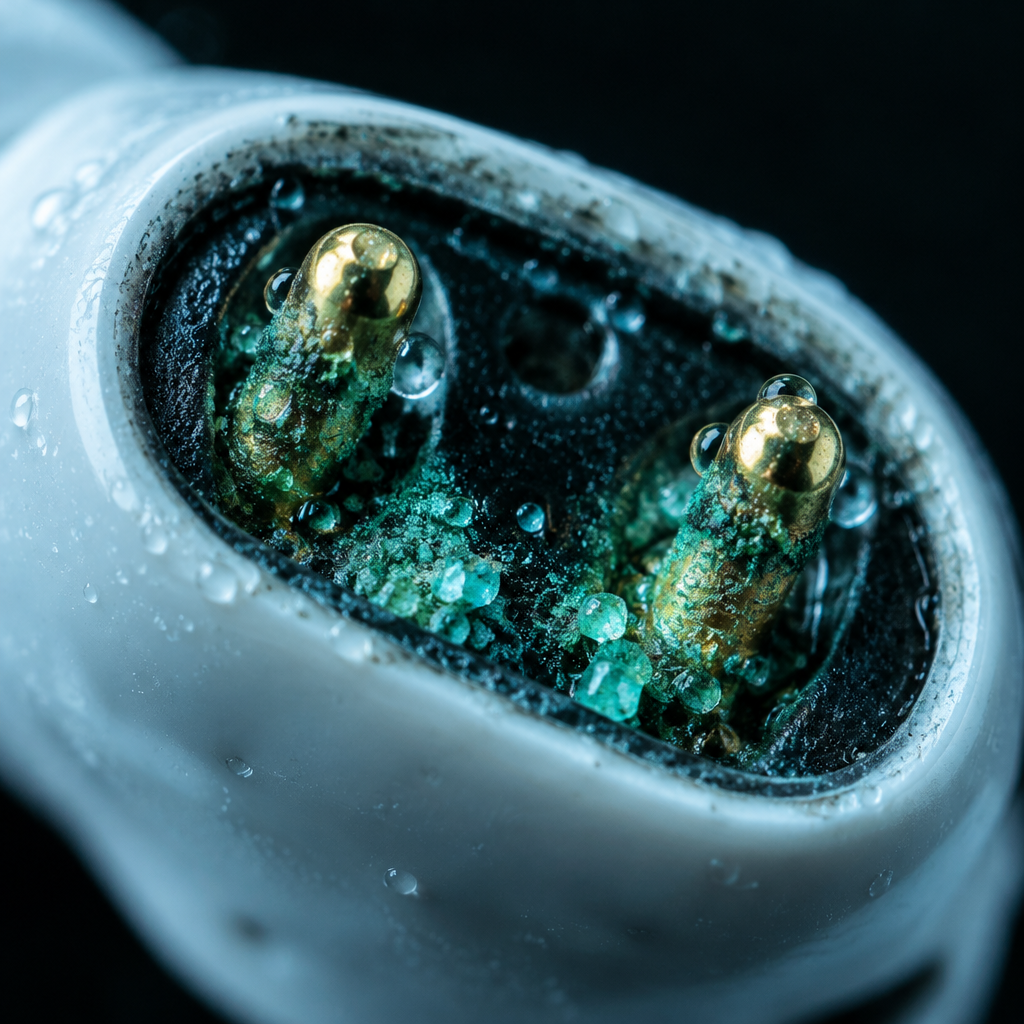
The charging contacts on true wireless earbuds are almost always pogo pins: tiny spring loaded cylinders that press against matching contact pads inside the case. Look at the material stack and the problem writes itself. The base metal under the plating is usually beryllium copper or brass, chosen for spring behavior and cost. Above that sits a nickel barrier layer, and above that, a flash of gold perhaps a tenth of a micron thick, sometimes less. Gold is on the pipeline because it never oxidizes, but a tenth of a micron is thin enough that plating porosity, microscopic pinholes from the deposition process, lets sweat reach the layers below. The moment that happens you have built a textbook galvanic couple. Gold sits near the noble end of the galvanic series, meaning in an electrolyte it becomes the cathode, and the less noble metal exposed at the pinhole becomes the anode and gets dissolved. Worse, the nickel and zinc inside brass react badly with chloride ions specifically, and chloride is the signature ion of sweat. Dezincification is the ugly end state: chloride leaches zinc out of the brass, leaving a spongy, weak copper skeleton that crumbles under spring pressure. The specs never mention any of this. The contact resistance simply climbs a few milliohms at a time until one day the charger reads the bud as a battery fault and refuses to fill it.
The Case Is a Terrarium
Here is the part nobody expects: the most dangerous liquid event in an earbud's life happens when it is dry, or feels dry. You finish a run, wipe the buds half heartedly on your shirt, and drop them into a closed plastic box which then sits in a gym bag at body temperature. Inside that case the relative humidity goes to one hundred percent. Every surface fogs with condensation, every temperature swing as you move between outside air, car, and house runs a fresh condensation cycle over the contacts, and the electrolyte film that sweat left behind keeps reconstituting itself from the trapped moisture. An electrochemical cell needs three things: two dissimilar metals, an ionic liquid, and time. The sealed case guarantees all three, daily, for years. It is a terrarium for exactly one parasite, and the earbuds are the host. This is also why one channel usually dies first. The two buds do not sit in identical chemical environments; whichever one got the sweatier ear, the more fingertip contact, or the deeper scratch through its gold plating carries the weakest cell and erodes first.
Charging Wet Metal Is Worse Than Swimming With It
If galvanic corrosion were the only enemy, earbuds would rust slowly enough to ignore. Charging voltage is what turns a leisurely problem into a fast one. The instant you dock a damp earbud, the five volts applied across those pins turns the sweat film from a passive electrolyte into an active one, driving electrolysis and metal migration at rates galvanic action alone never reaches. Copper and zinc ions literally migrate across the film and can grow conductive filaments called dendrites, tiny metallic trees that eventually bridge contacts and short signals. Manufacturers know this, which is why many modern earbuds include moisture detection on the charging path and will blink, chirp, or bluntly refuse to charge when they sense a wet pin. When your case flashes a warning at a seemingly clean earbud, it is not complaining about you. It is refusing to perform electroplating on its own contacts. Some users defeat this by wiping and redocking until it gives in. That is roughly the worst available move. The refusal is the device protecting itself from the single most destructive condition it will ever encounter; working around it is how a five dollar repair becomes a landfill statistic.
The Rating That Was Never About Sweat
The marketing says IPX4, or IPX7, or splashproof, sweatproof, workout proof. The fine print is doing heavy lifting. Ingress Protection ratings are tested under IEC 60529 with fresh water. IPX4 means the device survives a spray from a nozzle for ten minutes. IPX7 means thirty minutes under a meter of tap water. Nowhere in the protocol is there salt, acid, heat, repeated drying cycles, or an applied electrical bias, which is to say the test excludes almost everything sweat actually does. Tap water is a lazy electrolyte; chlorides and a low pH are what make corrosion move. There is also a ratings asymmetry that gets people constantly: the buds themselves often carry IPX4 or better while the charging case, the part with the exposed pins, is either unrated or barely rated and lives inside a sealed, humid, galvanically furnished chamber. A sweatproof earbud paired with an unprotected case is a waterproof jacket worn over a paper shirt. And the little liquid contact indicator stickers inside the housing, the ones that turn red after water incidents and void warranties, are exactly as misleading in reverse: they detect bulk water events and stay quiet about the film chemistry that actually ends the product's life.
The Ghost in the Machine Is a Metal Tree
The creepiest sweat failures are the ones that look like software. Phantom voice assistant activations. A bud that double taps itself. Volume that ratchets without a finger on it. Bluetooth that pairs but connects only after the third try. Dendrites again, and their sibling, creepage: sweat wicking through the hydrophobic mesh guarding a microphone port, or through a seam in the housing, carrying ions onto the circuit board. There the residue finds the leftover flux from manufacturing, because no clean flux residues are mildly hygroscopic and slightly acidic, meaning they actively pull water out of humid air and hold it against copper traces. Beneath the conformal coating, at pinholes and thin spots the industry politely calls holidays, that film grows a lattice of corrosion products and metal salts that are conductive when damp and insulating when dry. The result is an intermittent short that comes and goes with the weather, which is why so many people report earbuds that miraculously recover after a day in a drawer. They did not recover. The electrolyte dried out. The next humid gym bag restarts the clock. Intermittent electronics hauntings sourced from ionic contamination are among the best documented failure modes in the reliability engineering literature, and consumer earbuds are simply the most intimate example most people own.
How Engineers Fight a Liquid Enemy
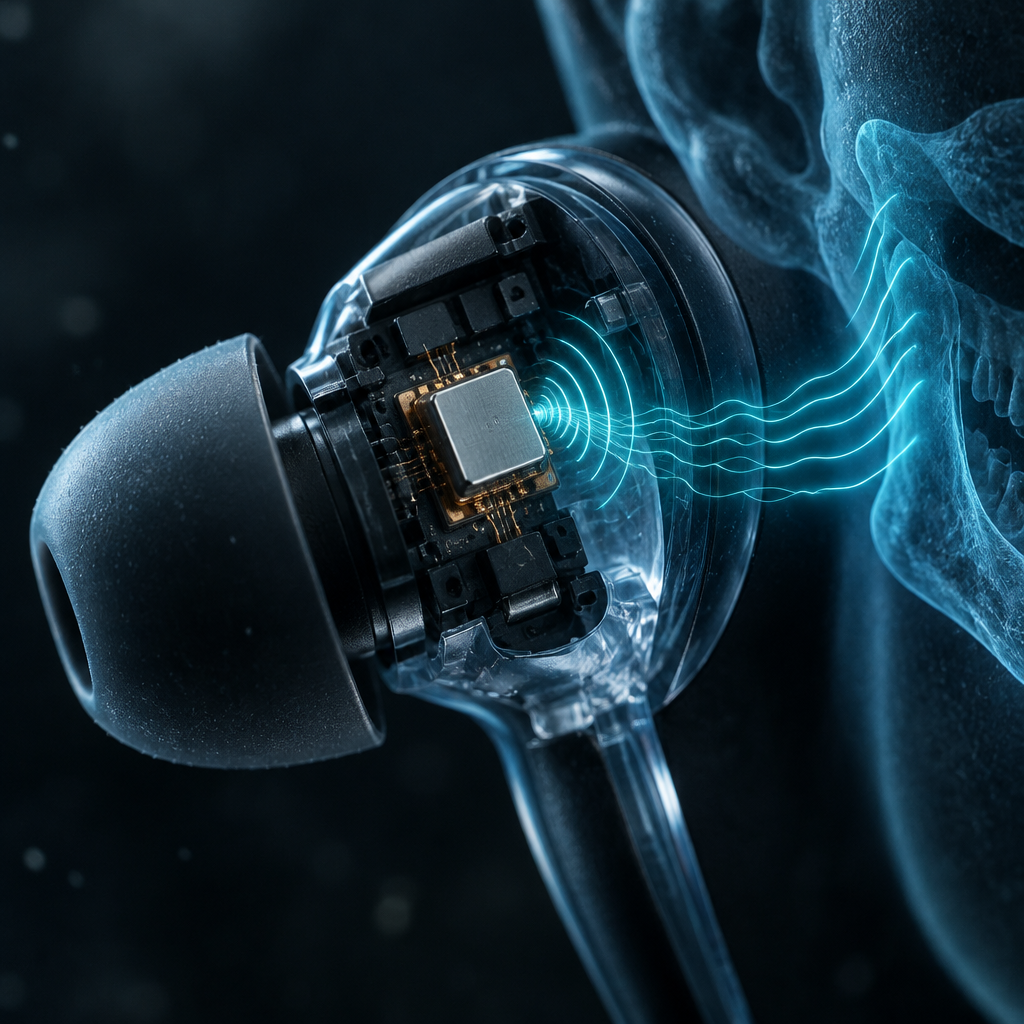
The industry is not passive about any of this. The cheap countermeasure is conformal coating: brushing or vapor depositing an acrylic, silicone, or parylene barrier over the finished circuit board. The premium one is molecular vapor deposition, where a parylene layer a few microns thick conforms to every edge and crevice, coating the whole assembly like shrink wrap at a scale invisible to the eye. Several brands have advertised nano coatings applied to the entire internal assembly for exactly this reason, and the coating genuinely works, right up until flexing cables, connector insertions, or a hard drop scratch through the film. Contact design fights back too. Good pogo pin geometry includes a wipe action, a tiny lateral scrub across the pad every time you dock, which mechanically cleans oxide layers away on the theory that the best defense is a self polishing contact. Gold thickness is quietly climbing on premium models, since doubling the plating is cheaper than a warranty program. The newest strategy is retreat: open ear clips and bone conduction bands move every current carrying metal part out of the sweaty canal entirely, and separated stem designs put contacts on a plastic arm that sits outside the ear instead of against it.
Buying Reliability Without Buying Snake Oil
The care habits that matter are unglamorous. Dry the buds genuinely, with a towel or shirt hem spent on thirty seconds of actual effort, before they go anywhere near the case. Never dock a bud that came out of your ear dripping, and if the case pushes back with a moisture warning, thank it and let everything air dry with the lid open. Wipe the contacts monthly with a foam swab barely damp with ninety percent or stronger isopropyl, on the pins in the case and the pads on the buds, and let the alcohol flash off fully before docking. A small silica gel pack rotated into the gym bag, oven recharged or swapped every few months, measurably lowers the humidity inside the case between sessions, and it is the one ten cent accessory with real electrochemistry behind it. Skip the rice; it is dusty, ineffective, and the dust is its own contamination problem. If a pair must survive serious sweat, buy on the boring specifications: published plating quality or premium contacts, a case that carries its own IP rating instead of borrowing the buds', conformal or nano coating mentioned anywhere in the marketing, and a shape that keeps metal away from skin. The pairs that last four years are rarely the pairs with the best drivers. They are the pairs whose makers understood that the product lives its whole life inside a salt storm, and engineered the boring parts accordingly. Your earbuds are not dying of battery old age. They are being dissolved, a few ions at a time, by the most renewable resource your body produces.