Open-ear audio has become the defining trend of 2025 and 2026, but bone conduction isn't new. Military pilots have used it since the 1960s. Hearing aid companies perfected it in the 1980s. What changed is miniaturization and consumer appetite for audio that doesn't seal your ears, doesn't hurt after eight hours of wear, and leaves you aware of your surroundings. Bone conduction delivers all three by routing sound through an entirely different pathway into your brain.
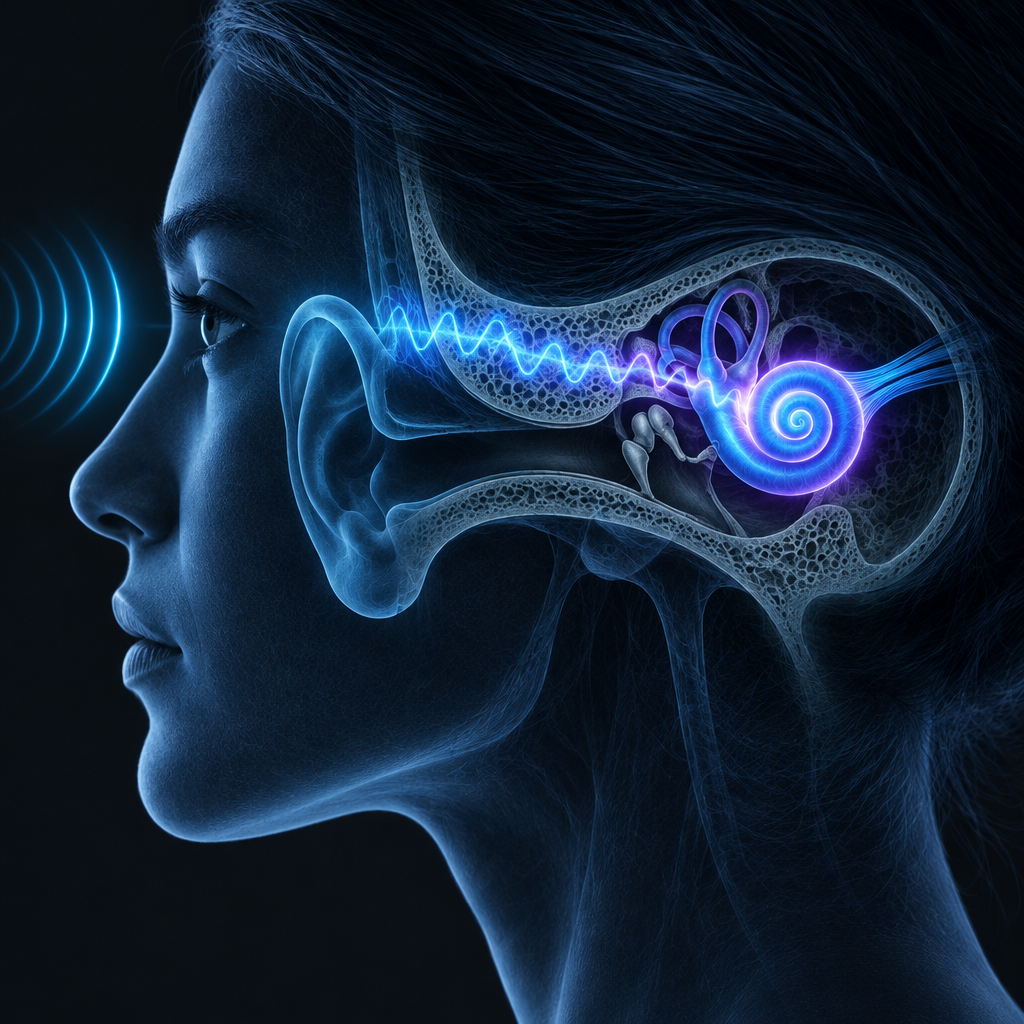
The conventional earphone path is simple: a speaker cone vibrates air, sound waves travel through your ear canal, hit your eardrum, transmit through three tiny bones in your middle ear, then stimulate your cochlea. Your cochlea converts those vibrations into electrical signals your brain interprets as music, speech, or a warning alarm. This is the only way humans have heard for 200,000 years. Bone conduction skips the first five steps and starts at step six.
The Physics of Skull Conduction
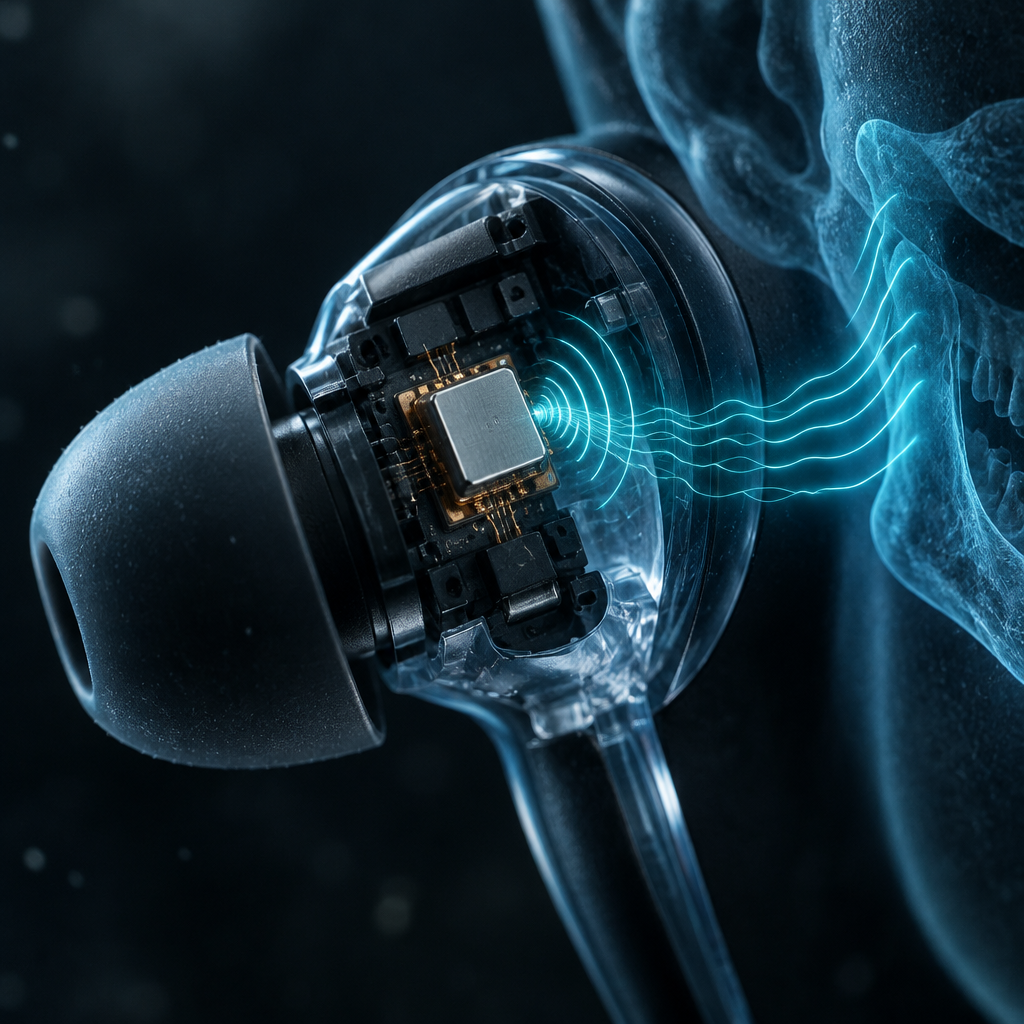
Your skull is a resonant chamber made of bone, a dense mineral matrix bound by collagen. Bone conducts vibrations with remarkable efficiency, approximately four times better than air at transmitting mechanical energy. When a transducer (a tiny vibrating element in a bone conduction headphone) presses against your cheekbone or mastoid process, it sends vibrations directly into your skull. Those vibrations travel through the bone matrix, reach your inner ear, and stimulate the cochlea from inside rather than outside.
The cochlea doesn't care how the vibrations arrive. Whether they come from airborne sound waves or bone vibration, the result is identical: stereocilia hair cells bend, ion channels open, electrical signals fire. Your brain receives the same sensory information either way. This is called the bone conduction pathway, and it's been well understood in neuroscience since the 1930s.
Placement matters enormously. The mastoid process, the bony protrusion directly behind your ear, is the sweet spot for bone conduction headphones. It's close to the temporal bone, which contains the inner ear. Placing a transducer here minimizes the distance vibrations must travel and maximizes the amplitude that reaches your cochlea. This is why every commercial bone conduction headphone (Shokz, Philips, AfterShokz) sits at the same position on the head.
Why Bone Conduction Is Not Wireless Audio Compromise
The first reaction most people have is skepticism. If bone conduction worked perfectly, wouldn't everyone use it? The answer is that bone conduction has genuine advantages and genuine tradeoffs, not "inferior audio that happens to be convenient."
Advantage one: situational awareness. Your ears remain completely open. You hear ambient traffic, your child calling, a dog barking, while simultaneously listening to a podcast or music. This is why bone conduction dominates in cycling, running, and workplace settings. You're not isolated; you're augmented.
Advantage two: no ear fatigue. Conventional earbuds, even premium ones, press into your ear canal. After six hours, the pressure becomes uncomfortable, then painful. Many people develop ear wax impaction from the seal blocking natural drainage. Bone conduction headphones create zero pressure inside your ears because they don't enter your ears at all. You can wear them for twelve hours with no discomfort.
Advantage three: accessibility. For people with conductive hearing loss (eardrum perforation, middle ear infection, ossification), conventional hearing aids don't work. The sound doesn't reach the inner ear because the middle ear is damaged. Bone conduction headphones bypass the damage entirely. For this population, bone conduction isn't a luxury; it's the only technology that works.
The tradeoff is bass response. Your cochlea is most sensitive to midrange frequencies between 1 kHz and 4 kHz. Below 250 Hz, the cochlea requires much higher vibration amplitude to detect sound. Bone conduction transducers can vibrate up to 1,000 Hz comfortably but struggle producing the amplitude needed for subwoofer-like bass. The result is that bone conduction headphones are better at vocals, instruments, and dialogue but feel thin on electronic music or hip-hop.
This is changing. The 2026 generation of bone conduction headphones (Shokz OpenFit, Philips A5002) increased transducer power by 30% over 2023 models, delivering noticeably deeper bass. They still won't rattle your skull like a subwoofer, but the gap is closing.
The Vibration Isolation Problem
Here's what separates mediocre bone conduction from excellent bone conduction: vibration isolation. If your transducer sits on your skin and vibrates, some of that energy is absorbed by soft tissue (muscle, fat) instead of propagating through bone. Loose contact is wasted energy. Tight contact is uncomfortable.
Premium bone conduction headphones solve this with precision fit bands. Shokz uses titanium bands that have a specific spring curve, calibrated so they press with exactly the right force against the mastoid process. Not too tight, not too loose. AfterShokz (now Shokz) spent seven years tuning this band before releasing the first OpenMove.
The fit problem explains why bone conduction sound quality varies wildly between brands and even between units. A perfectly fit Shokz OpenSwim sounds like quality audio. The same headphone, an inch higher on your head, sounds hollow and muffled. This is why bone conduction headphones are notoriously difficult to buy online; you need to try them on and feel the fit before committing.
Bone Conduction Beyond Audio
Military applications came first. Fighter pilots used bone conduction to receive radio communications without blocking their ears; they needed to hear engine noise and warning alarms. The technology worked flawlessly in combat settings because pilots wore helmets that held the transducer in perfect position.
Hearing aid manufacturers were next. Companies like Baha (Cochlear Limited) developed bone conduction implants for severe conductive hearing loss. A surgical implant attaches a transducer directly to the temporal bone, eliminating the fit problem entirely. Sound quality through implanted bone conduction rivals conventional hearing aids, and the surgery is considered low-risk. These implants have restored hearing to tens of thousands of people.
Consumer applications emerged in the 2010s. Shokz (originally AfterShokz) released the Xtraopen in 2011, the first commercial bone conduction headphone designed for outdoor athletes. Sales exploded. By 2024, bone conduction was a $300 million market globally. By 2026, every major audio company (Sony, Philips, Shokz) has bone conduction in their product line.
The Haptic Feedback Connection
Bone conduction and haptic feedback seem like separate technologies, but they're closely related. Both rely on vibration to communicate information through your body. The difference is purpose: bone conduction is about delivering audio information through bone vibrations, while haptics is about delivering tactile information anywhere on your body.
Some experimental headphones combine both. A hypothetical 2027 bone conduction headphone could vibrate at frequencies that carry audio information (20 Hz to 20 kHz) and also pulse distinct haptic patterns to signal incoming calls or messages. Your mastoid process would deliver both sound and tactile feedback. This is technically feasible and likely inevitable.
When Bone Conduction Is The Right Choice
Bone conduction isn't better or worse than conventional earbuds. It's different. Here's when each makes sense:
Choose bone conduction if: You cycle, run, or work outdoors and need situational awareness. You have conductive hearing loss or eardrum perforation. You wear headphones six or more hours daily and experience ear fatigue. You live in a place (cycling, military, sports facilities) where open-ear awareness is non-negotiable.
Choose conventional earbuds if: You want maximum bass response or the richest soundstage. You listen in noisy environments where isolation is necessary. You prioritize isolation and comfort over situational awareness. You want the most compact form factor possible.
The devices aren't converging toward a single form factor. Instead, the market is segmenting. Shokz dominates open-ear audio. Apple and Sony own the premium sealed earbud market. Hearing aid companies own the medical space. Each has different physics constraints and different user needs.
The Future of Bone Conduction
The next frontier is efficiency. Current bone conduction headphones consume battery power on two main tasks: vibration production and keeping the transducer pressed against your head. A 2027 design goal is reducing both. Micro-vibration motors from haptics companies (Immersion, TangibledMediaLabs) could deliver the same audio fidelity with half the power consumption.
The second frontier is form factor. The headband constraint is real. Some emerging designs use flexible earpieces that somehow attach and maintain position without a band. Others use magnetic attachment that sits in your ear while transmitting vibrations through bone. These are niche experiments, not mainstream products, but they show the design space is still wide open.
The third frontier is blended audio: bone conduction for open-ear awareness plus conventional audio for immersion. A 2027 headphone might split your left and right channels: left ear gets a conventional earbud for music, right ear gets a bone conduction transducer for ambient sound. This would give you full stereo music while maintaining environmental awareness. It sounds uncomfortable in theory but makes perfect sense in practice.
Bone conduction is no longer a niche. It's a parallel audio pathway that solves specific problems better than anything else. It won't replace conventional earbuds, but it won't disappear, either. For cyclists, runners, hearing-impaired users, and people who work in audio-aware environments, bone conduction is often the best choice available. For everyone else, it's a legitimate option worth trying.