The Most Important Earpiece Upgrade Is Happening Where You Cannot See It
New earpieces are usually sold with visible promises. Smaller stems. Better transparency mode. A charging case that looks like a pebble polished by a river. The more consequential upgrade may be buried in the radio architecture, where there is no glossy product photograph and almost nothing for your fingers to feel.
Bluetooth LE Audio is replacing the old assumptions behind wireless listening. Its headline features include the LC3 codec and Auracast broadcast audio, but the change that most directly affects everyday true-wireless behavior is Multi-Stream Audio. Instead of treating two earpieces as one conventional Bluetooth audio endpoint and then asking one bud to relay information to the other, a compatible source can create multiple, independent, synchronized streams.
That sounds like a small engineering detail. It is not. The arrangement influences connection stability, stereo timing, power consumption, spatial audio, and the way manufacturers design future earpieces.
The Old True-Wireless Compromise
To understand the improvement, it helps to picture the older arrangement. In many traditional true-wireless systems, the phone establishes a Bluetooth connection to one primary earpiece. That earpiece receives the music, plays its own channel, and forwards the other channel across a separate link to the secondary bud. The two pieces are wireless to your phone, but they are not necessarily equal participants in the conversation.
This relay model works impressively well considering how much miniature hardware must coordinate inside a human ear. It also creates a chain of dependencies. The primary earpiece has extra radio work. The secondary earpiece depends on a nearby transmitter that is itself moving, blocked by a head, or occasionally dealing with interference. If the relay link gets messy, the symptoms are familiar: a brief dropout in one ear, a tiny echo between channels, or a left and right image that feels slightly unstable.
Designers have built clever fixes. Some products dynamically switch the primary role. Others use proprietary links, larger antennas, or aggressive buffering. These solutions can be effective, but they are compensations for the basic topology.
Multi-Stream Audio Changes the Topology
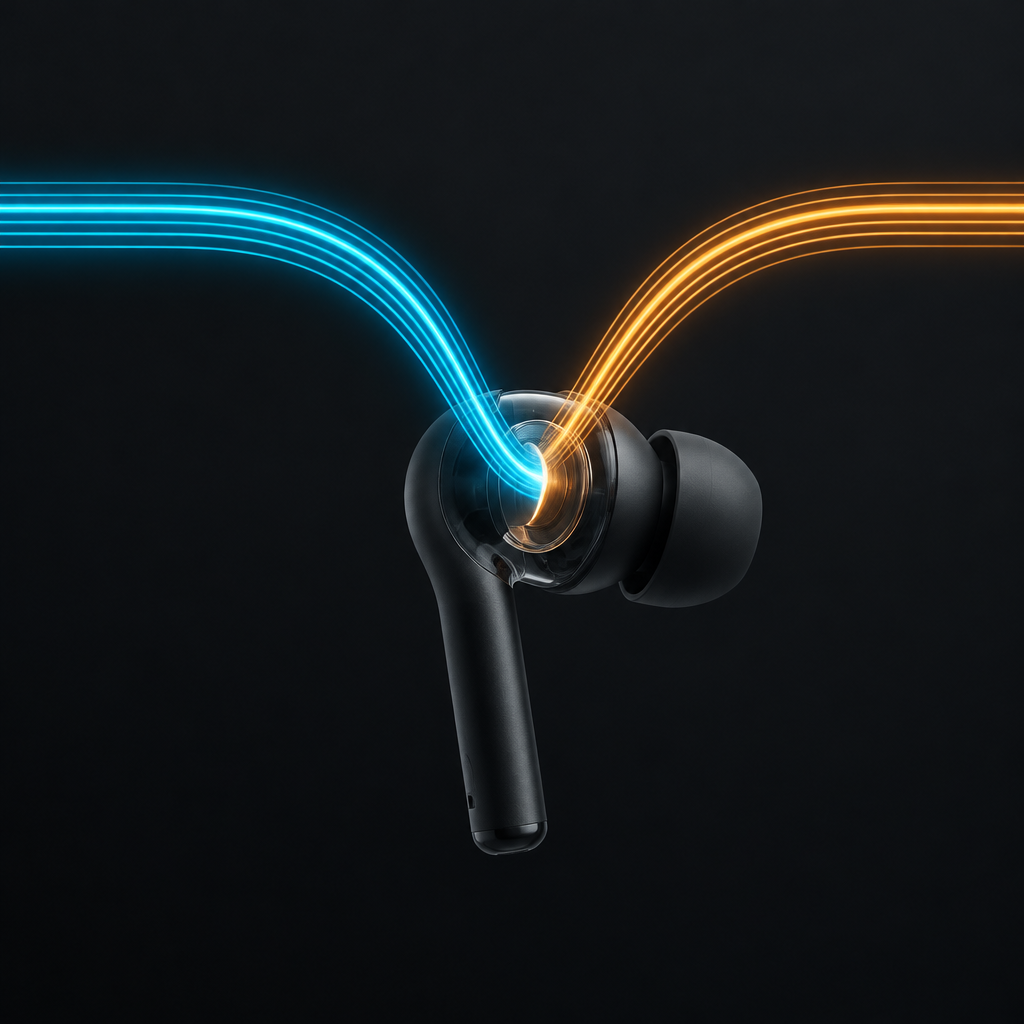
LE Audio approaches the problem through Bluetooth Low Energy and isochronous channels. An audio source can send separate left and right streams that remain synchronized, rather than making one earpiece act as a permanent courier. The streams are independent, yet they share timing information and the scheduling discipline required for a coherent stereo signal.
Isochronous does not mean that every audio packet is guaranteed to arrive. It means the system is designed around time. A packet has a useful listening window. If it arrives too late, retransmitting it may be worse than discarding it and moving on, because a late sample cannot repair the moment that has already passed. That is a very different priority from ordinary data transfer, where correctness usually matters more than a deadline.
For earpieces, this timing model is crucial. The listener does not perceive packets. The listener perceives a soundstage. A snare hit, a consonant, or the leading edge of a bass note must happen at nearly the same moment on both sides. LE Audio gives the system a standards-based way to coordinate those events without relying on a vendor-specific relay trick.
Why the Codec Matters Too
Multi-stream delivery is only half the story. LE Audio also introduces LC3, the Low Complexity Communication Codec. LC3 is designed to deliver useful audio quality at lower bitrates than the older mandatory SBC codec, while also supporting the short, predictable frames that low-power wireless systems need.
Lower bitrate does not automatically mean better sound. Audio quality depends on the codec implementation, bitrate choice, tuning, radio conditions, and the acoustic design of the earpiece. The important point is efficiency. If a radio can transmit a satisfying result with fewer bits, it has less work to do. Less radio activity can reduce energy consumption, create room for longer playback, or let a manufacturer spend power on other features such as transparency processing and onboard sensing.
LC3 also gives engineers a graceful way to respond to changing conditions. A system can select an appropriate bitrate instead of treating wireless audio as an all-or-nothing contest between perfect playback and a broken connection. That flexibility becomes especially valuable in crowded places, where the 2.4 GHz band is full of Wi-Fi traffic, smartwatches, laptops, and other earpieces.
Battery Life Is About More Than the Battery
When a product advertises longer battery life, the obvious explanation is a larger cell. In earpieces, physical space is brutally limited. The battery competes with microphones, a speaker driver, antennas, charging contacts, processors, sensors, and the plastic structures needed to keep everything in place.
Radio efficiency therefore matters. A synchronized multi-stream design can distribute work more evenly between the left and right earpieces. Neither side has to be the radio landlord forever. That can reduce the imbalance in which one bud drains noticeably faster because it handled the phone connection and the inter-ear relay.
There is a catch. LE Audio does not magically make every earpiece efficient. A manufacturer can waste the savings on an always-active equalizer, high-power noise cancellation, head tracking, or a microphone system running continuously. The standard creates better options; the final battery result still depends on engineering choices and software discipline.
Stability, Latency, and the Human Head
The human head is an inconvenient object for a radio link. It absorbs and scatters some of the signal traveling between a phone and an earpiece, and the problem gets more interesting when the phone is in a pocket on the opposite side of the body. Movement constantly changes the geometry.
Independent streams can give a system more paths around that problem. The result is not immunity from interference, but fewer assumptions about one bud being responsible for rescuing the other. If the design also uses the timing and retransmission features of isochronous channels intelligently, it can decide which missing packets are worth recovering and which should be concealed by the codec.
Latency benefits from the same focus on deadlines. A gaming mode still needs careful buffering, and LE Audio is not a magic guarantee of zero delay. Bluetooth performance is a system property involving the phone, operating system, source profile, earpiece firmware, and application. Still, a transport designed around scheduled audio gives engineers a cleaner foundation for reducing delay than a general-purpose link followed by layers of proprietary fixes.
Spatial Audio Needs Synchronized Ears
Spatial audio makes timing errors easier to notice. A small mismatch between left and right channels may be tolerable in a compressed podcast. It becomes distracting when a virtual object is supposed to sit in front of your face while you turn your head.
Head tracking adds another demand. The earpieces must measure motion, estimate orientation, and update the audio scene without making the sound wobble or lag behind your head. Independent synchronized streams are a sensible base for that workload because each side can receive the information it needs while preserving a shared clock.
This does not solve the hardest spatial-audio problem, which is personalization. Your ears are not generic, and a universal head-related transfer function will not place sound perfectly for everyone. Multi-stream audio solves a transport problem, not an acoustic one. It does, however, remove one technical obstacle between a spatial algorithm and consistent two-ear playback.
Compatibility Is Still the Fine Print
The phrase “Bluetooth 5.2” does not prove that an earpiece supports LE Audio. Bluetooth version numbers describe a broad collection of capabilities, while actual support depends on the profiles, codecs, controller hardware, operating system, and firmware that a product ships with. A device may contain suitable silicon and still launch without the necessary software.
Both ends of the connection matter. The phone or computer must support the relevant LE Audio profiles. The earpieces must support them too. A firmware update may add functionality, but it cannot always overcome limitations in the original radio design or product certification.
That makes shopping harder than reading a Bluetooth number on a box. Look for explicit references to LE Audio, LC3, Multi-Stream Audio, or isochronous channels. If a manufacturer only says “Bluetooth 5.3” and “high-quality wireless,” assume nothing. The future is arriving, but it is arriving through a checklist.
The Bigger Future: One Source, Many Listeners
The same LE Audio foundation enables Auracast, which allows a transmitter to broadcast audio to many compatible receivers. That could mean a television sending sound to several listeners, an airport transmitting gate announcements, or a museum offering synchronized narration without handing out fragile wired devices.
For earpieces, this is a shift from private point-to-point listening toward a more flexible audio environment. Multi-stream unicast helps your pair work better with your phone. Broadcast audio gives the pair new places to go. The two capabilities share the same underlying emphasis on efficient, time-aware wireless audio.
What to Expect From the Next Generation of Earpieces
The most interesting LE Audio products will not simply advertise a new codec. They will use the architecture to rethink the whole earpiece. Balanced radio workloads could reduce uneven battery drain. Better timing could support more convincing spatial audio. Efficient streams could leave power for hearing protection, voice isolation, adaptive transparency, and sensors that monitor how the devices are being worn.
Consumers may never see the words isochronous channel after buying a pair. They will notice fewer one-sided dropouts. They will notice that a voice sounds centered instead of drifting. They may notice that both earpieces come out of the case with similar battery percentages after a long commute.
That is often what good engineering looks like. The feature disappears, and the annoyance disappears with it. Bluetooth LE Audio’s Multi-Stream Audio is not a dramatic new speaker material or a flashy app mode. It is a more rational way to move time-sensitive sound through two tiny computers, and it may be the upgrade that finally makes true-wireless earpieces feel less like two devices cooperating and more like one instrument.