For years, wireless earpieces have operated under a familiar constraint: battery life. Longer listening sessions meant heavier devices, thicker charging cases, and the perpetual anxiety of juice running out mid-commute. Bluetooth's LE Audio standard, now rolling out across 2026 devices, upends that equation entirely.
Redefining Power Budgets in Wireless Audio
LE Audio isn't just another incremental spec bump. The technology represents a fundamental rethinking of how audio travels from source to ear, introducing power efficiency gains so substantial that manufacturers can now build thinner earpieces, extend battery life dramatically, or pack in computational features that were previously impossible due to power budgets. For earpiece designers, that flexibility unlocks entirely new product categories.
The LC3 Codec and Bandwidth Efficiency
The heart of LE Audio's efficiency lies in its codec: LC3. Unlike traditional Bluetooth audio, which relies on codecs like SBC or aptX, formats optimized for moving data fast rather than moving it efficiently, LC3 compresses audio using techniques borrowed from speech codecs. The algorithm prioritizes perceptual quality; it discards information humans can't hear rather than information the codec finds easy to compress. The result is transparent audio quality at bitrates half to a third of what older codecs require.
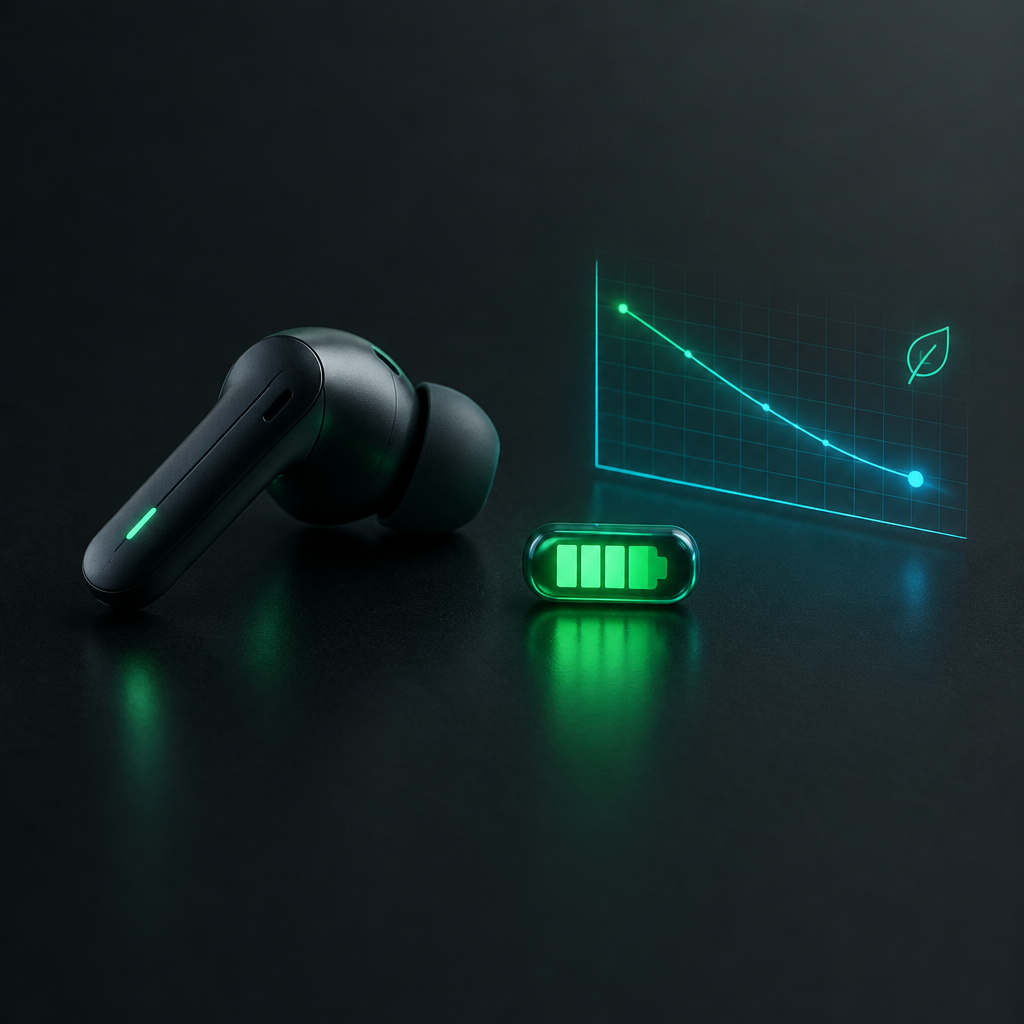
Consider the numbers. Standard Bluetooth A2DP streams 345 kilobits per second to deliver 48 kHz audio. LE Audio achieves the same perceptual quality at 192 kilobits per second, sometimes lower. A microphone and speaker in your earpiece draws less power when it's transmitting and receiving fewer bits. Multiply that across a full day of listening, and you see why manufacturers are suddenly claiming 150+ hour battery claims on single charge, claims that were pure fantasy just 18 months ago.
But power efficiency is just the opening act.
Auracast Broadcast and Multi-Device Streams
Auracast, the broadcast audio layer built on top of LE Audio, solves a problem that has plagued shared listening for decades: group listening without splitting the signal or daisy-chaining headphones. Imagine a hearing aid wearer at a restaurant. The server puts on a wireless microphone, and every hearing aid in the room, not just that one person's, receives the audio stream directly. A TV in a stadium can broadcast to hundreds of pairs of earpieces simultaneously. A train conductor reaches every passenger's earpiece without infrastructure beyond a cheap Bluetooth transmitter.
Convergence of Consumer Audio and Assistive Tech
For hearing aid manufacturers, the implications are seismic. Bluetooth LE Audio includes bidirectional communication, meaning earpieces can capture your voice and send it back. FDA-cleared hearing aids like Apple's AirPods Pro 3 now function as legitimate assistive devices, handling phone calls and translating speech in real time, features that required separate expensive hardware until 2025. The convergence of consumer earpieces and medical devices creates a category where premium audio, wellness, and accessibility collapse into one product. That's not a niche; that's the future of earpiece design.
Latency Reduction and Packet Scheduling
Latency tells another part of the story. Older Bluetooth audio introduced 100-200 milliseconds of delay, barely noticeable during movies, but frustrating for gaming or real-time communication. LE Audio targets 20-30 milliseconds, bringing wireless earpieces into parity with wired audio for the first time. Gaming earpieces, sports coaching devices, and live translation earpieces all become viable categories when latency that low becomes standard.
The technical architecture supporting this involves a rethink of Bluetooth's scheduler and packet handling. LE Audio uses a "CIG" (Connected Isochronous Group) structure that guarantees timing, rather than relying on the probabilistic delivery guarantees of classic Bluetooth audio. Every packet arrives on schedule or not at all; the receiver knows precisely when audio should play. That reliability, combined with LC3's robust error correction, means LE Audio earpieces can operate in interference-heavy environments, crowded offices, airports, concerts, where older codecs degrade gracefully but noticeably.
Adoption Timelines and Industry Roadmap
Adoption has been slow but accelerating. As of mid-2026, only flagship devices support LE Audio; entry-level earpieces still default to older codecs. But the momentum is real. Samsung's latest Galaxy Buds support LE Audio. Sonos has announced LE Audio-compatible earpieces. The Bluetooth SIG's roadmap shows mainstream adoption ramping through 2027. By 2028, it's reasonable to expect LE Audio as the default rather than the exception.
For buyers, the transition is transparent. Your next pair of premium earpieces will likely be LE Audio-compatible whether you know it or not. But the benefits, lighter form factors, week-long battery life, hearing aid integration, ultra-low latency, will be impossible to ignore. The earpiece market that emerges from this standard will look fundamentally different from the one we know today: more accessible, more efficient, and more capable than anything that came before.