Hearing loss affects half a billion people today. By 2050, the World Health Organization projects that 2.5 billion people will have some degree of hearing impairment. For decades, hearing aids were treated as medical devices, isolated from the consumer audio ecosystem that evolved around smartphones, earbuds, and wireless speakers. That isolation is ending. Bluetooth LE Audio, completed in 2022 and rolling out across devices in 2025 and 2026, is collapsing the boundary between hearing aids and consumer audio technology, and in doing so, it's reshaping accessibility for everyone.
The shift begins with a simple but profound principle: hearing aids should have the same connectivity capabilities as earbuds. That sounds obvious. It isn't. Until now, hearing aids operated on proprietary wireless systems because consumer Bluetooth technology consumed too much power, introduced too much latency, and didn't deliver sound quality that met clinical standards. Hearing aid wearers, who often depend on devices turned on all day, couldn't afford the battery drain that came with mainstream audio technology. Engineers faced an impossible choice: give hearing aids modern features and watch battery life collapse, or maintain the 5-to-7-day battery life that users expected and accept technological limitations.
Bluetooth LE Audio solved that. "LE" stands for low energy, and the specification delivers exactly that through improved encoding algorithms, more efficient power management, and lower latency. The result is that hearing aids can now stream high-quality audio, support multiple simultaneous connections, receive software updates, and operate as genuine smart audio devices without sacrificing the battery life that hearing aid users have depended on for years.
The Battery Life Revolution
Battery performance is not a minor detail in the hearing aid world. It is the constraint that has defined the category for decades. Zinc-air batteries can power traditional hearing aids for 5 to 7 days of continuous use. That performance bar is so established in user expectations that any hearing aid technology claiming to improve functionality had to prove it wouldn't reduce battery life. This became the fundamental limiting factor on innovation.
Starkey Hearing Technologies, one of the world's largest hearing aid manufacturers, framed the challenge this way: they wanted to build a new wireless ecosystem without impacting the battery life users were accustomed to. With Bluetooth LE Audio, they can. Lower power consumption per audio stream, combined with more efficient signal processing, means that features once impossible on a hearing aid, like receiving high-quality audio from a smartphone microphone pointed directly at someone in conversation, can now be implemented without touching battery life.
The effect compounds when you consider rechargeable hearing aids, which have been advancing steadily. Bluetooth LE Audio makes rechargeable hearing aids more practical by reducing the power draw of wireless connectivity. That opens the path to all-day wear with mid-day charging, or multi-day wear with overnight charging, combined with the same connectivity ecosystem that hearing aid wearers see in consumer electronics.
Making Hearing Aids Competitive with Consumer Audio
Once hearing aids operate efficiently on Bluetooth LE Audio, they become eligible for every consumer feature that Bluetooth audio devices enjoy. Remote microphone capability, one of the most powerful features in modern hearing aid design, becomes transparent. Point a Bluetooth LE Audio smartphone at someone in a crowded restaurant, and the hearing aid receives that audio stream with lower latency and higher fidelity than older systems allowed. The person wearing the hearing aid hears the conversation clearer than people without hearing loss around them.
That capability destigmatizes hearing aids in a way that no marketing campaign can match. When a hearing aid user can access the same audio features, the same streaming quality, and the same wireless convenience as an earbud user, the psychological barrier dissolves. Hearing aids stop being devices you hide. They become devices you choose, the same way you choose glasses or a smartwatch.
Nicholas Hunn, CTO of WiFore Consulting and a leading expert in hearing aid wireless technology, described the shift plainly: "Everything that is accessible for an earbud consumer is now going to be accessible to someone with a hearing aid." He sees this as one of the changes that reduces stigma, allowing society to think about hearing aids the same way it thinks about eyeglasses: as straightforward assistive tools, not medical abnormalities.
Auracast: Broadcast Audio for Public Spaces
Bluetooth LE Audio introduced a second feature that matters even more for public accessibility: Auracast broadcast audio. This is fundamentally different from traditional Bluetooth pairing. Instead of connecting device to device, Auracast allows an audio source to broadcast a single stream to an unlimited number of receivers simultaneously. No pairing required. No limit on concurrent users.
The implications for public accessibility are enormous. Imagine walking into an airport and seeing a sign that reads "Auracast Broadcast Audio Available Here," the way you've seen Wi-Fi signs for decades. You pull out your phone, earbuds, or hearing aid, scan for available broadcast streams, and select the one you want to hear. That could be the airport announcement system. It could be a muted TV at a departure gate. It could be a live translation of a gate agent's announcements in your preferred language. The audio comes directly to your device, synchronized between both earbuds or both hearing aids, without any connection negotiation.
In restaurants with muted TVs, Auracast broadcast audio transforms the experience. Anyone in the restaurant can tune in to the broadcast independently. Sports fans can hear the game at their table while others at nearby tables watch in silence or tune into a different broadcast stream. Movie theaters can offer Auracast broadcast audio in multiple languages simultaneously, with viewers selecting their preferred audio stream. Transportation hubs, places of worship, conference centers, and shops can all deploy Auracast transmitters to deliver audio directly to users' devices.
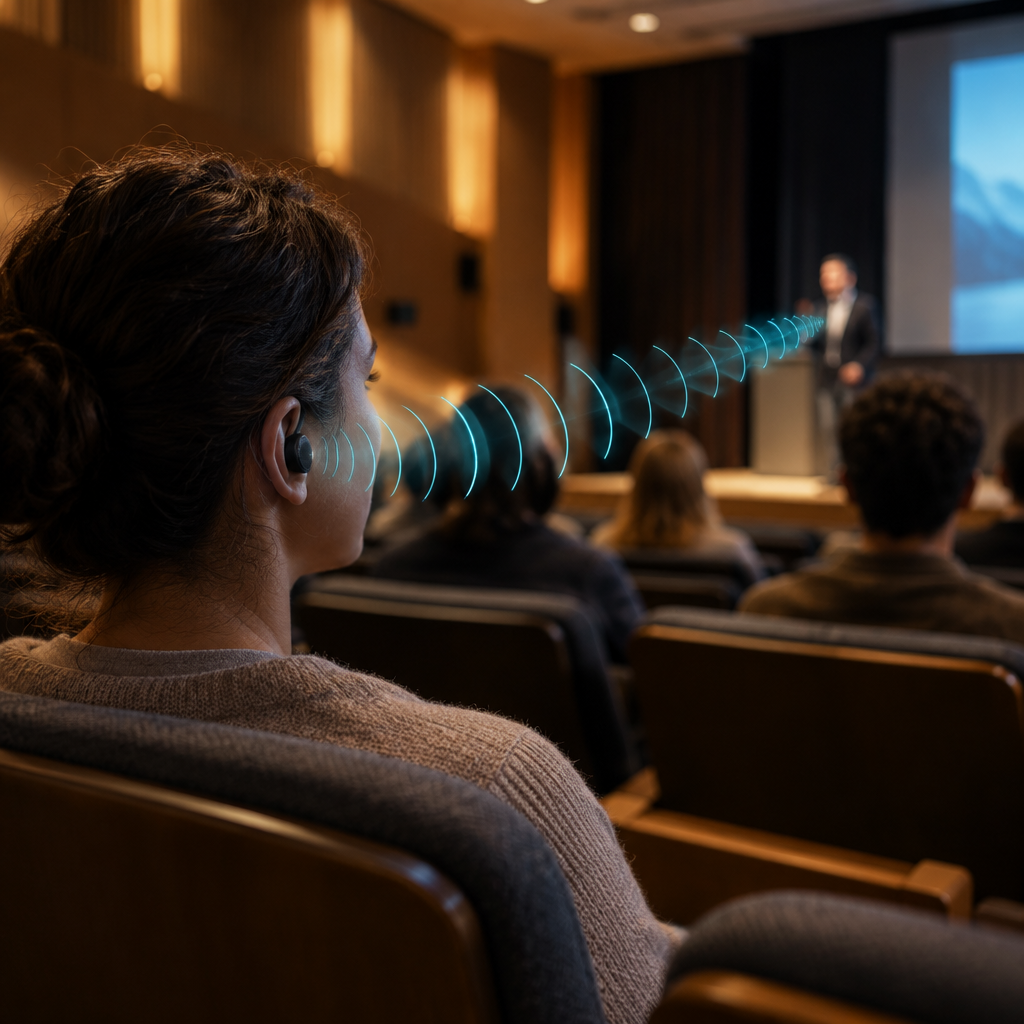
For hearing aid users, this is transformative. Museums can broadcast audio tours. Lectures can be streamed directly to hearing aids. Religious services can reach congregants with hearing loss without requiring individual assistive listening devices. The technology is genuinely universally accessible, because any device with Auracast support, whether it's a hearing aid, an earbud, a cochlear implant processor, or a smartphone, can receive the broadcast.
Reframing Audio as a Social Experience
Bluetooth audio has historically been personal audio. Your earbuds connect to your phone, and you experience music or calls on your own. That isolation has shaped how we consume media for two decades. Auracast broadcast audio inverts that model. It makes audio shareable without requiring connection negotiation, pairing, or technical setup. Multiple people can listen to the same broadcast and experience a shared audio event, whether that's a concert, a sporting event, a movie, or a public announcement.
Joel Linsky, Vice President of Technology at Qualcomm, framed Auracast as a transition from personal audio to social audio. That shift has philosophical weight. When you can listen to the same event at the same time as dozens or hundreds of other people, without coordination, you're experiencing media together. You're not isolated in personal audio. You're part of a shared listening experience.
For hearing aid users, this shift means inclusion. They're not using special equipment. They're using the same Auracast-capable device they'd use for personal audio, just tuned to the same broadcast as everyone else in the venue.
Rolling Out in 2026
Bluetooth LE Audio specification was finalized in 2022, but device support has arrived gradually. By mid-2026, iPhones, Android phones, and a growing roster of wireless earbuds support the standard. Hearing aid manufacturers including Starkey, Oticon, Phonak, and ReSound have released Bluetooth LE Audio hearing aids. Auracast-capable devices are entering the market, and venues are beginning to install Auracast broadcast transmitters.
The rollout isn't complete. Many older hearing aids don't support Bluetooth LE Audio. Many public venues haven't yet installed Auracast transmitters. But the trajectory is clear. By 2027, Bluetooth LE Audio will be the standard baseline for hearing aids, the way Bluetooth 5.0 is now baseline for earbuds. Auracast broadcast audio will become as common in airports, theaters, and transportation hubs as Wi-Fi signs are today.
What makes this shift profound isn't the technology itself, though the engineering is genuine. It's the principle underlying it: accessibility shouldn't be an add-on feature. It should be built into the foundation, into the standard, into the baseline ecosystem. When hearing aid users can access the same wireless features as any earbud user, when they can tune into public broadcasts the same way anyone else can, they're not using adapted technology. They're using standard technology that was designed with accessibility in mind from the start.
That's the promise Bluetooth LE Audio delivers. And for the half a billion people living with hearing loss today, it's not a feature. It's overdue.