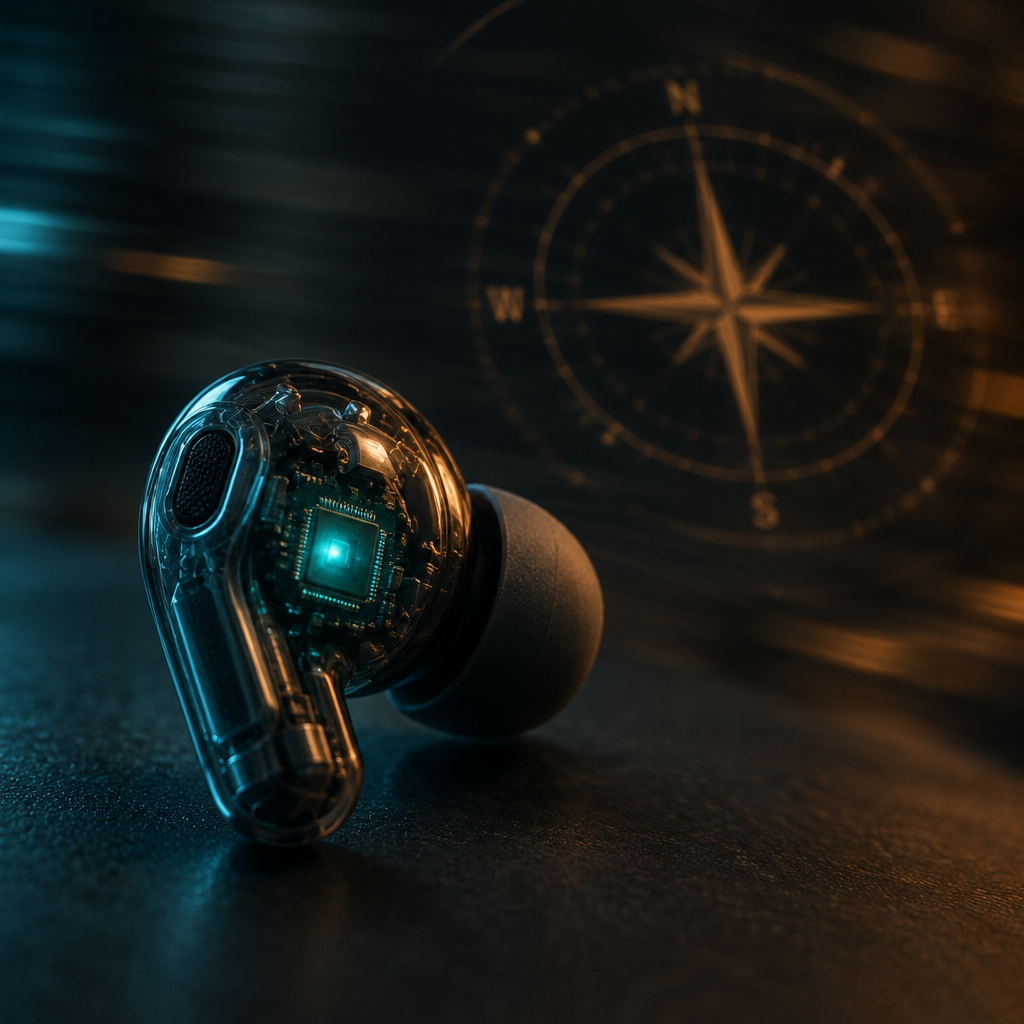
Bluetooth earpieces have spent a decade proving that tiny speakers can sound surprisingly good. The next contest is happening on the other side of the signal chain. It is about the microphone.
That shift is easy to miss because product pages still lead with familiar promises: active noise cancellation, immersive audio, longer battery life, and a case that charges over USB-C. Yet an earpiece is no longer merely a miniature loudspeaker connected to a phone. It is increasingly a two-way audio computer, one that listens to the wearer, listens to the surrounding room, and decides which parts of that sound should travel across the wireless link.
This matters whenever the listener speaks. A phone call on a windy sidewalk, a video meeting beside an espresso grinder, a voice message recorded in a moving car, and a conversation with a digital assistant all expose the same weakness. The earpiece may reproduce the other person's voice beautifully while sending back a voice that sounds distant, watery, or buried under the environment.
The engineering challenge is not simply to make the microphone more sensitive. A more sensitive microphone hears everything. The real goal is selective hearing.
An earpiece is a small microphone array
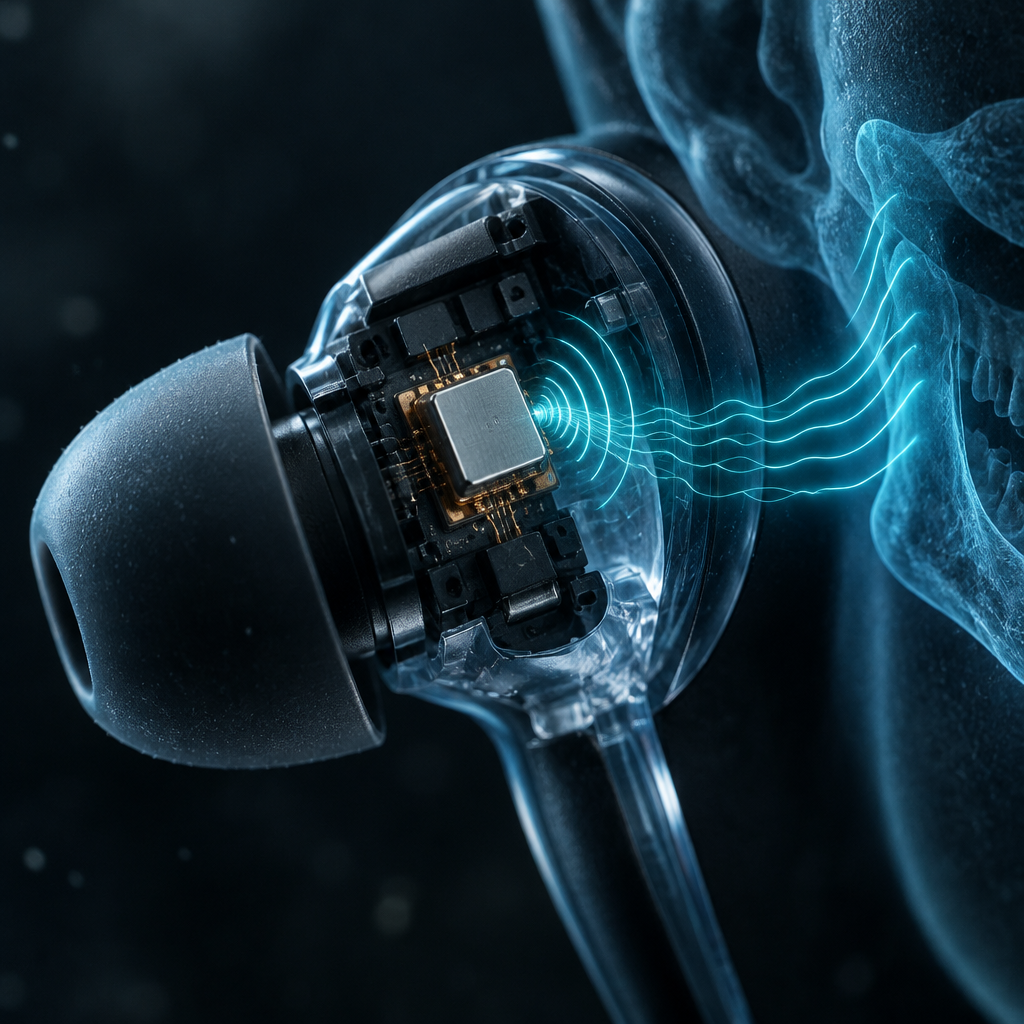
Most modern true wireless earpieces contain more than one microphone per side. Their placement is deliberate. One microphone may sit close to the mouth-facing edge, while another points outward toward traffic, wind, or conversation in the room. The pair creates spatial information that a single microphone cannot provide.
That information gives the signal processor something to work with. If a voice arrives at both microphones at slightly different times and with different levels, the earpiece can estimate where it came from. A beamformer then emphasizes the direction associated with the wearer and reduces sound arriving from other angles.
Beamforming is not magic, and it is not the same as simply turning down the background. A passing truck may be louder than the speaker and may overlap the voice across much of the same frequency range. The algorithm has to track a moving acoustic scene, preserve consonants, and avoid making the voice sound like it is being chopped into pieces.
The ear itself becomes part of the system. Because an in-ear device is close to the head, it can pick up bone-conducted vibration and internal leakage as well as airborne sound. Those signals are useful in different ways. Internal vibration can help estimate when the wearer is speaking, while the outward-facing microphones can monitor the environment and wind pressure.
In other words, the best Bluetooth earpieces are not asking one tiny microphone to solve a giant problem. They are combining several imperfect sensors and trying to make one convincing uplink.
Why voice calls expose Bluetooth's old compromises
Bluetooth audio was built around a basic asymmetry. Music mostly travels from a source to headphones. A phone call needs audio to move in both directions at once, and it needs the system to change behavior quickly when the microphone becomes active.
Traditional Bluetooth call audio uses the Hands-Free Profile and a speech-oriented mode. For years, that meant accepting a noticeable reduction in bandwidth when a headset microphone was turned on. The headphones could sound rich while playing music, then switch to a narrower, more telephone-like path during a call.
Bluetooth LE Audio offers a cleaner foundation for this problem. Its Low Complexity Communication Codec, LC3, is designed for both speech and general audio, with flexible bit rates and frame durations. The transport uses scheduled isochronous communication, which is useful for time-sensitive audio flowing in both directions. An earpiece can receive the caller's voice while sending the wearer's voice back without treating the microphone as an awkward afterthought.
That does not mean every LE Audio earpiece automatically delivers perfect calls. The source device, operating system, earpiece firmware, and application all need to support the same parts of the system. Compatibility remains a chain, and the weakest link still gets a vote.
Still, the architectural difference is important. The wireless connection can be designed around a coordinated pair of microphones and speakers rather than forcing a music product to enter a separate legacy telephone mode. More consistent timing also gives the signal processor a better basis for echo cancellation, noise reduction, and the synchronization of left and right devices.
LC3 is useful because speech is not a studio recording
Codec discussions often become a parade of maximum bit rates. For voice, that is the wrong scoreboard. A person on the other end of a call does not need the full frequency range of a cymbal recording. They need consonants to remain distinct, pauses to feel natural, and the voice to stay intelligible when radio conditions deteriorate.
LC3's value is its flexibility. It can deliver useful quality at modest bit rates, which can reduce the amount of radio activity and the energy spent moving and processing packets. It also supports packet-loss concealment. When a packet disappears, the decoder estimates a plausible continuation instead of presenting every brief radio failure as a sharp hole in the conversation.
That graceful degradation is especially valuable for earpieces. Their antennas are tiny, their batteries are smaller, and the human body can obstruct the path between the phone and one side of the pair. A codec that remains understandable during a moment of interference may produce a better conversation than one that sounds more detailed in a perfect laboratory link.
Shorter frames can help reduce delay, but they introduce a tradeoff. Less audio stored in each frame means less time to hide a bad packet or smooth over an unstable connection. Longer buffers improve resilience and make radio problems less audible, but they add latency. Good earpiece design is not about choosing the lowest number. It is about keeping the delay stable enough that conversation feels immediate.
Wind is the microphone's natural enemy
Wind noise is one of the hardest problems because it can overwhelm the microphone before digital processing gets a chance to help. Turbulence at a microphone port creates low-frequency pressure changes that may be far louder than the wearer's speech. Once the voice and the noise have been captured together, removing the wind without damaging the voice becomes difficult.
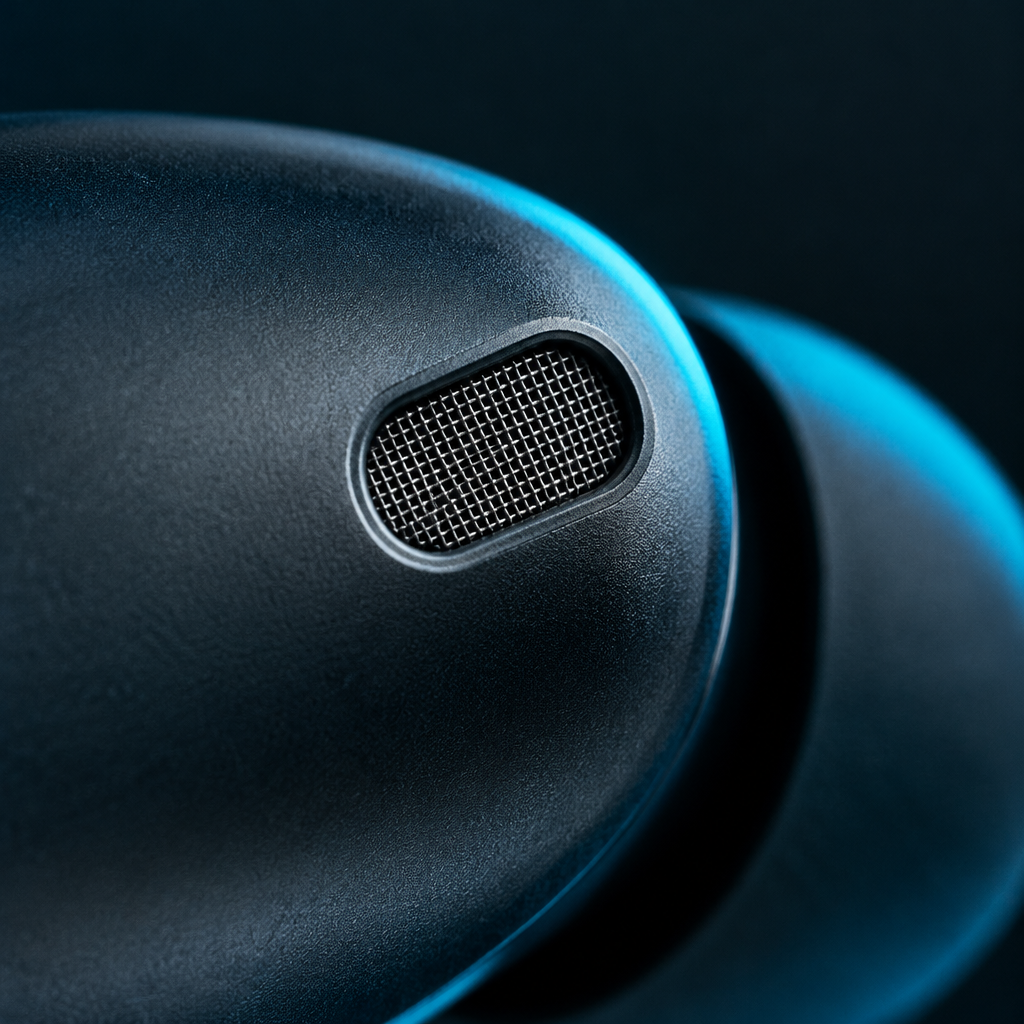
Manufacturers attack the problem in several layers. Meshes and acoustic ports can reduce the amount of wind reaching the capsule. The earpiece can compare microphones and detect pressure patterns that look unlike speech. A digital filter can reduce low-frequency rumble. More advanced systems use a neural network trained to distinguish speech from complicated background recordings.
Machine learning is powerful here, but it has a failure mode that listeners recognize immediately. If the model is too aggressive, speech becomes metallic or loses the edges of words. If it is too cautious, the other person hears every gust. The best result is usually not total silence. It is a voice that retains its texture while the environment recedes far enough into the background.
There is another complication: the earpiece has to know whether the wearer is speaking. Voice activity detection can reduce processing when nobody is talking and help the system choose the right noise profile when speech begins. A false trigger can cut into a ringtone or a nearby person's voice. A missed trigger can leave the first syllable of a sentence under the noise suppressor. Those tiny errors shape the feeling of a call more than a specification sheet does.
The earbud may become an always-ready voice sensor
Once an earpiece has multiple microphones, motion sensors, a capable processor, and a two-way Bluetooth link, its role expands. It can support hands-free dictation, live captions, translation, accessibility features, and voice control without requiring the wearer to hold a phone in front of the mouth.
That future depends on local processing. Sending every raw microphone sample to the phone would consume power, increase privacy concerns, and add network traffic. An earpiece can instead detect speech locally, suppress obvious environmental noise, and transmit a cleaner stream. Some functions can run entirely on the phone, while others may eventually run on the earpiece's own neural-processing hardware.
Local processing is not automatically private. A microphone that is ready to detect a wake phrase is still a microphone, and users need clear indicators and meaningful controls. The more useful earpieces become as voice interfaces, the more important it is to show when they are listening, what is processed locally, and what leaves the device.
Battery life complicates the ambition. Microphones, analog-to-digital converters, beamforming, echo cancellation, and machine-learning models all draw power. Efficient Bluetooth transport can help, but it cannot make computation free. The best products will coordinate radio duty cycles and processing load, using simple methods when the environment is quiet and reserving heavier models for difficult scenes.
What to look for when buying earpieces
Call quality should be tested as a first-class feature, not inferred from music performance. A large driver does not tell you whether a voice will reach the other end clearly. Neither does an impressive noise-cancellation number, because ANC for the listener and noise reduction for the microphone solve different problems.
Look for microphone samples recorded outdoors, in traffic, and around competing speech. Check whether the product supports LE Audio on both the phone and the earpieces, and do not assume that a Bluetooth version number guarantees it. Bluetooth 5.3 or 5.4 may describe the radio generation, while LE Audio support depends on profiles, software, and certification details.
Fit still matters. A stable seal helps the speaker system, but microphone ports must remain clear. Hair, hats, fingers, and wind can change the acoustic conditions. A beautifully tuned algorithm cannot fully compensate for a port pressed against a scarf.
The quiet revolution is happening on the uplink
Bluetooth earpieces are often judged from the listener's seat. We ask whether the bass is deep, whether the treble is smooth, and whether the outside world disappears. Those questions remain valid, but the more consequential upgrade may be heard by the person on the other end of the call.
LE Audio, LC3, microphone arrays, beamforming, and local speech processing are converging on a different kind of wireless earpiece. It is not merely a private stereo system. It is a small, wearable communications terminal that has to understand timing, direction, interference, and human speech at the same time.
The winning design will not be the one that claims to erase every sound around the wearer. It will be the one that makes speech feel natural in places where a bare phone microphone would surrender. When that happens, the microphone will stop being the least impressive part of the earpiece. It will be the reason the device feels indispensable.