Why Bluetooth Earpieces Do Not Crackle Every Time the Signal Breaks
Wireless audio has a slightly unfair reputation. A song is playing, the bass is moving along nicely, and then somebody puts a phone in a pocket, walks between you and the transmitter, or steps into a crowded train station. The radio link takes a hit. Yet the earpieces often keep playing. Maybe the sound softens for a fraction of a second. Maybe a cymbal loses a little edge. There is no dramatic burst of digital confetti.
That smooth recovery is not magic, and it is not proof that Bluetooth packets never go missing. Packets disappear all the time. The important question is what the earpieces do with the hole they leave behind.
In newer Bluetooth LE Audio designs, the answer often involves the LC3 codec and a receiver-side technique called packet-loss concealment, or PLC. LC3 does more than shrink music into a stream that fits through a radio connection. Its frame structure gives the playback device useful clues about how to make a damaged moment less objectionable. The result is a tradeoff that listeners notice immediately, even if they never hear the word codec: fewer clicks, fewer hard mutes, and a more stable sense of presence.
A wireless audio stream is a sequence of bets
Before an earpiece can play a song, the source device turns the audio into a succession of coded frames. Each frame represents a short slice of time. Bluetooth LE Audio commonly uses LC3 frame intervals of 7.5 or 10 milliseconds, according to the Bluetooth Special Interest Group. A frame is small enough to transmit quickly, but it still contains a compact description of the waveform for that brief interval.
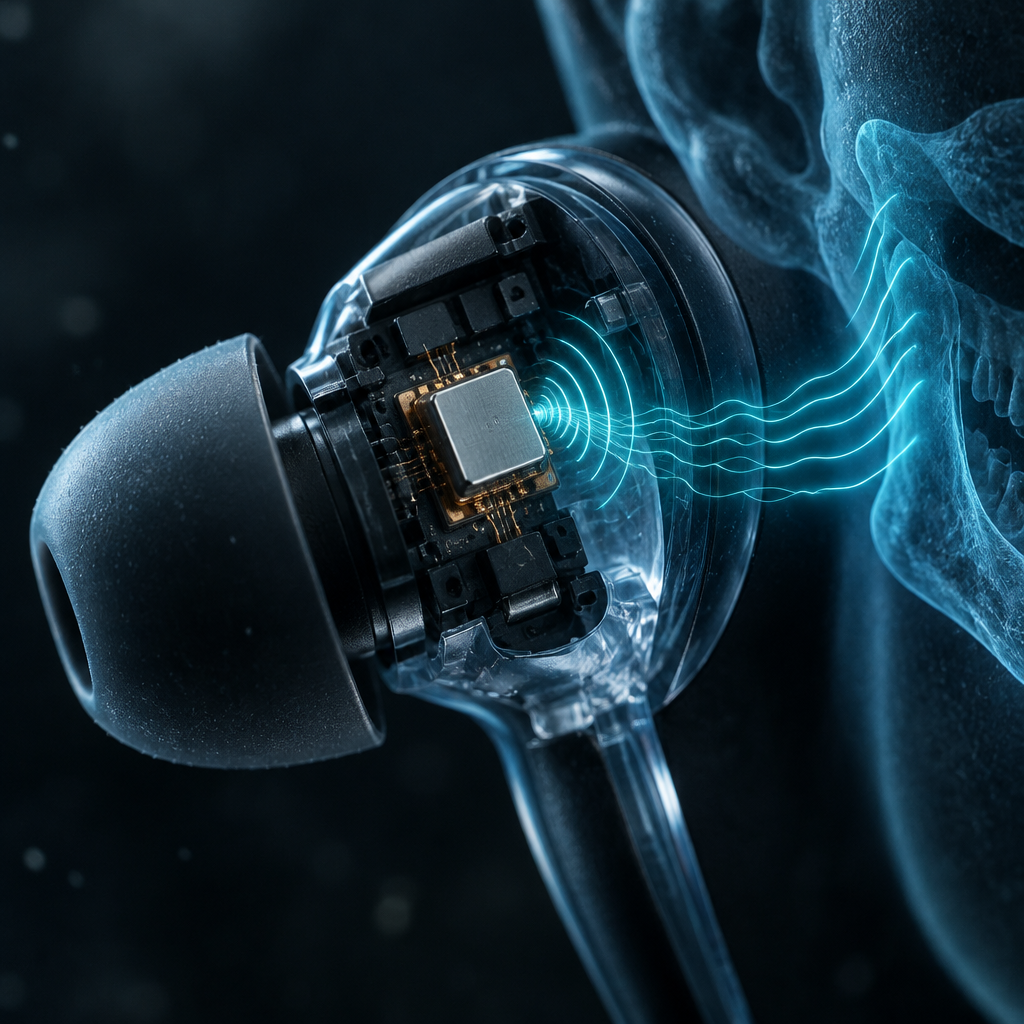
The source sends those frames over the air. The earpiece receives them, checks whether they arrived intact, decodes them, and feeds samples to its digital signal processing chain and speaker driver. The chain is fast, but it cannot negotiate with physics. Human bodies absorb radio energy. Wi-Fi networks and other Bluetooth devices share crowded spectrum. Reflections create dead spots. A short burst of interference can erase one frame or several.
With a conventional approach, a missing frame might produce a sharp discontinuity. The decoder has no valid numbers for that instant, so the output can click, pop, repeat a tiny fragment, or fall silent. A silence is sometimes preferable to a loud artifact, but repeated dropouts make a call feel broken and music feel cheap.
PLC changes the question from “what was the exact missing waveform?” to “what replacement will sound least wrong?” That distinction matters. The original samples cannot be reconstructed perfectly from nothing. The goal is perceptual continuity, not forensic restoration.
What LC3 contributes
LC3 stands for Low Complexity Communications Codec. It was designed for Bluetooth LE Audio, including music, voice, hearing assistance, and true wireless earpiece applications. The Bluetooth SIG describes it as a flexible codec that can operate across multiple sampling rates, bitrates, and sample depths. It can deliver useful quality at lower bitrates than the older SBC codec, which gives product designers more room to spend their limited radio and battery budgets.
That flexibility is important because wireless earpieces are not solving one problem. They need acceptable fidelity, low delay, modest processing demand, and enough battery life for a full day. A higher bitrate can preserve more detail, but it uses more airtime. More airtime can mean more energy and more opportunities for collisions. A lower bitrate saves resources, but only if the codec keeps the losses graceful.
LC3 is block based, so it processes audio in short windows rather than treating an entire song as one indivisible object. When a frame is missing, the receiver can use information from nearby frames and the codec’s model of the signal to create a substitute. Depending on the audio, that substitute may resemble a continuation of the previous sound, a carefully shaped fade, or a noise-like signal that avoids an unnatural hole.
The exact implementation belongs to the device and codec software. There is no single universal “PLC sound.” A well-tuned system tries to prevent the replacement from drawing attention to itself. A sustained vocal may be extended smoothly. A drum hit may be treated differently, because stretching a transient can smear the rhythm. Speech can receive another kind of treatment, since intelligibility matters more than preserving every harmonic detail.
Why hiding a lost frame is harder than repeating it
The obvious emergency fix is to replay the last good frame. It is simple, but repetition is audible. A repeated vowel can sound robotic. A repeated snare can sound like a tiny stutter. If multiple frames vanish, the same fragment becomes a loop, and the listener notices the machine behind the music.
Silence has the opposite problem. It avoids inventing audio, but a sudden zero crossing is not necessarily quiet to the ear. Cutting from a nonzero waveform to absolute silence can create a click. Even when it does not click, the gap tells the listener that the connection has failed.
PLC aims for a middle path. It preserves continuity in amplitude and frequency as much as possible, while gradually changing its strategy if the outage continues. The first missing frame may be concealed with a close estimate. Later frames may be faded, attenuated, or filled with shaped noise. That progression is deliberate. A plausible guess is useful for a tiny loss; a confident fiction becomes irritating during a long outage.
This is also why a listener can sometimes sense a softening before hearing a dropout. The earpiece is not restoring the lost data in the mathematical sense. It is managing the failure so the ear perceives a smaller disturbance.
The latency decision hiding underneath
Every earpiece designer has to choose how much audio to keep in reserve. A small jitter buffer lets the device play promptly, which helps with video, games, and conversations. But a small buffer has less time to wait for a delayed packet or a retransmission. A larger buffer gives the radio more breathing room, yet it adds delay and consumes memory and energy.
LE Audio separates some of these decisions from the older Bluetooth audio architecture. Its isochronous transport is designed for timed audio delivery, and the system can use redundancy or retransmission policies when the application allows it. A music listener may tolerate a little extra buffering. A competitive gamer or a person watching a live conversation may not.
PLC is therefore not a replacement for a reliable radio link. It is the shock absorber after the link has already misbehaved. If a product uses an aggressive low-latency setting, the concealment algorithm may have only a narrow window in which to work. If the radio environment is persistently bad, no codec can manufacture a convincing orchestra indefinitely.
Two earpieces, one listening experience
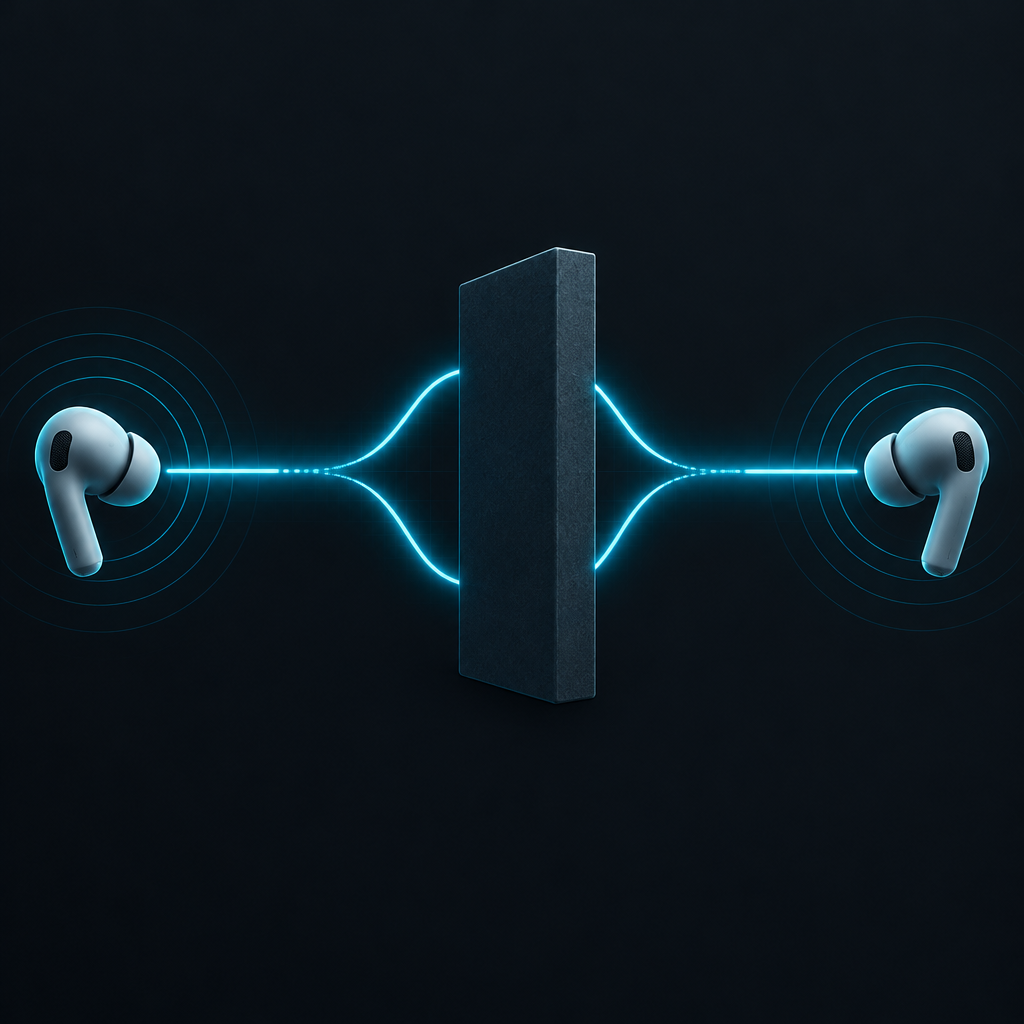
True wireless earpieces add another complication: left and right channels must remain synchronized. A brief loss in one side is not only a missing sound; it can also become a spatial error. If the left bud conceals a frame while the right bud plays its frame normally, the image may shift for a moment. Good implementations coordinate timestamps, playback clocks, and concealment behavior so the listener experiences one stereo field rather than two independent repairs.
This is one reason standardized LE Audio matters beyond the marketing label. The system defines a common framework for streams, timing, and control, while manufacturers still compete on antennas, microphones, DSP tuning, drivers, and power management. The earpieces have to make several small decisions at once: whether to request another packet, whether to conceal immediately, whether to adjust gain, and how to keep both sides aligned.
Calls reveal the technology more clearly
Music can hide a tiny error inside a dense mix. Speech cannot always do that. During a call, one missing syllable can change meaning, and background noise can make the receiver’s job harder. LC3’s use across speech and music is valuable here because a single audio framework can support different operating points without forcing every product into the same compromise.
Microphone audio also travels in the other direction. The earpieces capture a voice, process it, and send it to the phone or computer. Packet loss concealment on that uplink can help a listener hear a more continuous voice, but the microphone system must also fight wind, handling noise, and room echo. If a caller sounds smooth in a difficult location, several layers of engineering are probably cooperating, not just one codec feature.
What shoppers should actually look for
“LC3 supported” is useful information, but it is not a guarantee of identical performance across every phone, computer, and earpiece. The source and receiver both need compatible LE Audio support, and operating system behavior can affect which mode is selected. A product may advertise LE Audio while reserving some features for particular devices or firmware versions.
Look for specific claims about Bluetooth LE Audio compatibility, multipoint behavior, gaming latency, and firmware support. Reviews that test crowded wireless environments are more revealing than a quiet-room listening session. Pay attention to whether a reviewer describes brief losses as clicks, mutes, robotic repeats, or gentle softening. Those words are clues about the whole implementation, including the antenna and radio scheduler, not just the codec.
Battery life also deserves a skeptical look. LC3 can improve the quality and efficiency tradeoff, but the final result depends on bitrate, retransmissions, noise cancellation, microphone use, spatial processing, and the earpiece’s amplifier. A codec is one tool in the power budget, not a magic battery multiplier.
The quiet achievement is graceful failure
Wireless audio is often judged by its best moments: clean treble, deep bass, convincing spatial effects. In daily use, its worst moments may matter more. A train door closes. A phone shifts in a jacket. A busy office fills the spectrum with competing radios. The quality of the earpieces is revealed by how little drama follows.
LC3 and packet-loss concealment do not make Bluetooth invulnerable. They make a short failure less conspicuous. That is a more modest promise, and a more useful one. The best wireless technology is not always the technology that performs a dazzling trick. Sometimes it is the technology that notices a packet has vanished, invents the least offensive replacement, keeps the left and right earpieces together, and lets the song continue without asking you to care.
Frequently asked questions
What is packet-loss concealment in Bluetooth earpieces?
Packet-loss concealment is receiver-side processing that creates a perceptually smooth replacement when one or more audio frames are missing or corrupted. It cannot recover the exact original data, but it can reduce clicks, harsh gaps, and repetitive artifacts.
Does LC3 eliminate Bluetooth dropouts?
No. LC3 can make brief losses less noticeable, but radio interference, distance, body blockage, and device compatibility can still cause dropouts. Persistent interference eventually exceeds what any concealment algorithm can hide.
Do both my phone and earpieces need LE Audio for LC3?
Yes. The source and receiving earpieces need compatible Bluetooth LE Audio support, and the operating system must select that mode. Having LC3 listed on only one product does not guarantee that it will be used.
Is LC3 always better than SBC?
LC3 was designed to provide strong perceived quality across flexible bitrates and to support newer LE Audio features. Actual results still depend on bitrate, implementation, radio conditions, tuning, and the listening device. A well-designed product matters as much as the codec name.