Bluetooth earpieces have spent their entire existence negotiating a beggar's budget. Two megabits per second, shared between left and right channels, voice, metadata, and whatever else the operating system of your phone thinks matters. That ceiling has shaped everything: codec design, latency targets, power management, even the way manufacturers describe high resolution to customers who have no reason to trust the label.
Bluetooth High Data Throughput, or HDT, shoves that ceiling upward with a force that is almost rude. The maximum data rate jumps from 2 Mbps to 7.5 Mbps. Not through a new radio band, not through a clever compression trick, but through a fundamentally denser way of encoding bits into radio waves. For earpieces, this is not an incremental spec bump. It is the difference between a garden hose and a fire hydrant, and the engineering questions that follow are considerably more interesting than sounds better, right?
The modulation leap nobody warned you about
Today's Bluetooth LE audio uses Gaussian Frequency Shift Keying, a modulation scheme that is delightfully simple and correspondingly stingy with data. Each symbol carries one or two bits. The radio whispers. HDT replaces that whisper with something closer to a structured shout. It adopts Quadrature Amplitude Modulation, the same family of techniques that cable modems and Wi-Fi have used for years to squeeze enormous throughput from limited spectrum.
QAM works by varying both the amplitude and the phase of a carrier signal simultaneously. More signal states means more bits per symbol. HDT defines multiple rates: 2, 3, 4, 6, and 7.5 Mbps, all running at a 2 megasymbol per second signaling rate. The radio channel stays the same width. The bits just get packed tighter.
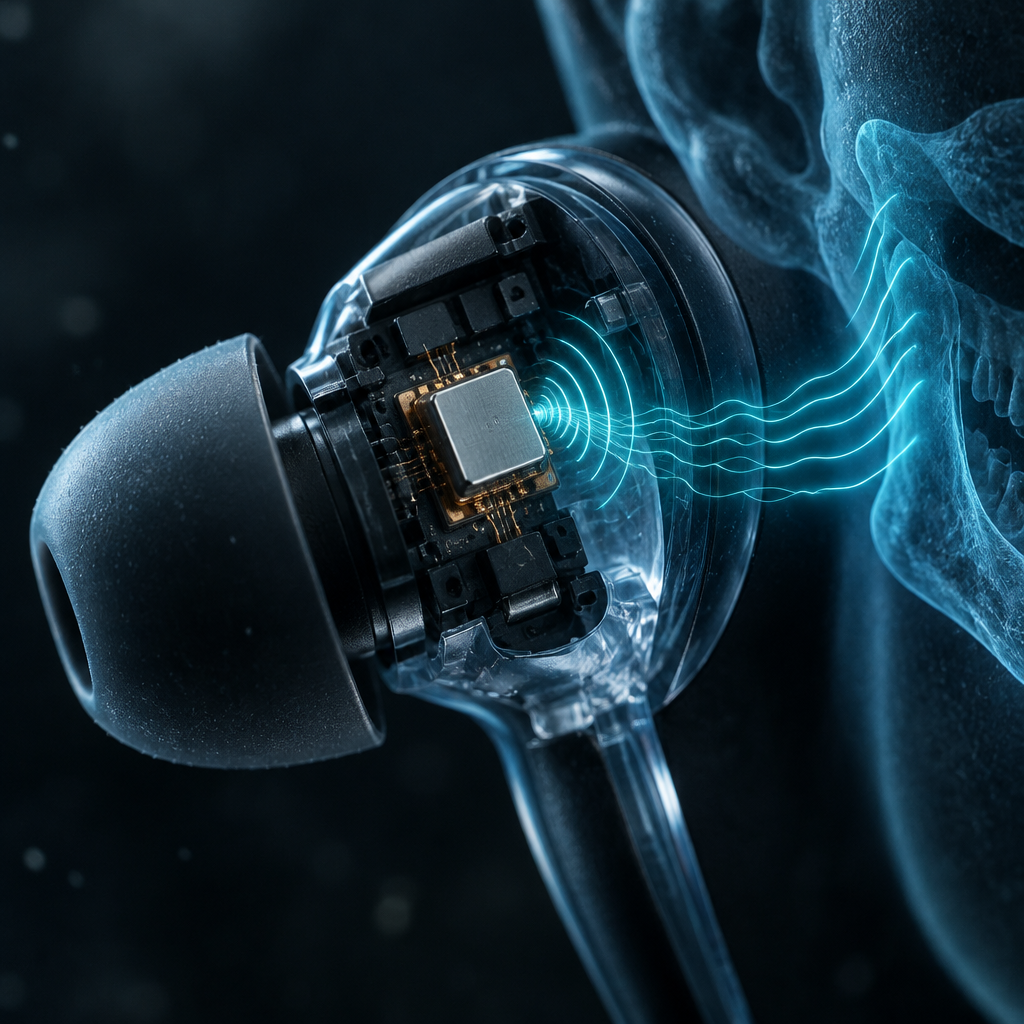
Tighter packing has a cost. The receiver must distinguish between signal states that are closer together, which demands more precise sampling and better noise margins. Coherent detection enters the picture. Instead of simply detecting frequency shifts, the receiver tracks the phase of the incoming signal and uses that phase information to decode symbols accurately. This is not a minor firmware tweak. It changes what the silicon inside an earpiece has to do, and it changes the power budget that pays for it.
Why four times the bandwidth actually matters for earpieces
Cynical readers will note that current earpieces sound fine. LC3 at moderate bitrates is genuinely good. SBC was annoying for years and people survived. So what does 7.5 Mbps buy that 2 Mbps does not?
The honest answer is: room. Room for lossless or near-lossless audio that does not require aggressive psychoacoustic discarding of signal content. Room for concurrent streams, so a left earpiece, a right earpiece, an ambient microphone feed, and a voice uplink can all coexist without one starving the others. Room for metadata, spatial audio positioning data, sensor telemetry, or whatever else a manufacturer decides to pile into the pipe. And room for all of that to happen with lower effective latency, because the radio finishes its business faster and returns to idle.
Consider the current compromise. An earpiece running stereo LE Audio at 328 kbps, plus a voice channel, plus ANC telemetry, is already spending a notable fraction of its 2 Mbps just staying alive. There is not much headroom for a higher-quality audio layer, even if the codec and the listener's ears are ready for it. HDT does not just add speed. It adds the surplus that lets engineers stop making compromises that nobody asked to explain on a spec sheet.
The packet architecture is quietly revolutionary
Speed is the headline. The packet structure is the real story. HDT defines packets that can carry up to roughly 8,000 bytes in their largest mode, divided into smaller blocks. Each block has its own checksum. If interference corrupts one block, the receiver requests retransmission of that block alone, not the entire packet.
This matters enormously for earpieces, which live in the most hostile RF environment most people will ever encounter: the human body. Your head absorbs 2.4 GHz radio energy. Your torso creates reflections. Your phone sits in a pocket that changes position every time you move. The current model handles this by retransmitting entire packets, which burns airtime and battery. Block level retransmission means a corrupted chunk costs a few hundred bytes of retransmission, not a few thousand.
The selective acknowledgment scheme lets devices interleave traffic too. An earpiece can receive part of a large audio packet, pause for a quick control message, then resume the audio transfer where it left off. The radio spends less time tied up, which translates directly into battery savings on a device where every milliamp matters.
Forward error correction: the unsung hero
HDT adds forward error correction at the physical layer for all bit rates. Convolutional codes generate redundant bits that let the receiver detect and correct certain errors without asking for a retransmission at all. In an RF environment as messy as the space around a person's ear, this is worth more than raw throughput.
Think about what happens when you walk past a microwave, stand near a router, or enter a crowded train platform. Bluetooth audio stutters because the bit error rate spikes and the protocol has to either retransmit or drop audio frames. FEC gives the receiver a chance to fix small errors locally, silently, without involving the transmitter. The audio keeps playing. The battery is spared the cost of a retransmit cycle. The listener never notices that the radio environment just got hostile.
For hearing aid use cases, where an earpiece might be streaming amplified ambient sound with near zero tolerance for dropouts, FEC is not a luxury. It is closer to a medical grade reliability feature that happens to be implemented in silicon.
Adaptive rates: fast when you can, stable when you must
Every HDT packet signals its data rate in the header. A connection can switch speeds packet by packet. When the channel is clean, the earpiece runs at 7.5 Mbps. When interference degrades the signal, the earpiece drops to 4, 3, or 2 Mbps for the next packet, maintaining the link instead of breaking it.
An optional link quality feedback mechanism lets the receiver report signal conditions, like RSSI and SNR, in real time. The transmitter can use that information to pick the fastest rate the current environment will support. This is not a static negotiation at connection time. It is a continuous, per packet adaptation.
The result is an earpiece that sprints when the radio environment is clear and slows to a stable walk when it is not. The listener should not hear the transitions. They should hear audio that continues regardless of whether they are standing in an open field or walking through a steel framed building.
Security scales with speed
Faster data rates mean larger attack surfaces, at least in principle. HDT responds with larger Message Integrity Check options: 64 bits and 128 bits, up from the 32-bit MIC used with existing Bluetooth LE PHYs. A new encryption key schedule lets devices switch keys and MIC lengths when transitioning between standard GFSK and HDT radio modes, so the security boundary does not develop a seam at the moment the modulation changes.
For earpieces handling voice calls, financial notifications, or health data, the stronger integrity checks are not paranoid. They are proportional. A 7.5 Mbps link can carry a lot of sensitive content in a hurry, and the integrity framework has to scale accordingly.
What earpiece makers need to solve
HDT is not a software update that rolls out overnight. The PHY changes require new radio silicon. Coherent detection demands more sophisticated receiver design than current GFSK demodulators provide. The QAM modulation schemes need careful antenna and front end engineering in a form factor that barely fits a battery.
Power consumption is the open question. Higher order modulation and coherent detection require more processing, and earpieces have thermal and battery constraints that headphones do not. A large over ear cup has room for a bigger battery and more metal for heat dissipation. A 5 gram earpiece does not. Whether the energy savings from shorter transmission times and fewer retransmissions offset the cost of more complex signal processing is a question that will be answered in silicon, not in specifications.
Then there is the ecosystem. The phone, tablet, or laptop has to support HDT transmission. The earpiece has to support HDT reception. The operating system has to know when to use it. Bluetooth SIG members are working on this now, but the gap between specification and consumer product is measured in years, not months.
The big picture for earpieces
HDT will not make your current earpieces obsolete overnight. It will not magically make a $20 pair sound like studio reference monitors. What it will do is remove the bandwidth ceiling that has constrained every design decision earpiece engineers have made for the past decade. Lossless audio over Bluetooth becomes physically possible rather than marketing fiction. Simultaneous high quality audio and voice becomes a default rather than a compromise. Reliability in noisy RF environments becomes a protocol level feature rather than a chipset by chipset lottery.
The earpieces shipping in 2027 and 2028 will live in a different world than the ones shipping today. Not because someone invented a new speaker driver or a clever noise cancellation algorithm, but because the radio pipe delivering sound to those tiny devices just got four times wider, and the engineers who build them finally have room to breathe.