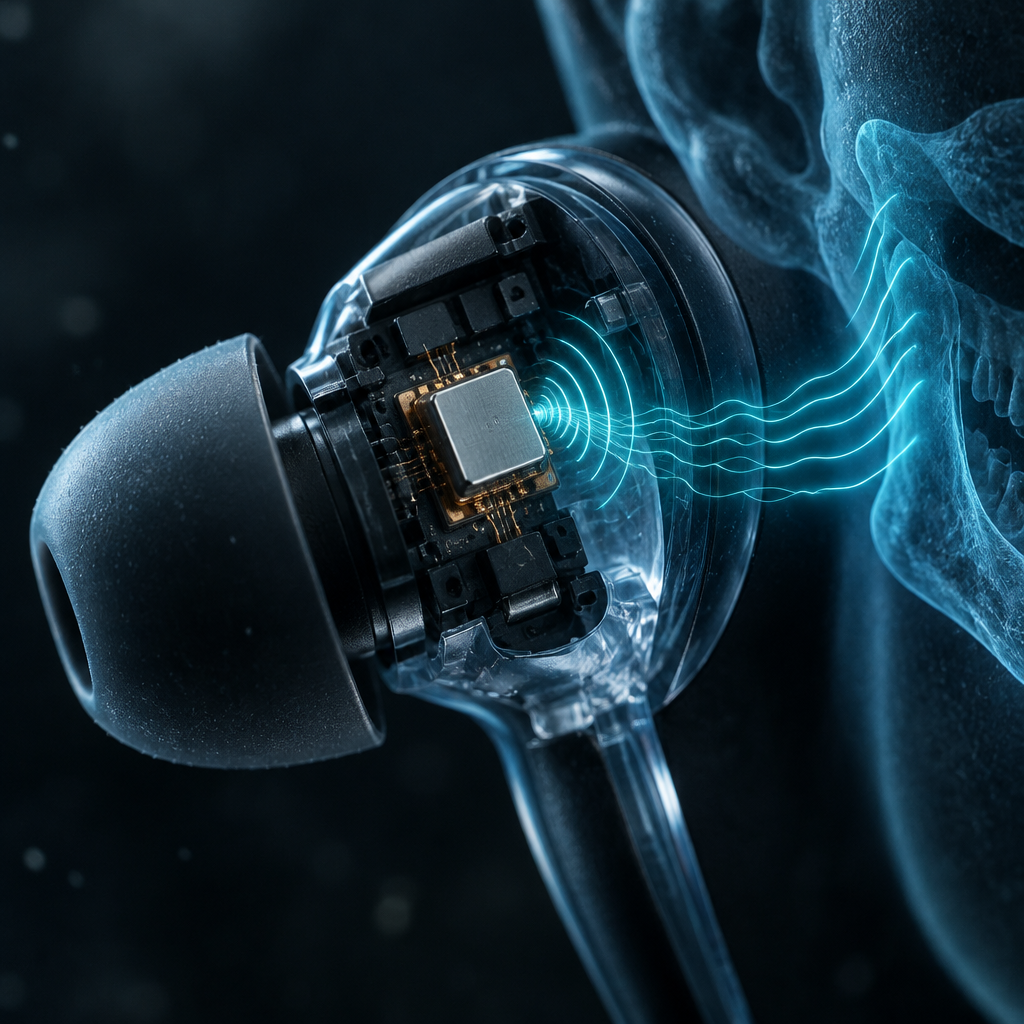
You dropped an earbud between the couch cushions. Again. Your phone says it is "nearby," which is technically true and practically useless. The signal strength bars tell you nothing about whether the bud is wedged under the left cushion, the right one, or somewhere under the dog.
That particular frustration is about to get a lot smaller.
Bluetooth 6.0 introduces a feature called Channel Sounding, and it is arguably the most meaningful upgrade to the wireless protocol since LE Audio. Where previous Bluetooth standards could approximate proximity using signal strength, Channel Sounding measures actual physical distance with sub-meter accuracy. For earpieces specifically, that capability opens doors which signal bars never could.
The Problem With RSSI
Every find-my-earbuds feature you have used until now relies on Received Signal Strength Indication, or RSSI. The logic is simple: stronger signal means closer device. The problem is that RSSI is about as reliable as guessing distance from how loud someone shouts.
Walls absorb signal. Your body attenuates it. A metal laptop lid between your phone and your earbud can drop the RSSI reading by 15 decibels, making a bud six inches away look like it is three meters out. Direction Finding, introduced in Bluetooth 5.1, improved things by measuring angle of arrival, but it requires antenna arrays on both ends. That hardware is bulky, expensive, and essentially impossible to fit inside a true wireless earbud the size of a jellybean.
Channel Sounding takes a fundamentally different approach. Instead of inferring distance from signal loss, it measures the radio signal itself with enough precision to calculate physical separation down to centimeters.
Two Methods, One Measurement
Channel Sounding combines two complementary ranging techniques: Phase-Based Ranging and Round-Trip Timing. They work together to deliver both accuracy and security.
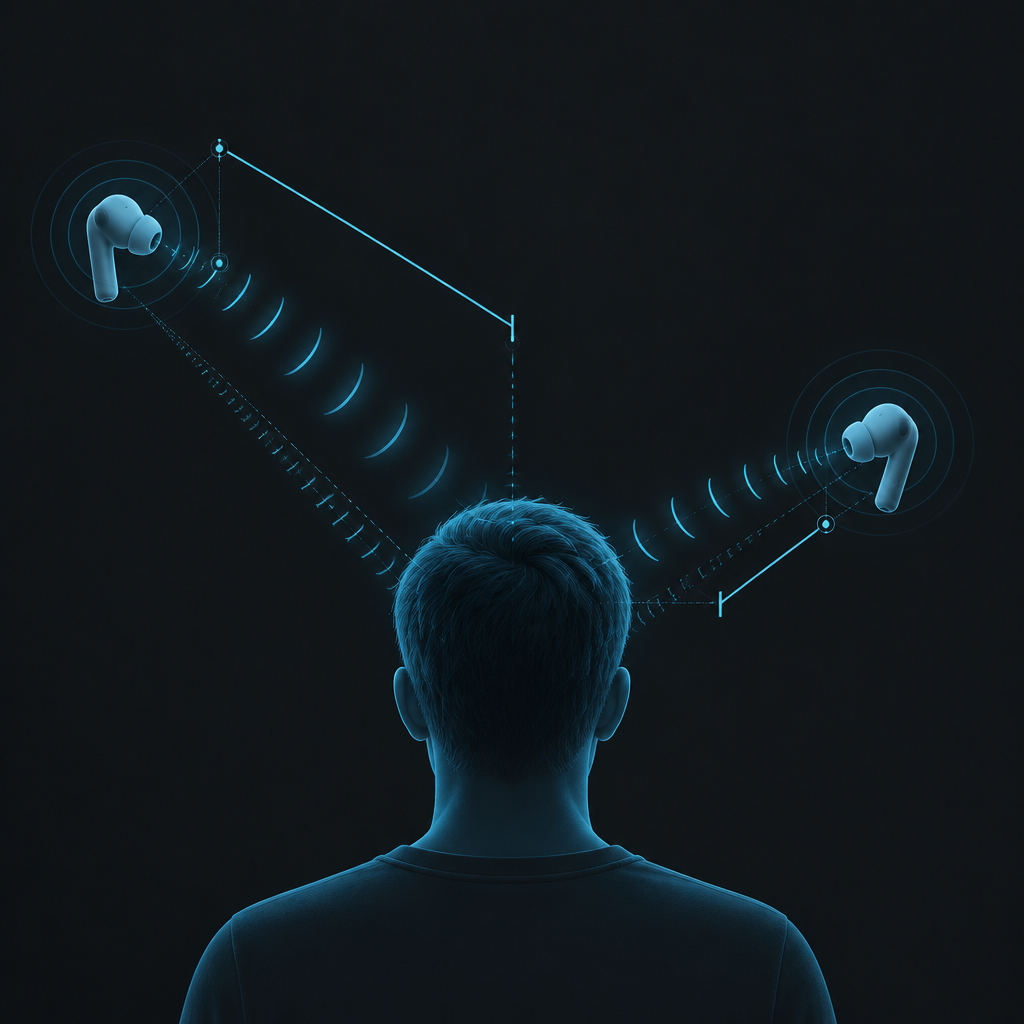
Phase-Based Ranging, or PBR, operates on a principle that sounds almost elegant in its simplicity. The transmitter sends a signal at a known phase on a specific frequency. The receiver reflects that signal back at the exact phase it arrived. The transmitter then measures the phase difference between what it sent and what came back. Repeat this across multiple frequencies in the 2.4 GHz band, and you can triangulate distance with centimeter-level precision.
Think of it like sonar, but instead of timing echoes, you are comparing the wave shape of your outgoing signal against its reflection. The shift in phase tells you exactly how far the signal traveled.
Round-Trip Timing, or RTT, works differently. It measures the time it takes for a signal to travel from initiator to reflector and back. Since radio waves travel at the speed of light, which is conveniently constant, the round-trip time directly corresponds to twice the distance between the devices. RTT accounts for the processing delay at the reflector, so the calculation stays honest.
PBR gives you the accuracy. RTT gives you the security. Used together, they create a ranging system that is both precise and resistant to manipulation.
Why Earpieces Need This
True wireless earbuds are the single most lost consumer electronics category on the planet. They are tiny. They fall out of ears, slip from pockets, and vanish into the dimensional rift between car seats. Apple, Samsung, and Google all offer find-my-device features, but the experience is famously crude: a pulsing dot on a map, a proximity meter that swings wildly as you walk around, a chime that plays if the bud still has battery.
Channel Sounding changes the granularity entirely. Instead of "warm, warmer, cold," your phone could tell you the earbud is 47 centimeters away at a bearing of roughly 2 o'clock. The sub-meter precision of PBR means you could walk to the couch, hold your phone near the cushions, and watch the distance count down in real time. No more patting furniture like a detective at a crime scene.
The 79-channel architecture helps here. Standard Bluetooth LE operates across 40 channels; Channel Sounding defines 79, of which 72 are active. More channels means more frequency diversity, which means the ranging signal cuts through multipath interference from walls, furniture, and human bodies far more effectively than RSSI ever could. Indoors, where earbuds are most often lost, this matters enormously.
Security: The Relay Problem
Distance measurement is only half the story. Channel Sounding also introduces something Bluetooth has never had before: cryptographically verified proximity.
Consider a scenario. You own premium earbuds that auto-pair with whatever phone is nearest. Today, a relay attack could intercept the Bluetooth signal, boost it, and forward it to an attacker's device down the block. Your earbuds would happily connect because the signal arrived; they have no way to verify that the source is actually close.
RTT prevents this. Because it measures the actual round-trip time of the signal, any relay attack introduces latency. The attacker's forwarded signal arrives a few nanoseconds late because it traveled farther. Channel Sounding detects that delay and flags the measurement as unreliable. The earbuds refuse to pair. The relay attack fails silently.
For earpiece manufacturers, this opens up proximity-based pairing that is actually secure. Bring your earbuds within arm's reach of your phone, and they pair. Move them away, and they do not. No more accidental connections to the Bluetooth device on the treadmill next to you at the gym.
Proximity-Aware Audio Features
Channel Sounding's distance awareness enables a category of earpiece features that were not previously possible. Consider proximity-based volume scaling: your earbuds detect how far your phone is from your head and adjust output accordingly. Walk away from your desk with earbuds in, and the volume could gradually increase to compensate for the phone's speakers getting farther from your ears.
Or think about Auracast broadcast audio. One of the friction points with Auracast adoption is the pairing process; you need to find the right broadcast in a venue with multiple streams. Channel Sounding could restrict pairing to only the broadcast source physically nearest to you. Walk up to a silent TV at the gym, hold your phone near the display, and the correct Auracast stream auto-selects. No menus, no scanning, no guessing which broadcast belongs to which screen.
Multi-device switching becomes more intelligent too. Your earbuds could use distance awareness to determine which of your paired devices is closest to you at any moment and route audio accordingly. Laptop three feet away, phone in your pocket one foot from your head? Audio follows the phone. Set the phone down and walk to the desk? The earbuds know, because they are measuring the distance in real time, and they hand off to the laptop.
The Device Landscape Today
Channel Sounding is not science fiction. Bluetooth 6.0 silicon is already shipping. Apple's iPhone 17 supports it. Google's Pixel 10 includes the capability. Silicon Labs, Nordic Semiconductor, and Infineon have all released qualified chipsets. According to the Bluetooth SIG, the feature has generated more developer interest in its first year than any previous Bluetooth enhancement.
Earbuds specifically are still catching up. The qualified product database shows a handful of earpiece designs in validation, but consumer models with Channel Sounding built in are expected in late 2026 and early 2027. When they arrive, the feature will likely appear first in premium models from Apple, Samsung, and Sony before filtering down to mid-range and budget tiers over the following year.
The Bluetooth SIG's own industry survey for 2026 confirms the momentum. Member companies across automotive, industrial, and consumer electronics report strong demand for sub-meter ranging capabilities. Nordic Semiconductor expects Channel Sounding to enable geofencing and safety zone functionality in commercial products this year. Silicon Labs reports widespread interest from industrial asset tracking customers. The technology is maturing faster than any previous Bluetooth ranging standard.
What To Watch For
If you are shopping for earpieces in the coming months, look for Bluetooth 6.0 in the spec sheet. Not every 6.0 device will implement Channel Sounding; the feature is optional within the standard. Manufacturers must specifically adopt it, and some may skip it to save on silicon costs or power budget.
The telltale sign will be marketing language around precision find-my-device features. When a company claims its earbuds can be located to within a foot rather than "approximately nearby," that is Channel Sounding doing the heavy lifting behind the scenes. Watch for the phrase "secure proximity pairing" too; that is RTT verification at work.
The upgrade cycle for wireless audio is accelerating. LE Audio gave us better codecs and lower power consumption. Auracast gave us broadcast sharing. Channel Sounding gives us spatial awareness. Together, these three pillars of Bluetooth's modern era are reshaping what earpieces can do, not just how they sound.
Your earbuds already know your music. Soon, they will know where they are.