For years, Bluetooth earpieces have been built around a simple relationship: one person, one phone, one private stream. Auracast changes the shape of that relationship. Instead of pairing every listener to a source individually, a compatible transmitter can broadcast an audio program that many nearby earpieces can discover and join.
That sounds like a small adjustment to the Bluetooth menu. It is not. Auracast is a new way to think about wireless sound, and it could make earpieces useful in places where Bluetooth pairing has always been awkward: airports, theaters, classrooms, gyms, houses with multiple listeners, and rooms where speech gets swallowed by distance and reverberation.
From a connection to a broadcast
Traditional Bluetooth audio is negotiated between a source and a sink. Your phone and your earpieces establish a relationship, agree on transport details, and keep the stream associated with that connection. This model works beautifully for personal listening, but it becomes clumsy when a room contains dozens of listeners.
Auracast uses the broadcast capabilities of Bluetooth LE Audio. The source advertises an audio broadcast rather than maintaining a separate private audio link for every listener. Earpieces scan for available broadcasts, identify the one the wearer wants, and synchronize to it. The result resembles choosing a Wi-Fi network, except the thing being joined is sound.
The distinction matters at the radio level. A one-to-one design has to manage many individual links as the audience grows. A broadcast can distribute the same audio payload to a crowd, while each receiver handles its own listening state. The venue does not need to know every listener personally, and a listener can leave without forcing the transmitter to tear down a pairing record.
Why LE Audio makes this possible
Auracast is part of the broader Bluetooth LE Audio architecture, not a replacement for every existing Bluetooth audio mode. LE Audio uses Bluetooth Low Energy radio transport and the LC3 codec, which was designed to deliver useful audio quality across a range of bitrates while supporting efficient operation.
LC3 is important because wireless audio is always a negotiation among quality, robustness, latency, and energy. A codec that remains intelligible at a lower bitrate gives designers more room to handle a crowded radio environment or extend battery life. It does not guarantee that every product will sound better than every older product. The implementation still depends on the earpiece's acoustic design, amplifier, digital signal processing, and the settings chosen by the manufacturer.
LE Audio also introduces a more flexible structure for synchronized streams. That matters for stereo earpieces. The left and right sides need to maintain timing while coping with radio interference, changing body position, and limited battery capacity. Better coordination can reduce the old problem in which one earpiece drops out, drifts, or drains much faster than the other.
For listeners, the most important point is less technical: Auracast requires a compatible transmitter and a compatible receiver. A phone with a new Bluetooth version is not automatically an Auracast source, and earpieces that advertise Bluetooth 5.x are not automatically LE Audio products. Version numbers are clues, not proof of a feature.
The public room is the real test
Personal music is an easy demonstration for wireless audio. A quiet room, a familiar phone, and a carefully mastered track can make almost any modern earpiece appear convincing. Auracast has a more demanding proving ground. It has to work when a listener is entering a venue, searching through nearby broadcasts, selecting the correct channel, and hearing speech that may be competing with a noisy room.
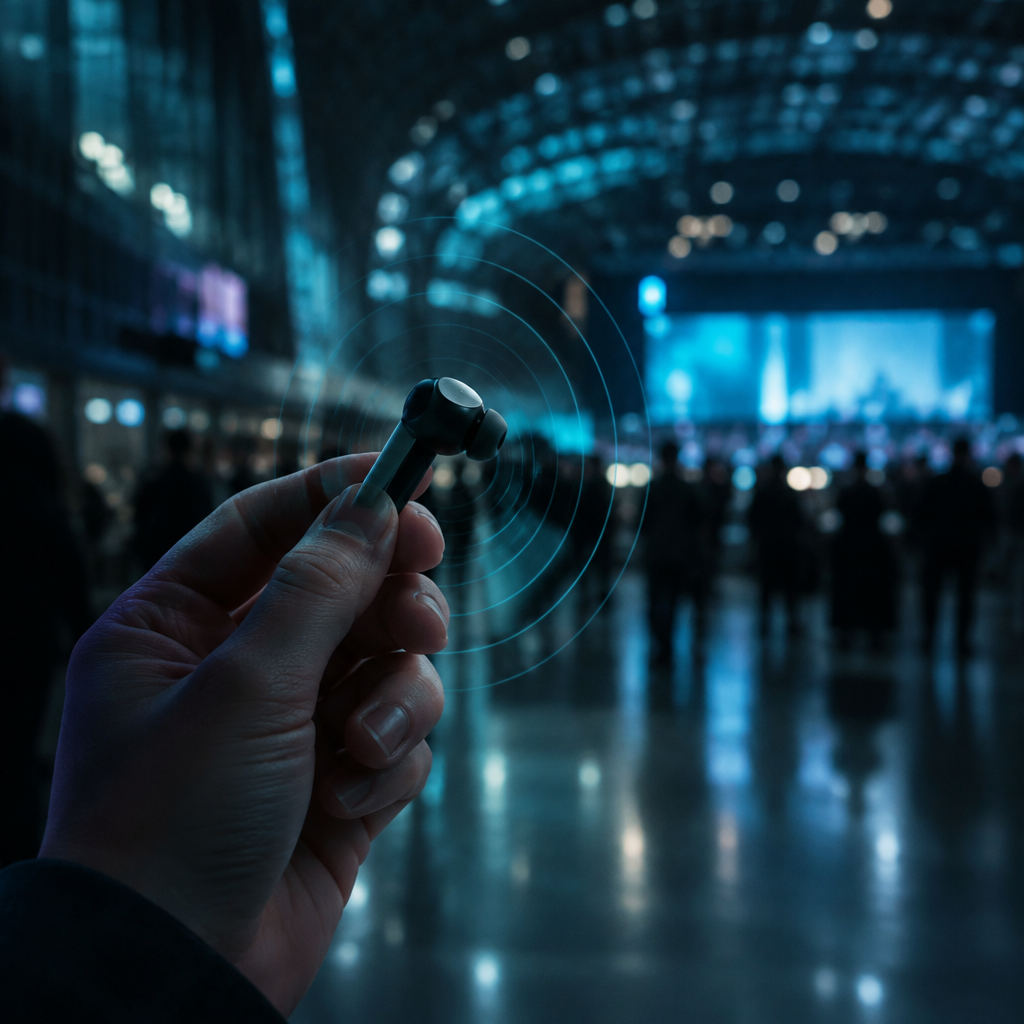
Consider an airport gate. A display or public-address system could transmit a gate announcement as an Auracast broadcast. A traveler with compatible earpieces could scan a QR code, choose the gate channel, or use a venue profile to find it. The audio would arrive directly at the ears instead of traveling through the room, bouncing off hard surfaces, and competing with conversations.
The same approach could help in a movie theater, lecture hall, house of worship, or museum. A broadcast can carry the main program, a translated language track, descriptive audio, or a dedicated assistive listening mix. The important engineering advantage is consistency. Everyone receives the signal from the same source, while each listener can choose a comfortable volume on the receiving device.
There are still practical questions. A venue has to install and maintain transmitters. The broadcast name needs to be clear. Channel selection must not feel like a technician's menu. If a visitor has to understand synchronization groups, encryption labels, and codec modes before hearing a tour guide, the technology has failed at the human interface even if the radio link is excellent.
Accessibility without a separate audio island
Auracast's most meaningful promise may be social rather than audiophile. Assistive listening systems have often required dedicated receivers, special induction loops, or venue-specific equipment. Those systems can be valuable, but they are not always available, easy to use, or comfortable to explain in public.
A common broadcast standard could let hearing aids, cochlear implant processors, headphones, and earpieces participate in the same audio environment. Someone who needs extra speech clarity could tune in, while friends and family listen through their own compatible devices. The technology does not make hearing loss disappear. It can, however, move assistance from a visibly separate system toward a normal part of the room's infrastructure.
That shift also changes the economics. A broadcast transmitter can serve many receivers, and listeners may already own the receiving hardware. Lower deployment friction could encourage smaller venues to provide better audio access. The outcome will depend on installation costs, device compatibility, local accessibility practices, and whether venue operators treat the feature as essential instead of decorative.
Sharing music becomes less awkward
Auracast is not limited to public infrastructure. A person could broadcast a playlist to friends at a picnic, share a movie's audio with a partner on a train, or send the sound from a television to several sets of earpieces. One source can become a small wireless listening room.
This is different from handing someone a second pair of earpieces and asking them to pair with your phone. The source does not have to juggle a long sequence of private connections, and a guest can join the broadcast without taking control of the phone. That could make shared listening feel more like a normal social action and less like troubleshooting.
Privacy is the obvious counterpoint. A broadcast is designed to be discoverable, so the owner of a private event needs a way to limit access. Auracast can support a public broadcast model and a more controlled model that uses an access key or invitation flow. The interface will determine whether people understand the difference. A living-room broadcast should not accidentally become the neighborhood's favorite open channel.
Battery life and latency are part of the experience
Radio efficiency is not a footnote for earpieces. Each side contains a small battery, a radio, an amplifier, microphones, and often a noise-control processor. LE Audio's low-power foundation can help, but the actual result depends on how aggressively the earpiece scans, how often it resynchronizes, how much processing is active, and whether the broadcast is encrypted.
Latency matters too. A delay is easy to ignore in background music, but it becomes distracting when a speaker's lips move before the words arrive. A theater or lecture system has to coordinate its microphones, mixing console, video, transmitter, and receivers. The audio standard can provide useful timing tools, yet a poorly configured venue can still make a room feel out of sync.
For earpiece designers, Auracast creates a balancing act. Scanning continuously improves discovery but costs energy. Increasing robustness can help in a crowded venue but may require more radio activity. Aggressive sleep behavior saves power but risks a slower join experience. The best products will hide those compromises behind a quick, dependable user interface.
What shoppers should look for
When shopping for Auracast-ready earpieces, look for explicit support for Bluetooth LE Audio and Auracast broadcast audio. Do not assume that a product supports the feature because it lists Bluetooth 5.3 or Bluetooth 5.4. Check the manufacturer's support page, firmware requirements, and the list of compatible phones or operating systems.
Ask whether both earpieces can receive a broadcast independently, whether stereo playback is supported, and how the product handles a normal phone call after leaving Auracast. Some early implementations may expose the feature through a special application or experimental firmware. That can be fine for enthusiasts, but it is different from a polished system that a family member can use without instructions.
Also pay attention to microphone behavior and control layout. A pair designed for public broadcasts still needs to work as everyday earpieces. The most useful device will move between personal Bluetooth audio, calls, transparency mode, and a public broadcast without losing its place or forcing a full reset.
The next earpiece is a receiver for more than music
Auracast will not replace private Bluetooth listening. Your phone will still send music directly to your earpieces, and secure one-to-one links will remain important. The more interesting change is that earpieces can now become general-purpose audio receivers for the spaces around us.
That is a bigger ambition than another codec badge. It asks airports, theaters, schools, broadcasters, device makers, and operating-system designers to agree on a shared listening model. If they get the discovery and accessibility details right, the wearer may stop thinking about Bluetooth as a pairing ritual and start treating it as an invisible layer of the environment.
The technology will succeed when the explanation becomes boring: scan, tap, hear. Until then, Auracast is a promising reminder that the future of earpieces is not only about making private sound better. It is also about making public sound easier to reach.