Bluetooth spent thirty years building a tollbooth. Every connection required a handshake, a bond, a pairing ritual. You wanted sound from a phone? Pair it. You wanted sound from a laptop? Pair that too. One source, one sink, one link at a time.
Auracast demolishes that tollbooth.
The technology, built on top of LE Audio's Broadcast Isochronous Streams, lets a single transmitter send audio to an unlimited number of receivers. No pairing. No discovery dance. No limit of seven concurrent connections, which was the old ceiling for classic Bluetooth. Your earpieces simply tune in, the way a radio catches a frequency. The analogy is not decorative; it is architecturally accurate.
What BIS actually does, in plain engineering terms
A Broadcast Isochronous Stream, or BIS, is the one-to-many counterpart to the Connected Isochronous Stream you may have read about in the context of headphones. CIS is point-to-point. BIS is broadcast. Both share the same isochronous philosophy: audio data arrives within a timing window or it does not arrive at all. The difference is who receives it.
A BIS lives inside a Broadcast Isochronous Group, or BIG. The transmitter creates the BIG, schedules the isochronous events, and sends audio PDUs (Protocol Data Units) on a set of advertising channels using the BIGInfo structure to announce the broadcast's existence. Receiving earpieces scan for these advertisements, read the metadata, and decide whether to synchronize.
There is no connection. No ACL link. No L2CAP channel. The earpieces are eavesdropping by design. That sounds casual, but it is a loaded design decision. Without a back-channel, the transmitter cannot know how many receivers are listening. It also cannot acknowledge or retransmit to a specific device. Every audio PDU goes out once, and every receiver either catches it or misses it. If a packet is lost because someone bumped the earpiece antenna or the 2.4 GHz band was crowded, the receiver relies on whatever error correction the codec and the BIG's coding scheme provide.
The LC3 codec, which underpins all LE Audio, was built with this loss budget in mind. Its frame structure and bitrate flexibility make it surprisingly tolerant of missing frames. A 10 ms frame at 32 kbps per channel, for instance, carries very little data per unit. If one frame disappears, the codec can interpolate or simply move ahead. The listener hears a brief gap, not a stuttering buffer refill.
The broadcast code: encryption without a handshake
One question that should bother anyone thinking about a public audio broadcast: what stops a stranger from listening?
Auracast supports optional encryption through a broadcast code. A venue can require a code, display it on a QR poster, hand it out on a ticket, or make it freely available. The stream is encrypted using that code, and receiving earpieces must supply it to decode the audio. Without the code, the same over-the-air data arrives at your earpiece, but it is unintelligible noise.
This is clever because it preserves the connectionless model. The transmitter does not negotiate keys with each receiver. Both sides derive the session key from the same broadcast code. One code unlocks every earpiece in the room. Change the code and you rekey the entire audience instantly.
Not all broadcasts need encryption. A gate announcement at Munich Airport is unencrypted; the goal is maximum reach. A corporate meeting room might require a code. A museum offering a premium audio tour could tie the code to a paid ticket. The flexibility is in the system, not bolted on afterward.
How earpieces experience a broadcast differently than headphones
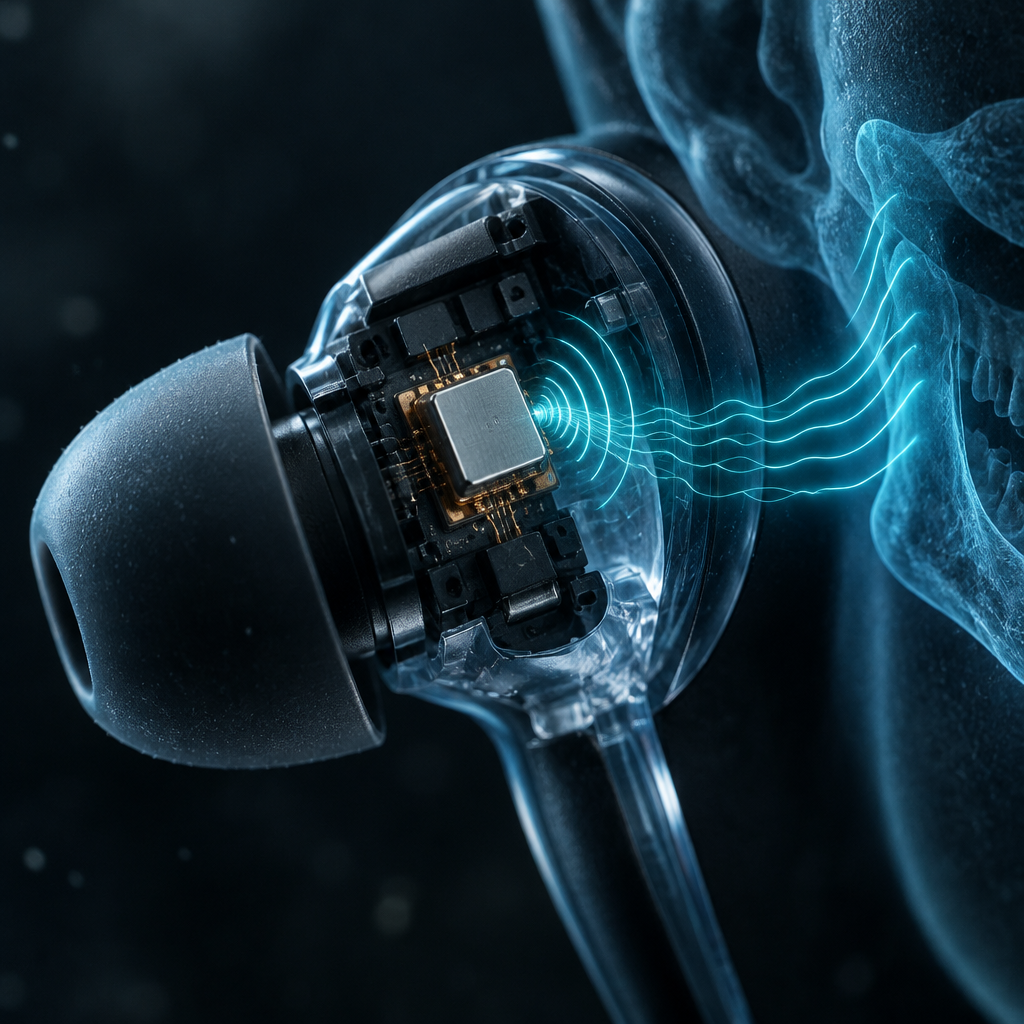
Earpieces have a structural advantage in the Auracast model that over-ear headphones do not share. True wireless earbuds, the kind split into left and right pieces with no cable between them, already operate a localized broadcast from the phone to each bud. The earpieces understand isochronous reception at a fundamental level because their own stereo coherence depends on it.
When an earpiece receives an Auracast broadcast, it is doing something it was already designed to do: decode timed audio data and present it against a clock. The additional work is synchronizing with the BIG's timing instead of the phone's CIS timing. The radio silicon is the same. The antenna challenges are familiar: a human body between the earpiece and the transmitter, a pocket full of metal, or the orientation of the bud in the ear canal all affect reception.
The user experience, though, is where earpieces shine. On Android devices that support Auracast, a broadcast can duck under whatever you are already listening to. Music plays at full volume. A gate announcement fades in over it, delivers its message, and fades out. Your podcast resumes. You never touched your phone. This audio mixing happens on the receiving device, not at the transmitter. The broadcast stream is independent of your personal audio. Your earpieces are layering two audio sources in real time, which is a neat trick for something the size of a jellybean.
Where broadcasts are already live in 2026
Munich Airport turned on Auracast at six gates across Terminal 1 and Terminal 2 in July 2026, partnering with Sittig Technologies. Passengers with compatible hearing aids, cochlear implants, earbuds, or headphones can receive live gate announcements directly. QR codes at each gate point passengers to the stream. The pilot follows a similar deployment at Frankfurt Airport.
The Sydney Opera House installed Auracast in its Playhouse Drama Theatre and Studio, courtesy of GN and the Bluetooth SIG. St Paul's Cathedral in London ran an early trial. The Marriott Theatre, an 800-seat venue in Illinois, deployed Auracast alongside its existing hearing loop so that patrons without hearing aids could still receive clear audio on their personal earpieces from any seat, including the lobby.
Churches and gyms are the grassroots adopters. A Facebook group for small church media operations includes threads on configuring Auracast hearing assist in rented spaces, with volunteers sharing transmitter placement tips and coverage maps. A community church in Glendale polled its congregation in June 2026 and found enough interest to proceed with an installation.
The venues span enormous to tiny. The underlying protocol does not care. A BIG scales from one receiver to one thousand without the transmitter spending a single additional microwatt per listener.
The earpiece and hearing aid are becoming the same object
The shallowest reading of Auracast is that it is a feature for hearing aids. The deeper reading is that it erases the distinction between a hearing aid and an earbud.
Over-the-counter hearing aids in 2026 already stream music, take calls, and connect to phones via Bluetooth. Several products cost under $100 and look indistinguishable from consumer earbuds. JLab's Hear OTC earbuds offer wireless streaming and hearing assistance in the same form factor. The Jabra Enhance Select 700 provides Bluetooth audio at a 100-foot range. The gap that once separated a medical device from a consumer gadget has narrowed to a firmware difference.
Auracast accelerates this convergence. A hearing aid receives the same airport gate broadcast as a pair of Samsung Galaxy Buds. Both decode the same LC3 frames from the same BIS. Both present the audio through their own signal chain, one amplified for hearing loss and the other tuned for music. The transmitter does not know or care which type of device is listening.
For someone with mild hearing loss who has been reluctant to wear a hearing aid, the calculation changes. Their everyday earbuds already do the job in public venues. The stigma barrier dissolves when the assistive technology is invisible inside a device everyone already wears.
What earpiece buyers should look for in 2026 and 2027
Not every pair of earbuds on the shelf can receive Auracast. The feature requires LE Audio support in both the Bluetooth chipset and the firmware. Qualcomm's Snapdragon Sound platform includes Auracast on recent chips. Samsung's Galaxy Buds3 line supports it. Jabra, JBL, and several OTC hearing aid makers have enabled it. Apple's AirPods do not yet support Auracast reception at the time of writing, and iOS does not expose Auracast in the native Bluetooth settings; third-party apps are the workaround on iPhone.
If you are shopping for earpieces and want to be ready for public Auracast deployments, check three things. First, does the product explicitly list Auracast or LE Audio broadcast reception, not just LE Audio generally? Second, does your phone's Bluetooth controller support it, and has the manufacturer enabled it in software? A chipset that is technically capable can still ship with the feature dormant. Third, if you are an iOS user, verify whether the earpiece manufacturer offers a companion app with Auracast support, because the operating system will not hand it to you natively.
The rollout will be uneven. Airports, theatres, and large cultural venues are moving first. Smaller venues, transit systems, and workplaces will follow. The protocol is ready. The silicon is shipping. The remaining bottleneck is awareness: enough venues need enough receivers in enough ears to justify the transmitter cost, and enough consumers need to know to ask for it.
The invisible upgrade is infrastructure
The most important thing about Auracast is not that your earpieces can receive audio from a transmitter. It is that they can receive audio from a transmitter that does not know they exist.
Every previous Bluetooth audio experience was a private conversation between two devices that shook hands, agreed on a codec, and maintained a link. Auracast is a public broadcast. The transmitter sends. The earpieces listen. No one asks permission. No one keeps count. The system is modeled on FM radio, and like FM radio, its value compounds with every station that goes on the air.
Munich Airport is one station. The Sydney Opera House is another. The Marriott Theatre is a third. The church in Glendale is a fourth. Your gym might be next. Your office might be next after that. The earpieces in your ears, if they support LE Audio broadcast, are already the receiver. They do not need a new antenna or a hardware revision. They need the venue to switch on a transmitter and the user to know that a signal is there.
The quietest revolution in wireless audio is the one where you stop asking whether your earbuds can pair with something new and start asking what they can tune in to. The answer, increasingly, is everything around you.