Bluetooth audio has spent the last decade training us to think in pairs. Your phone talks to your earbuds. Your laptop talks to your headphones. A source, a receiver, one private connection, and a small ritual of pairing that everyone pretends is easier than it is.
Auracast breaks that model open. Built on Bluetooth LE Audio, the broadcast feature allows one transmitter to send an audio stream to many nearby receivers without creating a separate connection with each one. That sounds like a modest protocol upgrade. It is actually a change in what an earpiece can be.
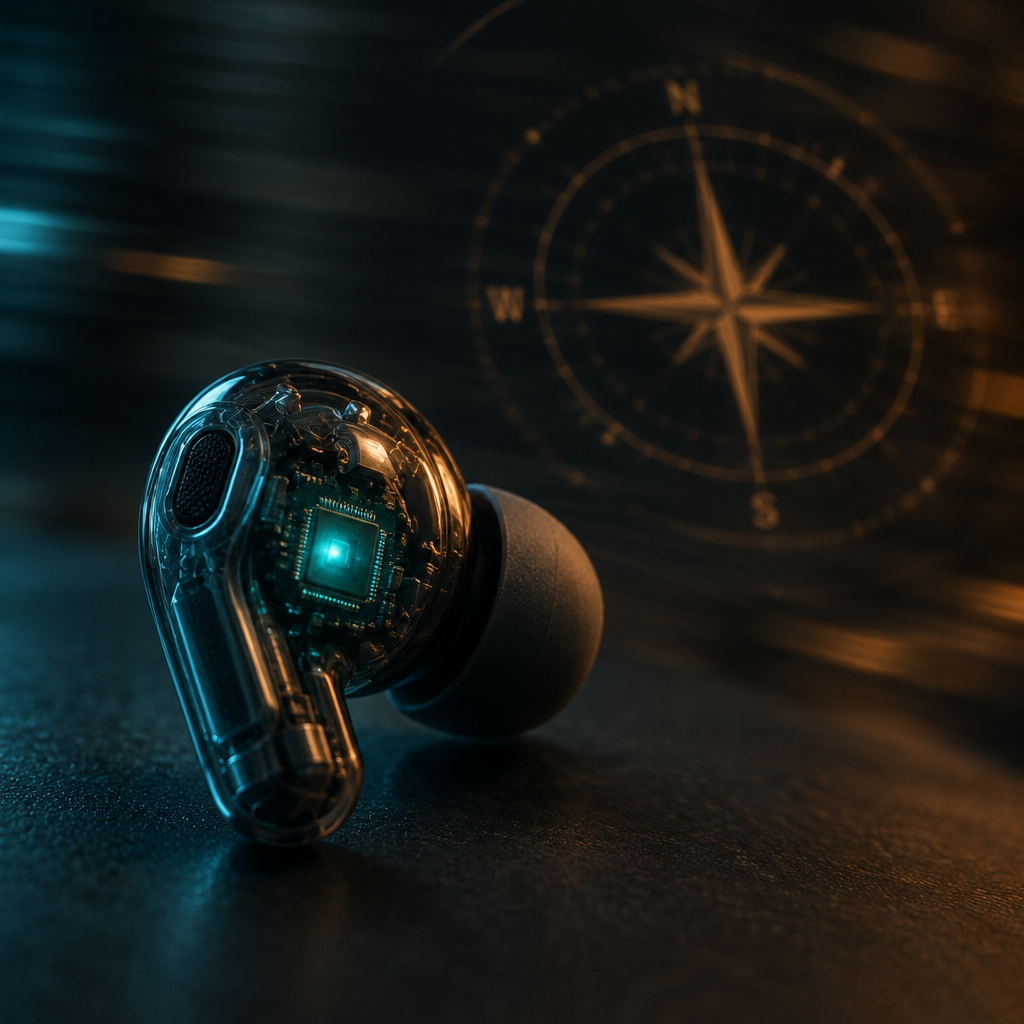
An earpiece with Auracast support is no longer only something that plays your audio. It can become a key to the soundscape around you, selecting a language channel at an airport, a commentary feed in a museum, a lecture in a classroom, or the clean dialogue track in a cinema. The device stops being merely personal and starts becoming locational.
Pairing Was Always the Wrong Metaphor
Classic Bluetooth audio is built around a one-to-one relationship. The source discovers a device, authenticates it, establishes a link, and sends audio through that link. It works well for a person sitting with their own headphones. It works badly when hundreds of people need the same sound at once.
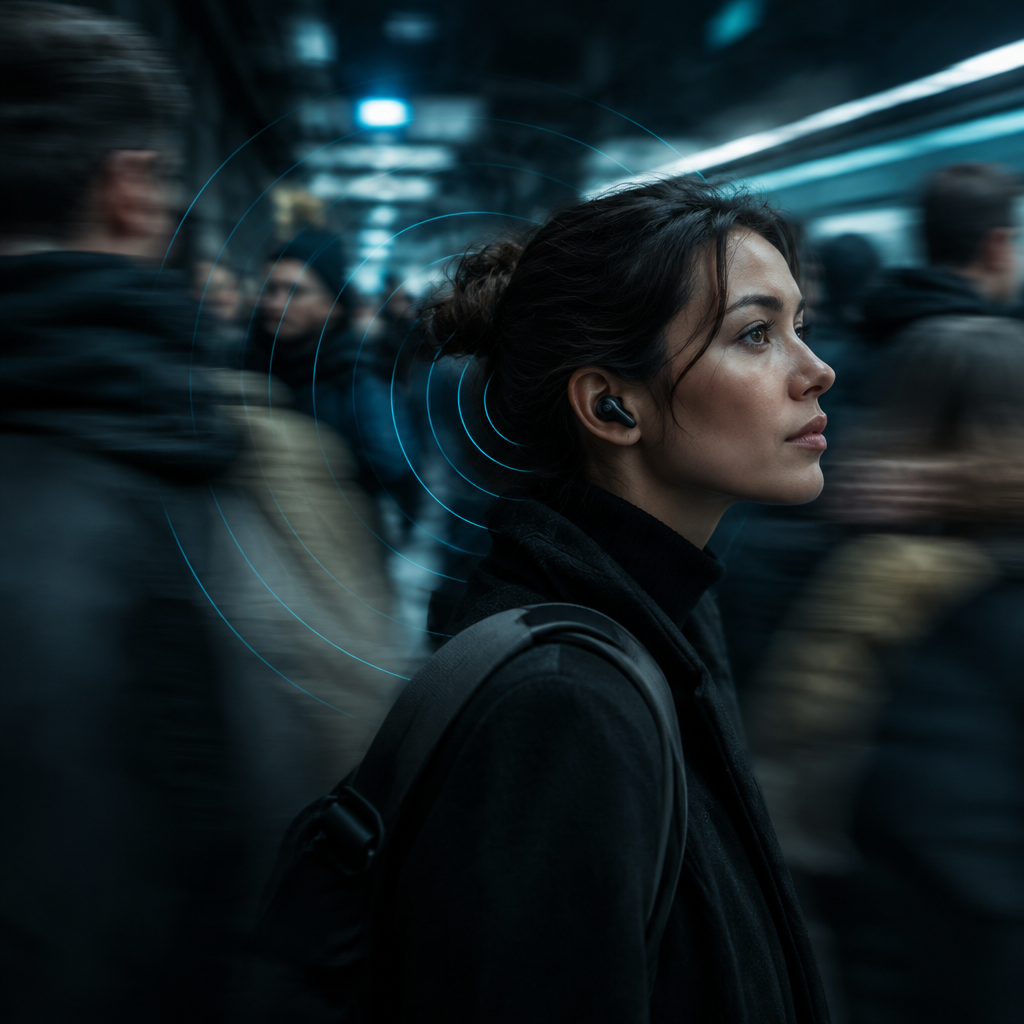
Imagine an airport gate. The public-address system needs to deliver a boarding announcement to everyone in the room, but a passenger using hearing aids needs a direct, intelligible feed. Under the old model, the airport would need a hearing loop, an infrared system, a proprietary receiver, or some combination of all three. Under Auracast, the gate can broadcast an audio stream that compatible earpieces and hearing devices discover locally.
There is no guest list in the traditional sense. A listener chooses a broadcast, much like selecting a Wi-Fi network or tuning a radio station. The earpiece does not need to maintain a dedicated audio connection with the transmitter for every individual in the room. That difference is the reason the system can scale.
The Engineering Lives in the Broadcast
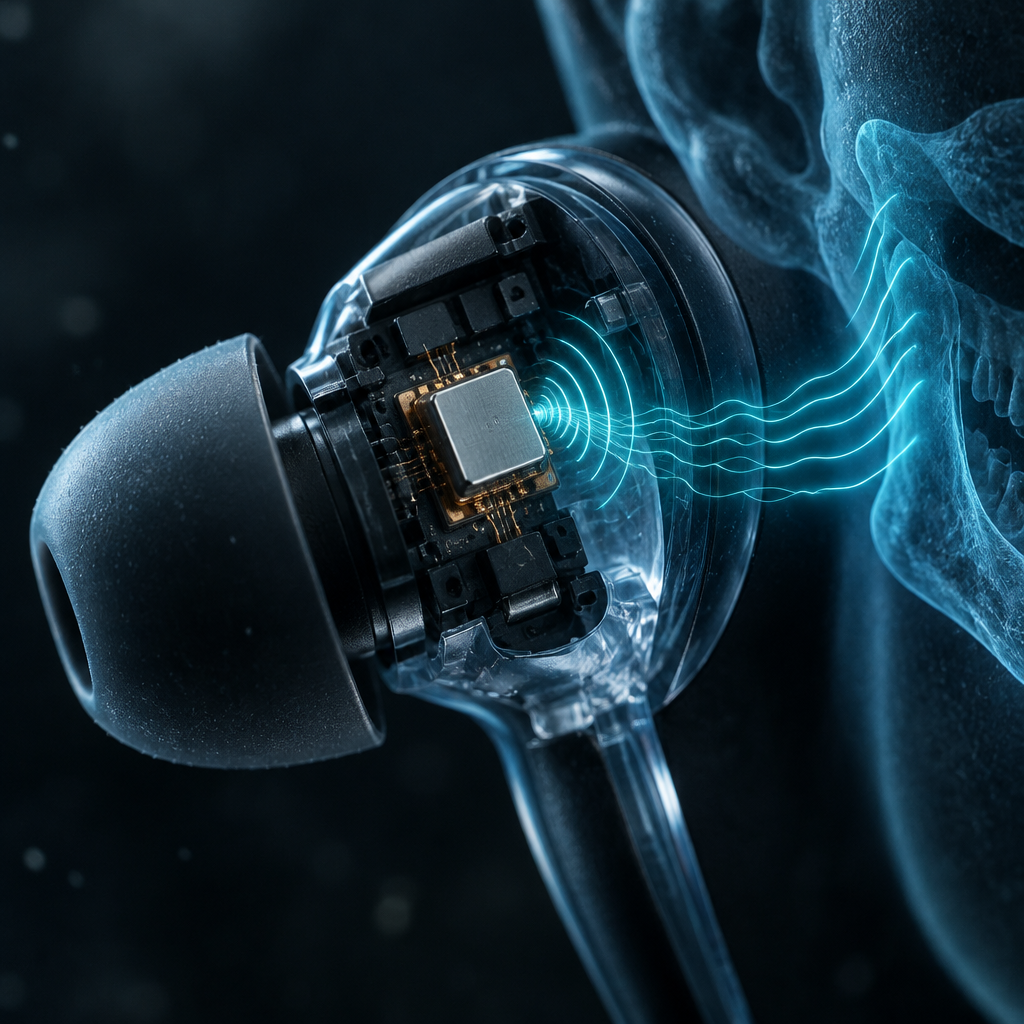
Auracast uses Bluetooth LE Audio's Broadcast Isochronous Streams, or BIS. The name is dense because the problem is dense. Audio needs predictable timing. Packets can be lost, but the receiver still has to reconstruct a coherent stream without turning a missed packet into a dramatic digital hiccup.
Isochronous transmission gives the system scheduled opportunities to deliver time-sensitive data. A broadcast can contain one or more BIS streams, allowing a venue to carry a stereo program, several language feeds, or left and right channels in a synchronized way. The receiver listens for the broadcast, reads its periodic announcements, and joins the stream it needs.
That is a very different workload from sending a private stream to a single pair of earbuds. A private link can negotiate around one listener's conditions. A broadcast has to serve everyone within range. It needs robust timing, sensible error recovery, and enough redundancy to keep the experience stable as people move, bodies block radio paths, and the environment gets noisy.
The codec matters too. LE Audio uses LC3, the Low Complexity Communication Codec, which is designed to deliver useful audio quality at lower bitrates than the older SBC baseline. Lower bitrate is not simply a battery story. It means the transmitter can spend less airtime moving the same perceptual information, leaving more room for reliability, additional channels, or lower power operation.
LC3 does not make physics disappear. A crowded venue still has interference. A metal gate area still reflects radio energy. A receiver with a weak antenna still has a weak antenna. What the new architecture does is give designers more efficient tools for making the stream intelligible under ordinary wireless conditions.
Discovery Is the Make-or-Break Detail
The broadcast itself is only half the experience. The other half is finding the right stream without making passengers navigate a menu designed by an engineer who has never carried a suitcase.
Auracast transmitters can advertise broadcast information through Bluetooth Low Energy announcements. A phone can act as an assistant, scanning nearby broadcasts and presenting names, icons, and access controls. Some implementations can let a listener scan a QR code or tap an NFC tag to open the correct audio channel. The goal is not to make every user understand BIS. The goal is to make the process feel like choosing a network.
Names become surprisingly important. An airport may have dozens of streams, including Gate B12 announcements, terminal-wide announcements, security instructions, and language-specific feeds. If the labels are vague, the technology becomes a scavenger hunt. If the labels are clear, the radio layer disappears into the experience.
This is why Auracast deployment is partly a user-interface problem and partly a facilities-management problem. The transmitter is only one component. Someone has to maintain the stream names, map them to physical spaces, update schedules, check volume levels, and ensure that the audio feed is actually synchronized with what is happening in the room.
The Accessibility Case Is Bigger Than Hearing Loops
The most important early use case is hearing assistance. A broadcast can deliver a cleaner signal directly to hearing aids or earpieces, reducing the distance between the microphone and the speaker's voice. That improves intelligibility, especially in rooms with reverberation, background noise, or poor public-address acoustics.
But accessibility is not a niche add-on here. The same broadcast can carry multiple languages, audio description, simplified narration, or a high-clarity dialogue mix. A museum might offer the standard tour, a child-friendly version, and an audio-description track from the same installation. A cinema could provide a hearing-assistance stream without asking a customer to borrow a special receiver at the concessions desk.
That matters because dedicated accessibility equipment often fails socially before it fails technically. People do not want to identify themselves, wait in line, wear a bulky loaner, or return a device that has been handled by hundreds of strangers. If their own earpieces can receive the same signal, assistance becomes less visible and more normal.
Why Earpiece Makers Are Paying Attention
For earpiece manufacturers, Auracast creates a reason to improve radios and software that users cannot easily see. A better microphone or a new driver is easy to demonstrate. A reliable public broadcast experience requires the entire product to behave well: fast scanning, clear prompts, stable switching, low latency, accurate channel labels, and battery management that does not punish the user for being in a broadcast-heavy place.
It also changes the value of the phone. In a conventional setup, the phone is usually the source. With Auracast, it can become a remote control for the listening environment, while the venue's transmitter supplies the audio. That creates a new division of labor. The phone handles discovery and selection. The earpiece handles reception and playback. The venue owns the content and the coverage.
There is an interesting competitive pressure hiding in that arrangement. If the public audio layer becomes common, an earpiece that cannot receive it will feel incomplete in the same way that a phone without modern Wi-Fi eventually feels incomplete. Compatibility becomes part of the product's useful life.
Privacy Is Not Automatic
Auracast broadcasts are designed to be discoverable, but discoverable does not mean every stream should be open. A venue can leave a broadcast unencrypted for public information, or it can protect access with broadcast codes and other controls. That distinction will matter in classrooms, corporate meetings, houses of worship, and ticketed events.
The technology can make a sound feed available. It cannot decide whether the feed should be available to everyone in the room, everyone who paid, or only a defined group of listeners. Those are policy questions. A public announcement may be open. A backstage production channel should not be. A classroom lecture may be public within a building but not intended for someone in the parking lot.
Range is another practical consideration. Bluetooth radio does not know where the walls are. A stream intended for one theater can spill into a lobby or another auditorium unless the installation is designed carefully. Good deployment will require power levels, antenna placement, channel planning, and physical boundaries that match the venue's actual layout.
The Adoption Problem Is Not the Standard
Auracast has a recognizable adoption trap. People do not urgently buy receivers for broadcasts that do not exist, and venues do not urgently install transmitters for earpieces that cannot receive them. The loop has to be broken by institutions with a reason to improve the listening experience for everyone at once.
Airports, transit systems, hospitals, universities, museums, and performance venues are the natural starting points because they already manage centralized audio. They also have a clear incentive to improve announcements, accessibility, and multilingual communication. Once a few high-traffic locations make the feature visible, consumers have a reason to ask whether their next earpieces support it.
The hardware transition will be uneven. Support depends on the Bluetooth chipset, operating-system support, firmware, and the manufacturer's willingness to expose the feature. An earpiece may support some LE Audio functions without offering a polished Auracast interface. A phone may discover broadcasts but not provide the same controls across every model. Certification can establish interoperability, but it cannot guarantee a delightful product.
The Sound of a More Selectable World
The deepest change Auracast introduces is not better fidelity. It is selectability. Public sound has traditionally been blunt. One announcement, one language, one volume, one mix, delivered to everyone whether or not it works for them.
Broadcast audio makes the environment addressable. You can choose the language. You can choose the commentary. You can choose a clearer dialogue feed while the people beside you hear the standard mix. The room remains shared, but the sound no longer has to be identical for every person inside it.
That is a substantial role change for earpieces. They become less like tiny speakers attached to a phone and more like personal interfaces for public infrastructure. The most important Auracast moment may not happen when someone listens to music. It may happen when a passenger hears a gate change clearly, when a theatergoer follows every line, or when a visitor understands a museum exhibit in their own language without asking anyone for help.
The technology is still early. Coverage has to be engineered. Labels have to be maintained. Privacy controls have to be taken seriously. Devices have to become easier to use. But the underlying idea is unusually durable: send one useful audio signal into a place, then let every compatible listener decide how to receive it.
Bluetooth began as a way to remove cables from personal devices. Auracast points toward its next job, removing the assumption that shared sound must be heard in exactly one way.