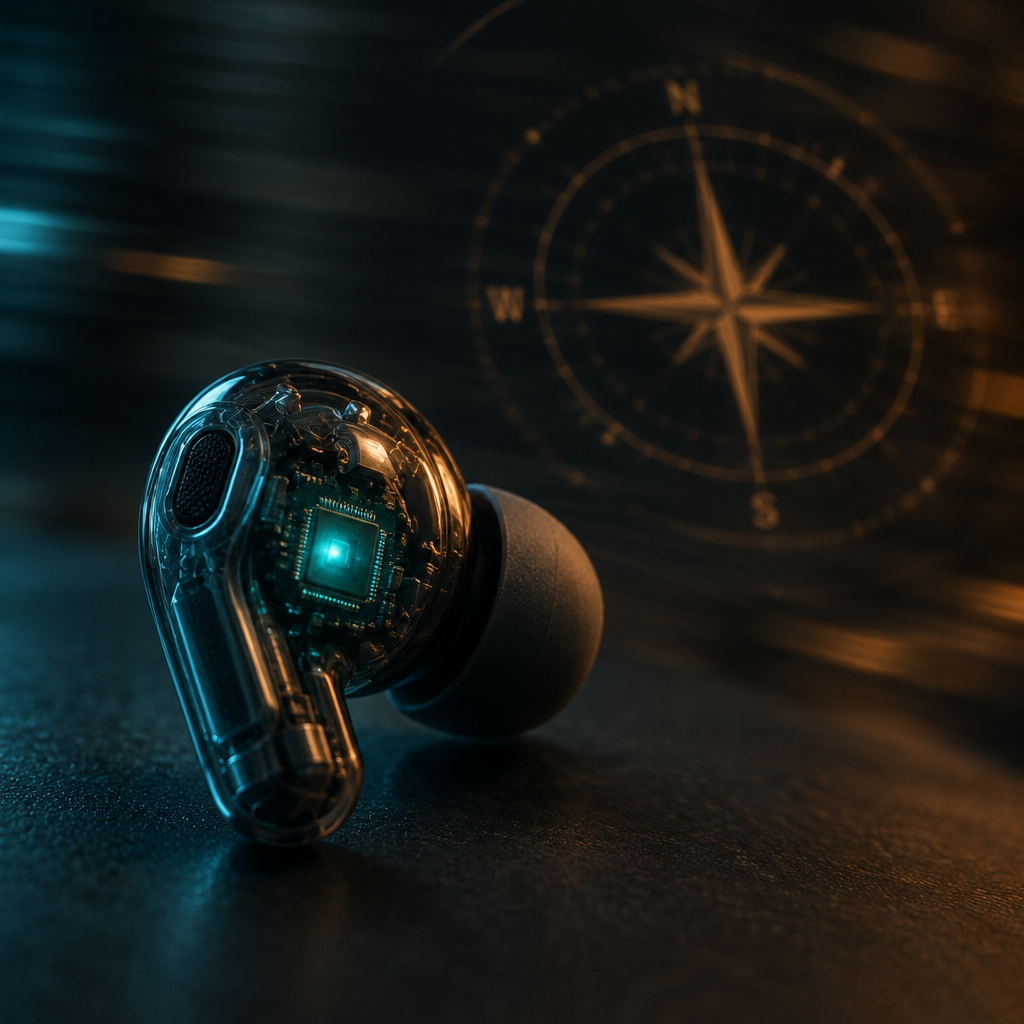
For most of audio history, the clever part of a headphone lived in the moving parts. A coil, a magnet, a diaphragm. The electronics around it were grunt work: amplification, basic filtering, maybe a touch of digital signal processing. That hierarchy is quietly inverting. The most interesting component in a pair of earpieces in 2026 is not the driver. It is the silicon that decides what the driver should do, moment to moment, before you ever hear a sound.
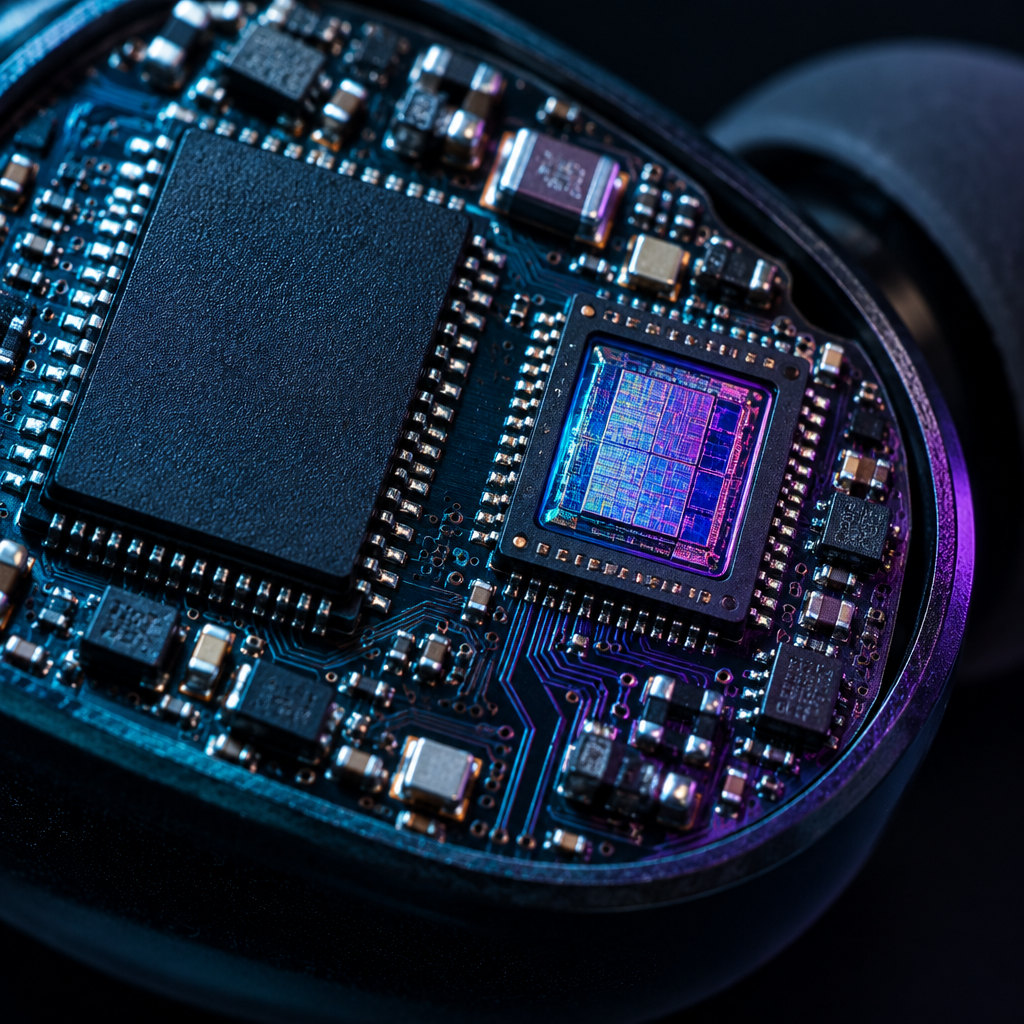
Anker's newly announced Thus chip is the latest and most aggressive example of that shift. It is billed as the world's first neural-net compute-in-memory AI audio chip, and it is headed first into Soundcore's flagship earbuds. The pitch sounds like marketing until you unpack the physics. Compute-in-memory, or CIM, is not a faster version of the architecture we already have. It is a different place to do math, and the location changes everything about what a battery-powered earpiece can reasonably attempt.
The von Neumann tax, paid in microwatts
Conventional chips operate on a separation that has held since the 1940s. Memory sits on one side. The compute units sit on the other. To run a calculation, the processor fetches weights from memory, shuttles them across a bus, performs the multiply-accumulate operations, and writes results back. For a laptop, that round trip is a rounding error. For a wireless earbud running on a battery the size of an aspirin, it is the whole budget.
Anker CEO Steven Yang framed it bluntly. Every AI chip built until now stores the model on one side and does the computation on the other. To think, the device has to carry all those parameters across, many times per second, every single inference. Thus puts the computation where the model already lives. The model never has to move again.
That single sentence hides a deep efficiency story. Moving data costs more energy than computing it, and the gap widens as models grow. In a tiny earpiece, where the die area, thermal envelope, and battery capacity are all brutally constrained, the data-movement overhead is what caps how smart the onboard neural network can get. Older earbuds leaned on networks of perhaps a few hundred thousand parameters, just enough to nudge noise cancellation. The Thus chip, by collapsing the fetch into the storage, reportedly handles several million parameters inside the same power envelope.
This is the leap that matters. A tenfold or greater increase in model capacity, at single-digit milliwatts, is the difference between an earpiece that reacts to sound and one that interprets it.
Why NOR flash, and why that is hard
Compute-in-memory is not a new idea in academia. What has stalled it commercially is the memory technology. Most CIM research leans on SRAM or emerging nonvolatile memories like ReRAM and MRAM. Anker chose NOR flash, the same reliable, dense, nonvolatile storage already ubiquitous in embedded systems. NOR flash retains data without power, which suits an always-listening earbud that wants to sleep aggressively between sounds and wake instantly.
The trick is performing analog or mixed-signal math directly on the memory cells, reading the cell states as weights and summing currents along bitlines to produce multiply-accumulate results in a single physical step. The weights never leave the array. Anker claims up to 150 times the AI computing power of a conventional arrangement at equivalent energy, a figure that should be read cautiously until independent benchmarks exist, but the directionality is credible. NOR flash is slower to write than SRAM, which would normally matter, but for an inference workload where the model is loaded once and run continuously, slow writes are irrelevant. You program the network, then you let it think.
The tradeoffs are real. Analog compute-in-memory is sensitive to temperature drift, process variation, and charge retention noise over the life of the cell. A weight that shifts by a fraction of a percent can compound across millions of parameters. Anker will need robust calibration, periodic refresh, and clever error compensation to keep inference accurate as the earbuds age. This is engineering at the uncomfortable boundary between digital certainty and analog physics.
What several million parameters buy your ears
More parameters are not vanity. They translate directly into what the earbuds can distinguish and suppress. Traditional call noise cancellation, the kind that tries to isolate your voice on a windy street or in a crowded cafe, leans on those small onboard networks. It struggles precisely when the noise gets interesting: overlapping voices, transient clatter, the acoustics of a moving environment. The result is either ambient leak-through or a voice squashed so aggressively by the noise suppressor that it sounds compressed and watery.
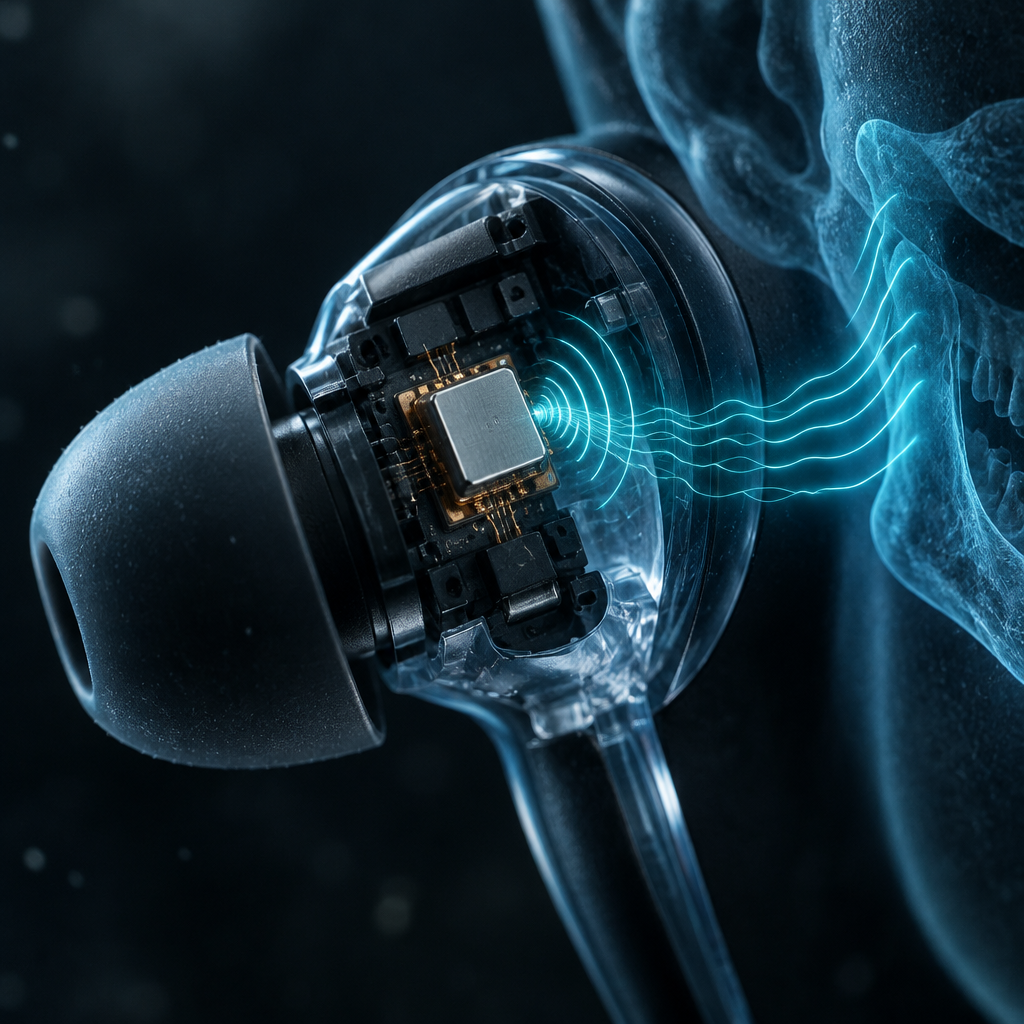
A larger network can model the difference between your voice and a stranger's voice, between a door slamming and a hand clapping, between the roar of a bus and the gust that preceded it. The Thus-powered Soundcore earbuds pair the chip with eight MEMS microphones and two bone conduction sensors that capture the vibration of your skull as you speak, giving the neural net a multi-modal view of where your voice actually originates. Bone conduction is the cheat code here. Airborne microphones hear everything; bone sensors hear mostly you. Fusing the two lets a network reject interference that an acoustic-only system could never separate, no matter how many mics you stack.
This is where the parameter count stops being abstract. A few hundred thousand parameters can learn a voice profile. Several million can learn the shape of your voice across rooms, across posture changes, across the day your sinuses are congested. It adapts in real time instead of falling back to a fixed filter.
The same headroom unlocks the features that live one layer above calls. Adaptive transparency that softens a siren without muting the friend beside you. Conversation boost that pulls a single speaker forward from a crowded table. Real-time translation that once demanded a phone in the loop now runs on the silicon pressed against your temporal bone. Each of these is a classification problem dressed up as a convenience, and classification is exactly what a fatter, local neural network does better than the lean models it replaces.
The always-on problem, solved sideways
Earbuds are uniquely punishing for AI because they are always active while worn. A smartwatch can sleep between glances. A phone can offload to the cloud. Earbuds live in your ear canal for hours, drawing from a battery measured in tens of milliamp-hours, and their most useful features, noise cancellation, voice detection, transparency mode, demand continuous inference. There is no idle moment to exploit.
That is why Anker started with earbuds rather than a more forgiving product. If you can make compute-in-memory pay inside the most constrained wearable, every other form factor gets easier. The earbud is the stress test. Success there implies that the same architecture scales outward to microphones, webcams, smart home sensors, and the broader IoT menagerie where battery life and always-on listening have always been at war.
It also reframes the cloud question. Most hearable AI today is split. Lightweight inference runs on the bud; the heavy lifting, transcription, translation, semantic noise gating, happens on a phone or a server. That split costs latency and battery, and it costs privacy, because your audio leaves your body. A chip that runs a meaningful network locally keeps the data on your ear. The voice model never has to phone home to understand you.
The competition and the honest caveats
None of this lands in a vacuum. Apple's AirPods Pro line and Sony's WF-1000XM series have been quietly accumulating on-device intelligence for years, leaning on custom DSP and dedicated neural accelerators. Qualcomm's Snapdragon Sound platforms bundle their own low-power AI blocks. Anker's claim of first-to-CIM is narrow but defensible: first to commercialize a neural-net compute-in-memory audio chip, not first to put AI in an earbud. The distinction matters. The architecture, not the mere presence of AI, is the news.
The real test is unglamorous. A chip that claims 150 times the compute has to prove it in the cacophony of an actual commute, over months of use, as the memory cells drift and the battery degrades. Anker will detail the first shipping products at its May 21 event, with leaked pricing pointing to a Liberty 5 Pro Max around $229.99 and a Liberty 5 Pro near $169.99. The interesting number will not be the price. It will be how the call quality holds up against the AirPods Pro 3 and the WF-1000XM6 in a real, ugly, noisy world.
What Thus represents is a bet that the next decade of earpiece improvement is not acoustic. Drivers are close to as good as physics and budgets allow. The gains left on the table are computational, and the ceiling on that computation was set by the von Neumann tax on tiny batteries. Move the math into the memory, and you lift the ceiling. The earbuds of 2030 may sound better not because their speakers changed, but because the chip between you and the speaker got clever about what to send through.