The Problem Bluetooth Couldn't Solve Until Now
For decades, Bluetooth has been the gold standard for short-range wireless communication. It powers billions of devices globally, from headphones to smart home sensors. But despite this ubiquity, Bluetooth devices have always struggled with one fundamental challenge: knowing exactly how far apart they are from one another.
Traditional Bluetooth ranging relied on Received Signal Strength Indicator (RSSI), a technique that estimates distance by measuring how much signal power drops over distance. The problem is that RSSI is wildly inconsistent. Walls, metal objects, and other radio frequency interference scramble the signal. You'd ask two Bluetooth devices to measure their separation, and you might get answers ranging from two meters to twenty depending on environmental factors. That imprecision made it impossible to build location-based services that required real accuracy.
Enter Channel Sounding: A Complete Reimagining
Bluetooth Channel Sounding, formally introduced in Bluetooth Core Specification 6.0 in September 2024 and rolling out widely across smartphones and devices throughout 2026, is different. It doesn't rely on signal strength at all. Instead, it measures the exact time it takes for a signal to travel between two devices, combined with analyzing the signal as it bounces through the physical environment.
The technical foundation rests on phase-based ranging. Instead of looking at how loud the signal arrives, Channel Sounding captures detailed information about the radio waves themselves: their amplitude across 72 distinct frequency channels and their precise phase relationships. This creates a fingerprint of the actual path the signal took through space. By analyzing these phase patterns, two devices can calculate their separation with sub-meter accuracy, typically achieving 0.3 to 1 meter precision in ideal conditions and maintaining 10 to 50 centimeters accuracy even in challenging environments.
Why This Matters for Audio and Beyond
For audio enthusiasts and casual listeners alike, Channel Sounding unlocks possibilities that felt like science fiction just two years ago. Imagine earbuds that automatically pause when you walk away from your phone, resuming the moment you return within range. Picture hearing aids that orient themselves toward a specific speaker in a crowded room by measuring exact distance and angle to sound sources. These aren't theoretical applications anymore; manufacturers are already implementing them in 2026 devices.
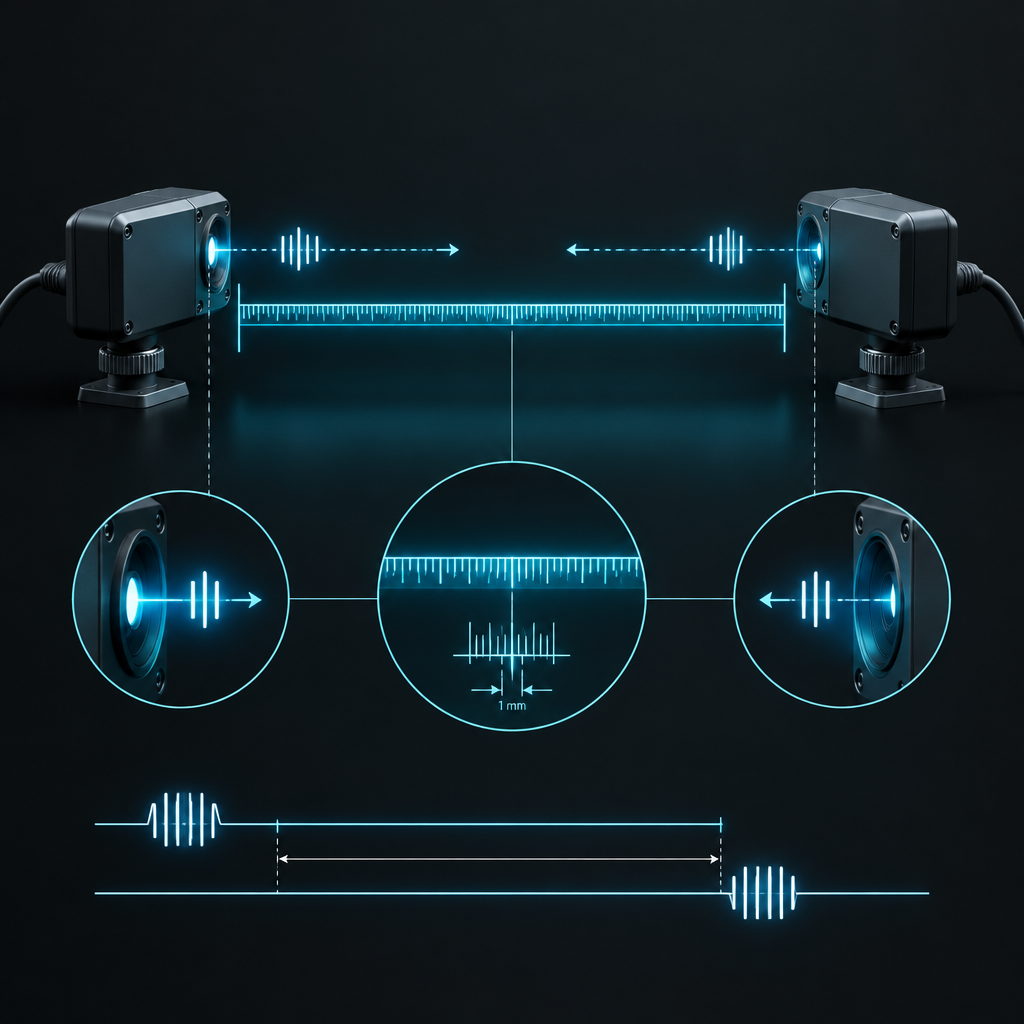
The technology works through a simple protocol: one device (the initiator) sends a specially formatted signal packet to another device (the reflector). That reflector immediately responds. The initiator measures the round-trip time, analyzes how the signal was distorted by the environment, and computes distance. The entire exchange takes milliseconds and requires minimal power.
Real-World Accuracy and Limitations
The accuracy claims deserve scrutiny because marketing always optimizes for the best-case scenario. In free space with no obstructions, Channel Sounding achieves the celebrated 0.3-meter precision. Place that same measurement inside a typical office with walls, furniture, and electronic equipment, and you're looking at 30 to 50 centimeters of error. Add a steel-reinforced concrete building or dense urban interference, and accuracy degrades further.
Water and metal are the adversaries. Both reflect and absorb radio signals unpredictably. A person holding an aluminum water bottle between two devices throws off the measurement. Rain affects outdoor ranging. These aren't deal-breakers for most applications, they're just the reality of wireless physics, but they matter for any system promising centimeter-level precision.
Power consumption is genuinely low, which is why it's viable for battery-powered audio devices. A single Channel Sounding measurement uses roughly the same energy as one Bluetooth connection establishment, and modern chipsets are already optimized for the task.
The Security Story
Bluetooth Channel Sounding incorporates security by design in a way that previous ranging methods completely lacked. The protocol uses cryptographic authentication to prevent spoofing attacks. A malicious device cannot convince legitimate devices that it's somewhere it isn't; the mathematical properties of the phase-based measurements make forgery extremely difficult compared to older RSSI-based tricks.
This matters because location data is inherently sensitive. As Channel Sounding proliferates in consumer devices, the security foundation becomes critical infrastructure. The Bluetooth SIG learned from earlier vulnerabilities and built defenses into the specification itself rather than patching them later.
What This Means for Audio Markets in 2026 and Beyond
Hearing aid manufacturers are already announcing Channel Sounding support in their 2026 lineups. Proximity-based streaming adjustments are coming to mainstream wireless earbuds. Spatial audio applications can now know with confidence when a listener has stepped out of a venue or moved to a different room.
For the broader Bluetooth ecosystem, Channel Sounding represents a shift from a purely connectivity technology to a positioning technology. That's significant. It opens entire categories of applications that were simply not feasible before. Asset tracking becomes reliable indoors. Device handoff can be location-aware. Audio playback can be context-sensitive.
We're still in the early adoption phase. Most devices released in mid-2026 don't yet implement Channel Sounding, even those advertising Bluetooth 6.0 support. Full ecosystem adoption will likely take another 12 to 18 months. But the trajectory is clear. By 2027 and 2028, Channel Sounding will be as standard as Bluetooth itself.
The Catch: It's Not Magic
Channel Sounding is revolutionary within the Bluetooth ecosystem, but it's not a replacement for dedicated positioning technologies like ultra-wideband (UWB) or GPS. It's designed for short-range, 10-meter-or-less applications. It requires both devices to implement the feature; older Bluetooth devices simply won't support it. And it demands more computational power than basic Bluetooth connectivity, which is why integration lagged behind the specification announcement.
What Channel Sounding does accomplish is remarkable: it brings precision ranging to the most ubiquitous wireless standard in the world. Every smartphone, every pair of earbuds, every hearing aid can eventually participate in a network of precise distance measurements. That's the real story. Not that Bluetooth Channel Sounding is better than UWB for some applications, but that it democratizes precision localization across billions of existing Bluetooth devices.
Looking Forward
The Bluetooth Special Interest Group has already committed to continuing refinement. Bluetooth 6.1, expected to finalize later in 2026, includes additional enhancements to Channel Sounding accuracy and power efficiency. The roadmap suggests further improvements focused on outdoor performance and interference resilience.
For audio professionals, device manufacturers, and everyday users, this is the moment to pay attention. Channel Sounding is the foundation for the next generation of wireless audio experiences. Understanding what it can and cannot do will help you make informed decisions about devices and applications as adoption accelerates through the rest of 2026 and into 2027.